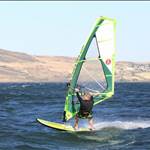
Why we dont use upright sails if seems they are aaerodynamicly better....
1.
Going back to the sweep - rake - cant thing. Rake and effective sweep are not the same thing. Imagine a non-raked mast that is canted 30 degrees to windward, and an apparent wind of 45 degrees. The wind hits the top of the sail first, and blows "down" the sail towards the trailing edge. This means that from the effective wind point of view, the sail has forward sweep, and that dramatically changes what the best span loading and sail shape looks like to get to minimum induced drag. So to get to neutral effective sweep, you have to rake the mast back 30 degrees. With 30 degrees of cant and 30 degrees of rake, you have zero sweep when the wind is at 45 degrees. So once you have a planform for the sail that is optimized for a particular sweep, you have to adjust rake if the cant changes, in order to maintain efficiency.
So as you start to cant the sail windward as the wind speed increases, you have to rake the sail backwards to maintain the same load distributions and efficiencies. You can still design the whole thing to run at whatever effective sweep you want (choose one), but then you have to actually build a membrane that works on that planform and spar set.
2
So why choose to use a raked mast, which adds length to the mast, but doesn't increase span or aerodynamic efficiency potential? It really comes down to load transfer at the mast base. With a raked mast, your arms won't get as tired. You want to be pulling at right angles to the load, and you don't get to choose the load vector - it is a state vector. So you craft the rig around the load vector such that the forces needed on the wishbone are minimized.
Do you agree with this ?
This bloke has been asking stupid questions on various topics, then when someone comes out with a decent answer he questions that....?
Think he's asking these questions just to annoy us, maybe he's a kiter.
Select to expand quoteLeeD said..
You should try windsurfing, before asking g stupid questions.
You should read his post before you criticise, he isn't suggesting we do things differently, he is giving some explanation of why what we do is reasonably optimal.
I think he is incorrect about the "raked mast, which adds length to the mast, but doesn't increase span or aerodynamic efficiency potential" part, if the airflow is reasonably perpendicular to the luff due to the combined effects of rake and cant, extra mast length adds directly to the span of the sail, and reduces the induced drag component. But I agree with his first paragraph.
Select to expand quoteMadge said..
This bloke has been asking stupid questions on various topics, then when someone comes out with a decent answer he questions that....?
Think he's asking these questions just to annoy us, maybe he's a kiter.
Or Macro's cousin
Select to expand quotePacey said..LeeD said..
You should try windsurfing, before asking g stupid questions.
You should read his post before you criticise, he isn't suggesting we do things differently, he is giving some explanation of why what we do is reasonably optimal.
I think he is incorrect about the "raked mast, which adds length to the mast, but doesn't increase span or aerodynamic efficiency potential" part, if the airflow is reasonably perpendicular to the luff due to the combined effects of rake and cant, extra mast length adds directly to the span of the sail, and reduces the induced drag component. But I agree with his first paragraph.
Did you understand 2.paragraph about mimimized load on sailor?
I didnt,can you explain..
Do you think that sail designer raked sail on purpose because of 1.explanation?
Or we end up with current concpet by accident through years of evolution(trail and error)?
Select to expand quotefpw9082 said..Pacey said..LeeD said..
You should try windsurfing, before asking g stupid questions.
You should read his post before you criticise, he isn't suggesting we do things differently, he is giving some explanation of why what we do is reasonably optimal.
I think he is incorrect about the "raked mast, which adds length to the mast, but doesn't increase span or aerodynamic efficiency potential" part, if the airflow is reasonably perpendicular to the luff due to the combined effects of rake and cant, extra mast length adds directly to the span of the sail, and reduces the induced drag component. But I agree with his first paragraph.
Did you understand 2.paragraph about mimimized load on sailor?
I didnt,can you explain..
Do you think that sail designer raked sail on purpose because of 1.explanation?
Or we end up with current concpet by accident through years of evolution(trail and error)?
I'm not sure either, but it is interesting how rake, cant and sweep are interconnected. Hadn't thought about it from that perspective before. Can you give us the source of your quotes, there might be something preceding the 2 quoted paragraphs that help.
I doubt it was designed that way on purpose. Most of windsurfing has been pretty evolutionary
On a boat they have a keel roughly midship. Windsurf has a fin aft. Coe should be infront of keel/fin by 'X'(designed) amount for the whole thing to work as efficiently as it can. Windsurf non planing uses fin n boardshape together with more forward Coe of sail to increase speed until hull is unstuck from water, then its all about the sail Coe n fin. So sail must be raked to align Coe n fin at speed. Yeah?
Could we suggest a new forum category? Eg "Tedious, long-winded technical posts with at best niche appeal"
Select to expand quoteolskool said.. >>Windsurf non planing uses fin n boardshape together with more forward Coe of sail to increase speed until hull is unstuck from water, then its all about the sail Coe n fin. So sail must be raked to align Coe n fin at speed. Yeah?
Is that why foil board sails have a lower foot? The CLS of the board doesn't change as much between foiling and displacement modes, so sail isn't raked as much when fully going.
^ Not sure Decrepit. But Yep I'd agree. Makes sense. You guys have always been the brains trust here for me. (far more experience than I)
I first picked up on the rake thing when riding my Windskate. You don't really rake the sail at all. Essentially you ride in the slogging position. Front foot near mast, as the board doesn't need to transition from slogging to planing. I'm thinking the CLR on board doesn't change very much at all.(zero leeway) Similar to how a boat is balanced n sailed. Upright rig as CLR is fairly constant position due to keel..
Select to expand quoteshoodbegood said..
Apparently all this jumbo changes when the sailing craft moves forward?
Im no scientist. Couldn't calculate any forces or vectors to save my life. But will give an explanation a crack.
On a sailboard yes. Coz its the fin n it's relationship with sail Coe that provides the movement through the water when at speed.
Slogging its a combo of board rails ,hull shape and fin, so the grip in the water is further forward on the hull. Not just the fin at rear of board. Nothing techo there.
Select to expand quotemusorianin said..
Could we suggest a new forum category? Eg "Tedious, long-winded technical posts with at best niche appeal"
And this new forum could have a rolling set of Q & A s. You're not allowed to comment unless you can demonstrate at least some attempt to read and absorb what has been said already.
^^^^ thats the opposite of what happens in such threads.....
Does appear to be a new trend last couple of years, beginners just questioning the most ridiculous things that aren't really necessary to enjoy the sport. Or knowing better than all the designers who've been sailing 30yrs and have engineering type quals also....
Select to expand quoteMark _australia said..
^^^^ thats the opposite of what happens in such threads.....
Does appear to be a new trend last couple of years, beginners just questioning the most ridiculous things that aren't really necessary to enjoy the sport. Or knowing better than all the designers who've been sailing 30yrs and have engineering type quals also....
Exactly- you get the feeling he is much more a theoretically sailor. His assertions often seem to fail to take into account the most important part of the Windsurfing rig - the sailor.
Also, I'm not sure you need to reduce the load on the sailor... why? Also, why would you purposefully can't the rig to windward as the wind increases?
Canting rig to windward reduces the wind the sail 'sees'. When severely overpowered n in survival mode you naturally do this. A boat lays/cants 'off' the wind when overpowered. We cant to windward to achieve the same result. Try it next time you sail. You will feel More power with a near vertical mast. Watch others sail next time you're out. You will see it happening all the time. Most don't even realise they're doing it.
"Canting sail windward".
To be able to hold the increased force, which creates a bigger margin for error.
38 years of short board sailing 
Select to expand quoteolskool said..
Canting rig to windward reduces the wind the sail 'sees'. When severely overpowered n in survival mode you naturally do this. A boat lays/cants 'off' the wind when overpowered. We cant to windward to achieve the same result. Try it next time you sail. You will feel More power with a near vertical mast. Watch others sail next time you're out. You will see it happening all the time. Most don't even realise they're doing it.
Canting sail kill sail power,rake also kill sail power even more ,because rake angle is huge
Select to expand quoteolskool said..
Canting rig to windward reduces the wind the sail 'sees'. When severely overpowered n in survival mode you naturally do this. A boat lays/cants 'off' the wind when overpowered. We cant to windward to achieve the same result. Try it next time you sail. You will feel More power with a near vertical mast. Watch others sail next time you're out. You will see it happening all the time. Most don't even realise they're doing it.
Oh I know when I'm doing it, I just also realize it is sub optimal for speed. So, I do it as little as possible.
Keeping the mast laterally vertical is ideal, i.e. zero cant is the optimum for GPS speed sailing.
However raking the sail is essential. Its the only way you can move the COE of the sail rearwards as the centre of lateral resistance of the board moves rearwards as the board moves firstly onto the plane and then progressing to flying the fin.
Select to expand quoteJohn340 said..
Keeping the mast laterally vertical is ideal, i.e. zero cant is the optimum for GPS speed sailing.
Evidence would suggest otherwise. Antoine Albeau on a world record 53.27 knot run:

yes, I think cant gives you a bit of vertical lift, potentially reducing wetted area, also allowing rider to hang outboard more, and hang on to more power. Going fast isn't only about how much power the sail produces. As before mentioned, you can't divorce the sailor from any windsurfing analysis.