So with the leech all twisty and venting off excess power, up top, and also accounting for apparent wind up top...
What happens if we let the sail twist off alllllll the way down, say, even past the boom? (if I remember correct NP had a sail that sorta does this already)
Could you develop a sail with massive wind range? Would it be too soft and cushy? Could you get away with ...one sail?
Just stoking the camp fire there.
I think they already did that
as a non racer I was amazed how far down the looseness comes now on a freeride or race sail, compared to a wave sail.
that's why now we use a 8m in wind we used to use a 6.5 in...... with more range, just less bottom end.
caveat: very non-technical point of view above.
Select to expand quoteSparky said..
no
What he said.AND we dont get extra points for a essay answer, that comes to the same conclusion as NO.
There is an ideal angle of attack for a sail (foil) to work best (highest L/D) at. A skilled sailor uses the boom to control that AoA. 
Or you could just make a sail that had an ideal AoA 'somewhere' up it's span, and just put up with it being wrong everywhere else. Draggy, but super forgiving maybe??

Twist can certainly be taken too far. 
Select to expand quoteevlPanda said..
So with the leech all twisty and venting off excess power, up top, and also accounting for apparent wind up top...
What happens if we let the sail twist off alllllll the way down, say, even past the boom? (if I remember correct NP had a sail that sorta does this already)
Could you develop a sail with massive wind range? Would it be too soft and cushy? Could you get away with ...one sail?
Just stoking the camp fire there.
Sails already do twist all the way down. Okay, maybe not foot batten but, down that low, there isn't that much wind - you're just closing the gap with that part of the sail. 
ONE sail for most wind conditions is like ONE gear for your car or ONE setting for your running speed..a very bad idea.
But a good sounding theory if you live in a theory world and don't interact with reality.
IMO, if the leach was loose to enable twisting off excess power all the way down the sail, it would become a very unstable sail, very twitchy.
I base this on experience while using something like a 3.5 on a very windy day, where you have to add as much downhaul as you can, so that the sail provides the correct amount of power to match the wind. It will work, but becomes very unstable, you won't feel over powered, but the sail doesn't behave like it should.
Over down hauling sucks, and that feeling is what you'd probably end up with, w/o over down hauling a sail like that.
Select to expand quoteLeeD said..
ONE sail for most wind conditions is like ONE gear for your car or ONE setting for your running speed..a very bad idea.
It's also like one bicycle, one hi-fi system, one joint strike fighter, one computer, one dick, or one sail for a yacht. It's the ultimate level of refinement.
Select to expand quoteevlPanda said..LeeD said..
ONE sail for most wind conditions is like ONE gear for your car or ONE setting for your running speed..a very bad idea.
It's also like one bicycle, one hi-fi system, one joint strike fighter, one computer, one dick, or one sail for a yacht. It's the ultimate level of refinement.
Two balls though... if you want to play rugby or football (footy or soccer, whatever float your boat).
Select to expand quoteMastbender said..
IMO, if the leach was loose to enable twisting off excess power all the way down the sail, it would become a very unstable sail, very twitchy.
I base this on experience while using something like a 3.5 on a very windy day, where you have to add as much downhaul as you can, so that the sail provides the correct amount of power to match the wind. It will work, but becomes very unstable, you won't feel over powered, but the sail doesn't behave like it should.
Over down hauling sucks, and that feeling is what you'd probably end up with, w/o over down hauling a sail like that.
It that was the case, then all of the PWA slalom racers have their sails rigged wrong.
Select to expand quoteLeeD said..
ONE sail for most wind conditions is like ONE gear for your car or ONE setting for your running speed..a very bad idea.
It depends what you want to do. There are tens of thousands of people who enjoy sailing small dinghies that have just one sail, like Lasers, and there are millions of people who enjoy riding single speed bicycles.
Plenty of the boats that have just one sail (or one set of sails) have a wind range that is wider than most windsurfers and most windsurfer sails, in many ways. Many of them can sail from almost dead calm conditions to 25-30 knots, which is an enormous range in both speed and power. There are also windsurfers (mainly longboard racers) who use one sail all the time, or almost all of the time. Simplicity is just a different path to explore; it's not a bad one to go down.
Select to expand quoteevlPanda said..
So with the leech all twisty and venting off excess power, up top, and also accounting for apparent wind up top...
What happens if we let the sail twist off alllllll the way down, say, even past the boom? (if I remember correct NP had a sail that sorta does this already)
Could you develop a sail with massive wind range? Would it be too soft and cushy? Could you get away with ...one sail?
Just stoking the camp fire there.
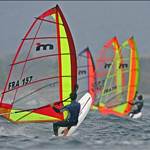
Boats can already do this; checke the amount of twist here;
Check the right hand boat here;
I think there are several problems for windsurfers;
1- If the mast keeps bending, the head of the sail moves backwards. This loads up the back hand, which windsurfers hate;
2 - when the sail twists enough, the head backwinds and therefore pushes the leading edge of the sail to windward, at a time when there is already lots of load on the back hand. Anyone who sailed original Windsurfers with the super bendy original blue mast can remember getting slammed in to windward by the rig inverting, even when you actually pushed away with the front hand;
3- In boats we can easily tune the twist for the conditions moment-by-moment, because we have vangs, travellers, mast rams, etc that we can use to adjust the mast bend, the downward force compared to the lateral force, etc. In boards where we don't have these things, the chance of getting the rig to twist off precisely when a particular sailor wants it to are pretty remote.
Also, the difference between the wind angle at the top of the rig and the angle down low can change because of other factors, such as wind shear which is affected by swell size, whether it's a cool wind blowing over hot ground or vice versa, whether you're sailing inland or on the coast, etc. You can really notice this in boats where you have such excellent twist control and regularly set the boat with more twist on one tack than on the other, or set it up with more twist on a lake than on the ocean.
My sail quiver spans from 5.4 to 8.5 M2 in cammed race sails. I choose a size based on the current wind when rigging. I almost never change sails if the wind conditions change during a session. While a sail has an optimum range (usually around 5 kts), it's practical range (the range it can actually be sailed) is much larger. For example, on Saturday, I rigged my 7.9. Its optimum range is 13 to 16 kts. However it's practical range is 11 to 22). During some of the rain squalls I would have preferred my 7.1 or even my 6.3, but because the race sails are so stable, I was still able to sail my 7.9.
Select to expand quoteChris 249 said..LeeD said..
ONE sail for most wind conditions is like ONE gear for your car or ONE setting for your running speed..a very bad idea.
It depends what you want to do. There are tens of thousands of people who enjoy sailing small dinghies that have just one sail, like Lasers, and there are millions of people who enjoy riding single speed bicycles.
Plenty of the boats that have just one sail (or one set of sails) have a wind range that is wider than most windsurfers and most windsurfer sails, in many ways. Many of them can sail from almost dead calm conditions to 25-30 knots, which is an enormous range in both speed and power. There are also windsurfers (mainly longboard racers) who use one sail all the time, or almost all of the time. Simplicity is just a different path to explore; it's not a bad one to go down.
True, but I can also sail one board with a 5.0 sail in 2-30 knots. The issue is performance and there isn't much for any dinghy in light winds. What's great about windsurfing, is that with multiple sails (and boards), we can achieve great performance in almost any wind. I also get the simplicity angle, and in my early days, it was simple, but that was it until I got bored with the lack of performance in light winds or being incapable of managing stronger winds. The same is true for small dinghies unless they are just used for racing.
Select to expand quoteChris 249 said..evlPanda said..
So with the leech all twisty and venting off excess power, up top, and also accounting for apparent wind up top...
What happens if we let the sail twist off alllllll the way down, say, even past the boom? (if I remember correct NP had a sail that sorta does this already)
Could you develop a sail with massive wind range? Would it be too soft and cushy? Could you get away with ...one sail?
Just stoking the camp fire there.
Boats can already do this; checke the amount of twist here;
Check the right hand boat here;
I think there are several problems for windsurfers;
1- If the mast keeps bending, the head of the sail moves backwards. This loads up the back hand, which windsurfers hate;
2 - when the sail twists enough, the head backwinds and therefore pushes the leading edge of the sail to windward, at a time when there is already lots of load on the back hand. Anyone who sailed original Windsurfers with the super bendy original blue mast can remember getting slammed in to windward by the rig inverting, even when you actually pushed away with the front hand;
3- In boats we can easily tune the twist for the conditions moment-by-moment, because we have vangs, travellers, mast rams, etc that we can use to adjust the mast bend, the downward force compared to the lateral force, etc. In boards where we don't have these things, the chance of getting the rig to twist off precisely when a particular sailor wants it to are pretty remote.
Also, the difference between the wind angle at the top of the rig and the angle down low can change because of other factors, such as wind shear which is affected by swell size, whether it's a cool wind blowing over hot ground or vice versa, whether you're sailing inland or on the coast, etc. You can really notice this in boats where you have such excellent twist control and regularly set the boat with more twist on one tack than on the other, or set it up with more twist on a lake than on the ocean.
Their must be many similarities with a sailboat and a windsurf sail.
Their must be many differences in how a windsurf sail performs on a board and how a sailboat sail performs on a boat.
Select to expand quoteforceten said..Chris 249 said..evlPanda said..
So with the leech all twisty and venting off excess power, up top, and also accounting for apparent wind up top...
What happens if we let the sail twist off alllllll the way down, say, even past the boom? (if I remember correct NP had a sail that sorta does this already)
Could you develop a sail with massive wind range? Would it be too soft and cushy? Could you get away with ...one sail?
Just stoking the camp fire there.
Boats can already do this; checke the amount of twist here;
Check the right hand boat here;
I think there are several problems for windsurfers;
1- If the mast keeps bending, the head of the sail moves backwards. This loads up the back hand, which windsurfers hate;
2 - when the sail twists enough, the head backwinds and therefore pushes the leading edge of the sail to windward, at a time when there is already lots of load on the back hand. Anyone who sailed original Windsurfers with the super bendy original blue mast can remember getting slammed in to windward by the rig inverting, even when you actually pushed away with the front hand;
3- In boats we can easily tune the twist for the conditions moment-by-moment, because we have vangs, travellers, mast rams, etc that we can use to adjust the mast bend, the downward force compared to the lateral force, etc. In boards where we don't have these things, the chance of getting the rig to twist off precisely when a particular sailor wants it to are pretty remote.
Also, the difference between the wind angle at the top of the rig and the angle down low can change because of other factors, such as wind shear which is affected by swell size, whether it's a cool wind blowing over hot ground or vice versa, whether you're sailing inland or on the coast, etc. You can really notice this in boats where you have such excellent twist control and regularly set the boat with more twist on one tack than on the other, or set it up with more twist on a lake than on the ocean.
Their must be many similarities with a sailboat and a windsurf sail.
Their must be many differences in how a windsurf sail performs on a board and how a sailboat sail performs on a boat.
Got that right, not to mention that one leans into the wind, and one leans away from the wind, making the way the wind interacts with the sail completely different.
Select to expand quoteNCUSAGUY said..Mastbender said..
IMO, if the leach was loose to enable twisting off excess power all the way down the sail, it would become a very unstable sail, very twitchy.
I base this on experience while using something like a 3.5 on a very windy day, where you have to add as much downhaul as you can, so that the sail provides the correct amount of power to match the wind. It will work, but becomes very unstable, you won't feel over powered, but the sail doesn't behave like it should.
Over down hauling sucks, and that feeling is what you'd probably end up with, w/o over down hauling a sail like that.
It that was the case, then all of the PWA slalom racers have their sails rigged wrong.
That's a completely different animal from what I was talking about.
Select to expand quoteforceten said..Chris 249 said..evlPanda said..
So with the leech all twisty and venting off excess power, up top, and also accounting for apparent wind up top...
What happens if we let the sail twist off alllllll the way down, say, even past the boom? (if I remember correct NP had a sail that sorta does this already)
Could you develop a sail with massive wind range? Would it be too soft and cushy? Could you get away with ...one sail?
Just stoking the camp fire there.
Boats can already do this; checke the amount of twist here;
Check the right hand boat here;
I think there are several problems for windsurfers;
1- If the mast keeps bending, the head of the sail moves backwards. This loads up the back hand, which windsurfers hate;
2 - when the sail twists enough, the head backwinds and therefore pushes the leading edge of the sail to windward, at a time when there is already lots of load on the back hand. Anyone who sailed original Windsurfers with the super bendy original blue mast can remember getting slammed in to windward by the rig inverting, even when you actually pushed away with the front hand;
3- In boats we can easily tune the twist for the conditions moment-by-moment, because we have vangs, travellers, mast rams, etc that we can use to adjust the mast bend, the downward force compared to the lateral force, etc. In boards where we don't have these things, the chance of getting the rig to twist off precisely when a particular sailor wants it to are pretty remote.
Also, the difference between the wind angle at the top of the rig and the angle down low can change because of other factors, such as wind shear which is affected by swell size, whether it's a cool wind blowing over hot ground or vice versa, whether you're sailing inland or on the coast, etc. You can really notice this in boats where you have such excellent twist control and regularly set the boat with more twist on one tack than on the other, or set it up with more twist on a lake than on the ocean.
Their must be many similarities with a sailboat and a windsurf sail.
Their must be many differences in how a windsurf sail performs on a board and how a sailboat sail performs on a boat.
Well, that was partly the point - we can see what happens when we over-twist sails in a boat and we can see why it works in boats but is a problem in windsurfers.
The fact that windsurfer sails on a board performs differently to boat sails was covered in the first couple of points. If a boat sail is twisted so far that the head "inverts", it's no big deal because the boat sailors have different forms of control (ie rudder and sheets) and therefore aren't as worried about a sail becoming too heavy on the back hand. In windsurfers, it IS important to make sure the sail doesn't load up the back hand too much or you'll get slammed to windward when your back hand becomes overpowered.
So yes, it's different from the way boats work - and we can learn from the differences and from the similarities.
Select to expand quoteMastbender said..
Got that right, not to mention that one leans into the wind, and one leans away from the wind, making the way the wind interacts with the sail completely different.
In what way? Plenty of boats sail upright lots of the time. Some of them heel to windward. Some heel to leeward. Some boards sail with the rig upright, or close to it. Nowhere has anyone apparently shown that the angle makes the airflow "completely different".
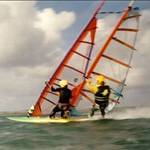
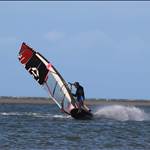
Top pic is the second most popular dinghy in the world going upwind in the way the triple world champ recommends, although a bit exaggerated. Underneath is Bjorn winning a PWA slalom race. Not much difference.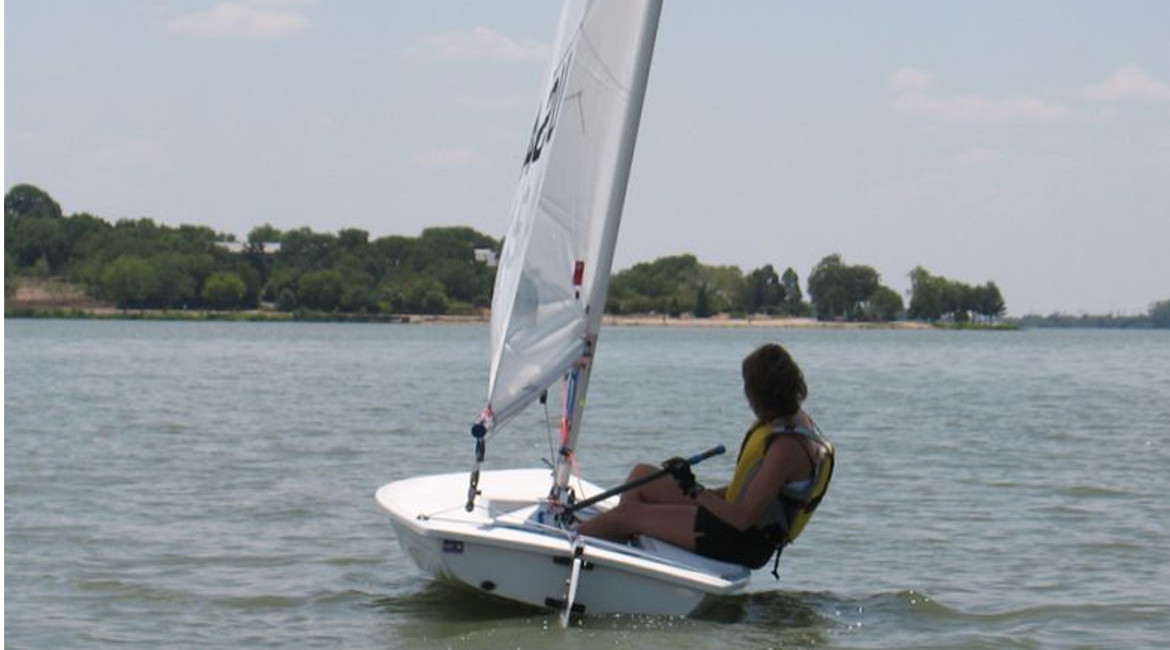

In light winds when longboard racing, the rig is often upright or tilted to leeward, and there's no big difference if you lean it to windward.
Select to expand quoteNCUSAGUY said..Chris 249 said..LeeD said..
ONE sail for most wind conditions is like ONE gear for your car or ONE setting for your running speed..a very bad idea.
It depends what you want to do. There are tens of thousands of people who enjoy sailing small dinghies that have just one sail, like Lasers, and there are millions of people who enjoy riding single speed bicycles.
Plenty of the boats that have just one sail (or one set of sails) have a wind range that is wider than most windsurfers and most windsurfer sails, in many ways. Many of them can sail from almost dead calm conditions to 25-30 knots, which is an enormous range in both speed and power. There are also windsurfers (mainly longboard racers) who use one sail all the time, or almost all of the time. Simplicity is just a different path to explore; it's not a bad one to go down.
True, but I can also sail one board with a 5.0 sail in 2-30 knots. The issue is performance and there isn't much for any dinghy in light winds. What's great about windsurfing, is that with multiple sails (and boards), we can achieve great performance in almost any wind. I also get the simplicity angle, and in my early days, it was simple, but that was it until I got bored with the lack of performance in light winds or being incapable of managing stronger winds. The same is true for small dinghies unless they are just used for racing.
With respect, the fact that you and Lee (or me) may happen to get bored with something doesn't mean that it's a bad idea.
Okay, so you and Lee find it boring - so what? I probably find lots of things that you like boring too, but I don't claim they are a "bad idea". I get bored very quickly by sailing a slalom or B&J board back and forth but it other people like it, good on 'em.
While I'm proposing controversial and/or plain silly ideas...
What about a fin where you can extend it by adding a "block", that continues the shape, at the top? Or does that just completely break the shape?
I'm sailing OK with one board, one mast, one boom, two fins and two sails. I reckon double that and you're well covered.
(I'm living in the city; no space)
Select to expand quoteevlPanda said..
While I'm proposing controversial and/or plain silly ideas...
What about a fin where you can extend it by adding a "block", that continues the shape, at the top? Or does that just completely break the shape?
I'm sailing OK with one board, one mast, one boom, two fins and two sails. I reckon double that and you're well covered.
(I'm living in the city; no space)
Sounds fishy...