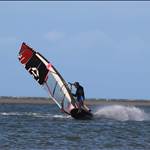
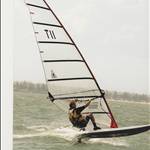
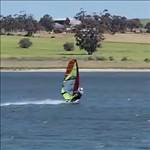
Let's talk hypothetically, Person "A" is a beginner on a large floaty board. Person "B" is an intermediate who knows "A" on a tiny board. Person "C" is an expert.
"A" had fallen off and the wind and waves are taking his rig 200m downwind. "B" goes past 3 times and sees that "A" is not making ground in catching the runaway rig, and "A" waves for help. "B" is too far downwind to reach "A", but decides to go after his rig instead. "B" then ditches his rig and swap to "A" rig to sail to him upwind.
"C" now sees the situation and holds onto "B"s rig to stop it going further downwind. "B" gets to "A" to handover his rig but now has to swim back to his own rig which "C" is holding onto.
Now, let's say you were "B" or "C", what could have been done better?
They shouldve waved to "D" and "F" who are sitting on the beach pissing themselves watching the dumb arses get it all wrong.
Or just told "A" to get "F"'d as he shouldve known better to go out in waves when learning. 
call a water taxi ?
buy a jet-ski?
Once B gets to A they can both use the big board to go downwind and recover B's rig....
As "A"'s rig is so big and floaty, get "A" to hold on, while "B" sails downwind to catch his rig.
Sailor B attaches the tail of Sailor A's board to the tail of his board with a piece of spare rope he always carries and drags the board and rig to shore. Sailor C goes to sailor A and drags him to shore. Sailor A gives sailor B & C each a carton of the beverage of their choice.
A (beginner) should not be out in offshore wind so should catch up with his board when he swims ashore
You take the fox and the chicken over the river and leave the chicken there. Then you go back and leave the fox on the other shore and take the rabbit over to where the chicken is. Then go back for the fox.
Something like that.
(serious though - was it a board and rig separation for A? And B is on a very small board (implying too small to get upwind etc?)
Select to expand quotewhyner said..
Call a C A B
www.seabreeze.com.au/Members/Profile/Details.aspx?member=flyingcab
No don't do that. He will rant on how good knitting is and how lame poling is 
B should not have ditched his rig but just held on to both B and A rig to stop them going down wind and let A swim down wind to his rig and then have a lesson on how to sail back up wind. C then would not have had to stop but could have just kept sailing keeping an eye on A and B making sure all was okay.
How can someone on a board that they can paddle not catch a rig? Even though A is a beginner he should have had a bit more common sense. He should have been able to catch his rig and then paddle the whole lot back to shore. If he couldn't paddle back because of offshore winds, he shouldn't have been out there.
Select to expand quoteGrumpySmurf said..
Let's talk hypothetically, Person "A" is a beginner on a large floaty board. Person "B" is an intermediate who knows "A" on a tiny board. Person "C" is an expert.
"A" had fallen off and the wind and waves are taking his rig 200m downwind. "B" goes past 3 times and sees that "A" is not making ground in catching the runaway rig, and "A" waves for help. "B" is too far downwind to reach "A", but decides to go after his rig instead. "B" then ditches his rig and swap to "A" rig to sail to him upwind.
"C" now sees the situation and holds onto "B"s rig to stop it going further downwind. "B" gets to "A" to handover his rig but now has to swim back to his own rig which "C" is holding onto.
Now, let's say you were "B" or "C", what could have been done better?
Sorry I can't help you here - I'm not that good at algebra
Im not completely sure if this is a rescue or your helping him retrieve his gear?
Don't worry about the equipment Focus on your own safety first then Getting the person being rescued back to shore!
DANGER- to you- to other- to the casualtymake sure that no one elso gets hurt. You will not be able to help if you are also a casualtyonly proceed if it is safe to do so.
RESPOND- is the casualty consious?gently shake the casualty and ask : 'Can you hear me?' , 'What is your name?'if the casualty is conscious,check for and manage bleeding and other injuriesif the casualty is unconscious,he/she should be turned on the side.Turning an unconscious casualty on the side to clear and open the airwayKneel beside the casualty.Place the casualty's farther arm at a right angle to the body.Place the nearer arm across the chest.Bend the nearer knee up.Roll the casualty away from you.Support the casualty in this position until airway and breathing have been checked.A Clear and open the AIRWAYClearing the airwaywith the casualty supported on the side,tilt the head backwards and slightly down.Open the mouth and clear any foreign object.Only remove dentures if loose or broken.Opening the airwayPlace one hand high on the casualty's forehead.Support the chin with the other hand.Gently tilt the head backwards.Lift the jaw forward and open the casualty's mouth slightly.
B and C should have informed A the conditions were beyond his capability before A even got to the water.
This prevents A from being in a position which puts A,B & C at risk.
Mate. I think you guys did well helping out some one in need. I can't say how you could have done it better without being there and seeing the exact situation. I remember back when I was a beginner and falling off and my rig fell onto my board. So the rig is pretty much out of the water cause it on top of my big old white whale of a board and now the 15 or so knots is blowing it down wind away from me There was no way I was ever gunna catch that by swimming. Thankfully my cousin was out sailing with me and gave me a tow/ride to my gear. Worst case scenario is that I was on a lake and I would have eventually got to the gear when it got blown to the edge and I swam/drifted there too
I have always remembered that day and have been very greatful for the help
All you people giving the smart arse replys (while some are quite comical) can't tell me you never needed help at some stage during your learning stage
Person A (the beginner) now has an idea of his limits. Nobody knows there limits until they try them and I'm sure he will be a bit more cautious next time the conditions are like that day
Everyone will most likely need to be assisted at least once in their windsurfing career whether be injury or breakage
This guy that is asking for suggestions on how better to help someone This guy might be the guy to help you on that day.
By the way as I mentioned above. I do find some of the comments/replys funny so I do have a sense of humour
Er, how "hypothetically" are we speaking here, GrumpySmurf?
By the way, I would have thought C should sail straight to A unless A is wearing a pfd. Bugger the rig if you let the sailor drown. Work everything else out after A has something floaty to cling onto.
It's a trick question; separated rigs never go downwind faster than a board. (and that's one reason you always swim to the board, not the rig)
Select to expand quoteevlPanda said..
It's a trick question; separated rigs never go downwind faster than a board. (and that's one reason you always swim to the board, not the rig)
If you can catch it! 

Thanks guys for the humour and the suggestions...Select to expand quotenebbian said..
As "A"'s rig is so big and floaty, get "A" to hold on, while "B" sails downwind to catch his rig.
Is this physically possible? I think this would be a good option if do-able.Select to expand quoteJohn340 said..
Sailor B attaches the tail of Sailor A's board to the tail of his board with a piece of spare rope he always carries and drags the board and rig to shore. Sailor C goes to sailor A and drags him to shore. Sailor A gives sailor B & C each a carton of the beverage of their choice.
Sounds like a good option if that spare rope is actually carried. Is the tail (back foot strap?) the best place to tie it onto? Or the head of the mast? Sorry, I wasn't clear - in this case, "A" was swimming after board and rig still attached.Select to expand quoteT 11 said..
A (beginner) should not be out in offshore wind so should catch up with his board when he swims ashore
Sorry I wasn't clear - it was cross shore. Select to expand quoteMark _australia said..
(serious though - was it a board and rig separation for A? And B is on a very small board (implying too small to get upwind etc?)
The board and rig is still attached - Just that "A" had troubles catching it. Yes, "B" being a non-expert could not make ground upwind quickly.Select to expand quotelegless said..
B should not have ditched his rig but just held on to both B and A rig to stop them going down wind and let A swim down wind to his rig and then have a lesson on how to sail back up wind. C then would not have had to stop but could have just kept sailing keeping an eye on A and B making sure all was okay.
Yeah, I think this is more sensible.Select to expand quoteZed said..
How can someone on a board that they can paddle not catch a rig? Even though A is a beginner he should have had a bit more common sense. He should have been able to catch his rig and then paddle the whole lot back to shore. If he couldn't paddle back because of offshore winds, he shouldn't have been out there.
Sorry, I wasn't clear - in this case, "A" was swimming after board and rig still attached.