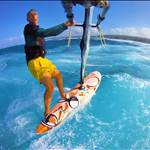
I am doing some repairs on my formula board which I use for foiling. One of the issues with the board is that some footstrap inserts were letting water in so I decided to replace them. I just removed a pair and noticed that the styrofoam is wet (I knew there would be water); I also noticed that much of the fiberglass surrounding the inserts didn't get any resin...
Anyway, what is the best course of action? should I let the the area dry? would a fan be enough? Cold temperature and rain will stick in the area for many months so leaving it outside won't work. I already made a hole in the tail of the board and let the board upright for several days and I got some water out but I know I won't be able to get rid of all the water. I also know that a board with water inside can last one session or many.
Ideas?
Drying is first step . Don't fix unless dry .
Unless in rain it has to eventually dry . Breezy under cover or behind a sunny window.
Where do you live ?
sticking a wick in it helps, sucks the water out into the atmosphere where it can dry, in that case a fan on the wick should help.
Of course, the wick has to go into the board where the water is. Anything absorbent will work, but I normally go for a strip of old towel.
Gravity will also help, so if you can place the board so the inserts are at the lowest point, you'll have more success
^^^ Yup
If you can't get it outside, stuff paper towel in the styro, leave it hanging out. Literally stab it into the styro with a stick or something.
Board upside down with lots of airflow around it. Moisture absorbant crystals from the hardware store right next to it might help if its humid outside it will be in your house a bit also.
For a proper wet board that's really opened up well, and in 25-30deg and sunny I find it takes about a week so its going to be a while for you
Select to expand quoteImax1 said..
Drying is first step . Don't fix unless dry .
Unless in rain it has to eventually dry . Breezy under cover or behind a sunny window.
Where do you live ?
Seattle USA
Select to expand quoteMark _australia said..
In that case, my 25-30deg is not what you call 25 to 30deg 
Yeah, I assumed you weren't suggesting to freeze the board
Select to expand quoteWillyWind said..
Seattle USA
If it's anything like the times I visited Seattle, you may want to dry the board inside the house. Turn the heat up and the humidifiers off - not that I think you're using humidifiers  .
.
Vacuum pump! I tried drying out my board, 2lbs heavier, by letting it out in the sun in a black bag with the vent off and the rear punctured. It took many days and still it's still heavy! How much overweight is your board? You may do your best job to dry it out and do a quick repair. Is the board worth it?
Select to expand quoteManuel7 said..
Vacuum pump! I tried drying out my board, 2lbs heavier, by letting it out in the sun in a black bag with the vent off and the rear punctured. It took many days and still it's still heavy! How much overweight is your board? You may do your best job to dry it out and do a quick repair. Is the board worth it?
My board was born overweight. It is a formula experience and the specs say that it should weigh 12.2 kilos. I weighed it several months ago with wet foot straps and mast base and it weighed 12.7 kilos. I reinforced the finbox and a added padding so I am not sure what is the new weight. I don't want to invest too much time and money on this project but to replace all the inserts would be less than 50 bucks.
if I decide to buy a dedicated foil board for light wind foiling with my race foil I would need to spend too much money. Another option would be buying a formula board in good shape but I will need to work on it as well to use it for foiling.
I removed one footstrap three days ago and the area was wet. I just check it again and it is dry. I will leave the board next to a furnace vent for several days and I think it will dry the area enough for the resin to adhere.
put it in a small room with a small dehumidifier and set dehumidifier to 20%, it will run a lot and not only dry out the board but it will heat up the room too, drying the board faster.
Unless you take it to a board guy who can spin it, I don't think there is any way to do this quickly. A vacuum pump helps. I live in a dry climate. Letting the board sit out in the sun for 6 months (even through the dry winter) did the trick.
Of course, you have to sail on a different ride during the long drying.
Yes, LeeD, weights do not include straps and there is some difference in weights between the specs and actual boards. But I do know the board has water inside because I drained it few times already.
Again, this is a cheap attempt. So no spinner, no dehumidifier, no waiting more than 2/3 weeks (this is my only foiling board). If it doesn't work, that is, the straps come loose, I can always cover them and have a waterlogged strapless board!
At least it should buy me some time until I decide what should be the replacement.
Fingers crossed
Most fixes of leaking insert mounting uses a routing out bad foam, laying in new pour or airex..or higher dense styrofoam, then rerouting to install footstrap inserts new or used.
Was it obvious to you, that your 12.7 kg board was maybe not too waterlogged?
A bit of water, yes. Wet straps can weigh close to over a kilo for 4 of them.
^^^ He said it has water in it.
Who cares how much, or if straps can hold 126.5g of water per strap?
LeeD, usual off topic sorta mean comments for no reason.
Select to expand quoteWillyWind said..
I removed one footstrap three days ago and the area was wet. I just check it again and it is dry. I will leave the board next to a furnace vent for several days and I think it will dry the area enough for the resin to adhere.
Sounds like a plan.
Dry out, dig out the offending areas.
fill with pour foam,8 pounds density , 2 is even more than the board has.I would epoxy core cell or ---
larger than the strap inserts into the routered out hole, the pour foam should remain say 1-2"
footstrap inserts, epoxy a core , as core cell diviny cell, to all 4 sides, doesn't need to be square .
again router out a hole slightly larger than the footstrap inserts say 1/8"
this gets epoxy into , wrapped in glass, carbon either, SGlass my pick.
A top layer of glass should overlay into the undamaged deck.
I epoxied Divinycell to the inserts. When they dry I will sand them. I also removed all the old inserts and filled up some parts with foam (the front straps had inboard positions but I will have only one set of straps on each side)
I found more straps with fiber that never saw epoxy and realized the mast base is crooked. It is not damaged, it was installed like that. It might be 3-4 mm off where you insert the mast base so I don't think one could tell the difference. But still, quality control should be better for what we pay when new.


This is a bit off-topic, but does anyone know where to get divnycell or similar in Sydney? The thinnest I've found is 5mm on playwithcarbon.com but its still twice as thick as I need and a bit pricey. I would use coremat but it'll be a little heavy covering a 150*200mm area on the deck. Same goes for cheap EPS foam, I could use pour foam but I'm afraid the poor board won't float by the time I'm done with it!
Select to expand quoteSaltySkiffies said..
This is a bit off-topic, but does anyone know where to get divnycell or similar in Sydney? The thinnest I've found is 5mm on playwithcarbon.com but its still twice as thick as I need and a bit pricey. I would use coremat but it'll be a little heavy covering a 150*200mm area on the deck. Same goes for cheap EPS foam, I could use pour foam but I'm afraid the poor board won't float by the time I'm done with it!
I like your pour foam idea .
The pour foam , depends on density , could weight more than EPS.
considering that anything else , core cell et all, will n?ed to be epoxied,
the weight gain will be a compromise.
I used an area between the straps , large, it floated fine.
I am installing the inserts and the epoxy foamed up in some inserts. I am using medium hardener, and working in my garage which is almost at the lowest temperature I can work in. I am using the proper ratio.
I know that foaming happens when the resin gets too hot, but in order for foaming to occur, we need to have a big amount of resin in one spot. I was keeping an eye on the temperature of the resin and it never got really hot, I was able to touch it for a few seconds. Although that is still pretty hot, it is not enough to melt the styrofoam (melting point is 450 F).
I run out of West System resin so I decided to buy a new brand, could that be the issue? With the west system I filled up a void that used more resin than what I used for the inserts and didn't have any issues (working temperature was the same)
I have more inserts and thinking about using gorilla glue. Have any of you used it? I wonder if epoxy is overkill. After all, the joint will be as strong as the EPS the inserts are attached to.
lastly, how many layers of glass should I put on top?
Moisture. I went back to the supplier to get more stuff and told him about my issue. He was not sure about the reason for foaming; at some point he said that moisture could do that so I told him about the issue with my board.
even though the board was next to a furnace vent for several days, out power towels in the holes, and everything felt dry to the touch, I guess the moisture content was still high, especially when the epoxy started heating in the area as it cured. I do t think it will be a big deal in my case because the foamed epoxy is still plenty hard for what I am using it for.
any idea of how many layers of 4oz glass on top?
That's the problem with EPS foam. Water can diffuse through the interstices between the expanded beads for a long distance. This is why you need to spin a board to force the water out to the ends. Or why you need to cut open some vents and dry for months. It is a real hassle. It helps to cut a vent at the far tail of the board, stand it up on its tail, stuff some wicking tissue paper into the hole, and wait for several months. Let gravity do some of what spinning would do.
Better yet, use a vacuum pump to try to evaporate all the water out of the foam. Do it in the garage where you can't hear the dang thumping for weeks on end.
This does not happen with closed cell foam boards, such as all those old glass gorge boards of the 80s. The water remained right there where it leaked in, and did not travel any further. Repairs were easy and quick. The problem with those boards was that they were not very stiff. This was actually a good thing, to provide for a soft ride in rough gorge conditions. An entire technology and culture was built around those boards.