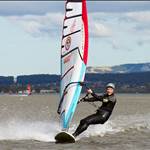
Can someone explain,why these 3 setup make nose fly more?
1)boom up
2)too much downhaul(open leech)
3)mast base back
A person who windsurfs tried those things and in practice it made the nose fly. An engineer theorized what would make the nose fly and came up with different conclusions.
Boom up tilts the rig back moving the centre of effort aft.
Base back moves the rig back also moving the centre of effort aft.
Excess downhaul reduces power in the upper part of the sail which would other wise put forward leverage on the mast and push the nose.
all three result in less downforce through the mast, which pushes the nose of the board down and holds the board on the water
You could also be a fat basket just like me with to much weight on the back of the board.

I think only point 3 is clear cut. As shifu says it results in less planted through the nose so more aft movement of lift.
1 and 2 are more specific to the sail. I put my boom up in light wind as I can impart more angle through the harness to mast foot pressure so more lift. But you may have less control as you are more locked into the stance, particularly if the wind picks up.
With downhaul it can increase power. Watch the guys at luderitz and why they downhaul the shizen out of it for more power. But other sails in light winds you lose power with too much downhaul. So the argument is wind strength dependant which is part of the equation.
1 and 3 are effectively the same. Raising the boom puts more pressure on the back foot as does moving the base back.
point-7.com/
point-7.com/academy/black-tips-4-mast-foot-positioning/
Select to expand quoteShifu said..
Boom up tilts the rig back moving the centre of effort aft.
Base back moves the rig back also moving the centre of effort aft.
Excess downhaul reduces power in the upper part of the sail which would other wise put forward leverage on the mast and push the nose.
Does setup boom up and mast base back ,make sail more cant to windward?
If does,than sail also produce more lift in vertical direction,which contributes to fly nose more up..
More pressure on back foot = more weight on back foot.
I'm not aware of any reason, though, why sail should or would cant more to windward. If you are balanced, more vertical lift should "lighten" board evenly. Excessively bringing the sail over one may be an indication that something else is amiss.
Perhaps you could tell us more about what prompts your question.
Of course, ignoring all of the above, if your speed isn't fast enough for the board to flatten out at full plane, then the nose will ride high. Most novices and some intermediates simply haven't experienced "good speed", which will bring the nose down. Mast back and boom high just amplifies the nose high situation with the lack of speed.
Rig bigger, hang on, and the nose will ride low.
Select to expand quoteNCUSAGUY said..
Of course, ignoring all of the above, if your speed isn't fast enough for the board to flatten out at full plane, then the nose will ride high. Most novices and some intermediates simply haven't experienced "good speed", which will bring the nose down. Mast back and boom high just amplifies the nose high situation with the lack of speed.
Rig bigger, hang on, and the nose will ride low.
While most novices in my experience tend to have the boom too low, still your point remains. I've seen so many at barely-planing speed, back foot pushing hard on the heel and digging the windward rail in. I've also seen a few who are so concerned with staying upwind that they find it difficult to foot off and accelerate the board up to speed before heading across or even up.
Thanks for looking at this from a different point of view.
Select to expand quoteShifu said..
Boom up tilts the rig back moving the centre of effort aft.
Base back moves the rig back also moving the centre of effort aft.
Excess downhaul reduces power in the upper part of the sail which would other wise put forward leverage on the mast and push the nose.
if COE moves back why that will bring nose up?
what is corelation between COE and boards trim?
Select to expand quoteif COE moves back why that will bring nose up?
what is corelation between COE and boards trim?
Im no scientist,but use this effect to get my RB planing in marginal conditions. Moving COE back reduces down force at mastbase. I can then with a relatively tightleach sail pump the board onto the plane in about 3 pumps. For correct boardtrim trim COE should line up vertically between front n rear straps. I notice this most when i swap a RB tuned sail onto a shortboard.(less DH, COE back n high in sail) Shortboard will always round up. As the sail cannot exhaust easily its push is higher n closer to or behind the fin. So the board naturally wants to head upwind. For me the board flies due to not enough DH. ( COE too high n back) I usually tune for lulls n wrestle the gusts. Ok on a RB but very hard to sail in powered shortboard conditions. Have a look at UJ when powered up. The bottom of mast is pushed to windward n slightly lifts on the board.
These are things ive noticed while getting my head around the miriad of variables in sail tuning.
what you mean by too much downhaul? If you over downhaul, pass the max, this will make you sail unstable I think and it might not necessary lower the nose. In the acceptable range of downhaul, in slalom when the board foil and once in the while and the nose fly too much, release 1cm will sit down the nose according to Antoine Albeau.
Wing11 I think if you just stick with "they reduce mast base pressure" that would be enough.
This is a good question and there is some nice info above.
The trim is important and I thought I might could add a bit that hopefully also make sense.
It is quite a big topic with a lot of factors involved, but I try to just add a few small helping points below
One of the most frustrating things is if the board lifting to much from the nose / or to much back foot pressure.
That all leads to control issues, 'loosing the front foot out of the front foot strap', fatigue on the back leg as it do all the work, spin outs.
In general the more upright you can sail the better, as you have more control over the board and rig.
Also if you can get a trim where you have around 40% front foot pressure and 60% back foot pressure, then you are doing well.
1) If you have to much downhaul you loose the leach tension / power and you need to lean the sail more backwards to get the same lift from the fin, so the nose will fly more / or to much and the whole set up can get very twitchy. It is a lot about body position and weight / power through the back leg / foot. + the 'down force' through the mast foot from the rig.
1b) Especially on smaller sails it is important not to over downhaul as they are more twitchy because of their size. You will sail in stronger wind and more choppy condition so added 'down force ' is a plus as long as you can control it.
2) Too high boom 'lift'the board out of the water more. On big setups you have the boom a lot higher and on small set up a lot lower in general. To high a boom shifts more pressure on your back leg / foot and also shifts some pressure away from the mast foot and the nose will fly more.
3) Moving the mast foot back decreases some of the 'down force'from the rig into the board and also move a bit more preasure through the back leg and the nose will 'fly'more.
There is a few other things to look at:
- Using to small fin can also have a negative impact on the trim. The smaller fin will force you to rake the sail further back to get the lift out of it and you can end up with the nose flying to much, with to much back foot pressure.
- Using a to narrow boom on a bigger set up can also have a negative impact as the back hand position on the boom (towards the sail) is further in and you will find yourself leaning back a bit more towards the back ,and the more you are shifting some pressure to the back leg / foot.
There is many factors :), but hope the above helped a bit.
Select to expand quoteSail Repair WA said..
This is a good question and there is some nice info above.
The trim is important and I thought I might could add a bit that hopefully also make sense.
It is quite a big topic with a lot of factors involved, but I try to just add a few small helping points below
One of the most frustrating things is if the board lifting to much from the nose / or to much back foot pressure.
That all leads to control issues, 'loosing the front foot out of the front foot strap', fatigue on the back leg as it do all the work, spin outs.
In general the more upright you can sail the better, as you have more control over the board and rig.
Also if you can get a trim where you have around 40% front foot pressure and 60% back foot pressure, then you are doing well.
1) If you have to much downhaul you loose the leach tension / power and you need to lean the sail more backwards to get the same lift from the fin, so the nose will fly more / or to much and the whole set up can get very twitchy. It is a lot about body position and weight / power through the back leg / foot. + the 'down force' through the mast foot from the rig.
1b) Especially on smaller sails it is important not to over downhaul as they are more twitchy because of their size. You will sail in stronger wind and more choppy condition so added 'down force ' is a plus as long as you can control it.
2) Too high boom 'lift'the board out of the water more. On big setups you have the boom a lot higher and on small set up a lot lower in general. To high a boom shifts more pressure on your back leg / foot and also shifts some pressure away from the mast foot and the nose will fly more.
3) Moving the mast foot back decreases some of the 'down force'from the rig into the board and also move a bit more preasure through the back leg and the nose will 'fly'more.
There is a few other things to look at:
- Using to small fin can also have a negative impact on the trim. The smaller fin will force you to rake the sail further back to get the lift out of it and you can end up with the nose flying to much, with to much back foot pressure.
- Using a to narrow boom on a bigger set up can also have a negative impact as the back hand position on the boom (towards the sail) is further in and you will find yourself leaning back a bit more towards the back ,and the more you are shifting some pressure to the back leg / foot.
There is many factors :), but hope the above helped a bit.
Is there a straight forward fix to the front foot coming out of the strap? Mast fwd & lower boom?
Select to expand quotechoco said..
That is a really good video, all the time people are trying to hold the board down and wondering why they cant go fast but this video explained it perfectly
Select to expand quoteSail Repair WA said..
2) Too high boom 'lift'the board out of the water more. On big setups you have the boom a lot higher and on small set up a lot lower in general. To high a boom shifts more pressure on your back leg / foot and also shifts some pressure away from the mast foot and the nose will fly more.
www.guycribb.com/userfiles/documents/tuning_%205-a-day.pdf
quote his text:
"Lowering your boom height puts more weight onto your front foot. Raising your boom puts more weight onto the mast foot (and since it takes it off your front foot it feels like it puts more onto your back foot once you're blasting.) Raising the boom, increasing weight onto the mast foot, bang smack in the middle of the board, levels the board off in the water so it's flatter in every dimension (front to back and side to side.) This reduces the drag and thus improves early planing."
problem is on internet there is lot of contrary explantaion,which confused surfers..
we all know what we must do to bring nose down,but why this happend =than is 100 explanations..
this is reason why I post this topic..
Your 3 points is generally my approach to trim the board for speed.
To go faster with my bigger gear I pull the mastrack back and raise the boom ( generally rig the sail to max recommend DH). This frees the board and helps me drive off the fin. I do move my body weight forward so I can hang more of my weight through the lines. It feels like I have taken all the weight of the board which makes it glide over the chop nicely. But I am on the tall side so it may work differently for others.
I moved my four footstraps back on my 97 Sonic and the board lifted a lot more.
Better to sail with in the chop. However on a speed strip they'd likely move the footsteps far forward to reduce the lift.
More speed produces more lift. On a speed strip where they are doing 45 knots plus having the straps all the way back it would presumably be harder to keep the board down.
I try to sail with around 90 percent of my weight on my back foot,and swing my upper body weight forward in the gusts to keep the nose down.
Theres no real right or wrong just whatever works. Look at some of the unorthodox pro golfers swings.
I tried Isaac setup once with 30 inch long lines and I was hopelessly slow on it.
One long reach of 1500 metres and I was exhausted. Yet it works for him and others.
Mm I'm lazy and usually put heaps of dowhaul on my OD's as I know I can't pull more on once I'm out on the water..Because I'm only 5'6" i also have the front footstraps right back ( still too far apart for my size). Someone said that would make my 80ltre isonic twichier..Maybe i should try a bit less downhaul and see how it goes..?
With my Severne OD's ( 2017) I rig with the extension to the specs then haul it right down so only 1/2cm from the base..it gives a very loose leech.
So are you supposed to downhaul so the pulleys are almost touching the cleat or how much space should there be? Or is it more look at the looseness of the leech and estimate?
Generally speaking the specs are approximate. You need to rig to what you feel is good and what looks to be right. You are best to find designated ""wrinkle" points on the leach to downhaul to. Specs can differ with age of sail, mast, mast extension, etc.
Assuming one is sailing FAST and wants to go faster, then the speed tips video comes into play. It's designed to reduce the wetted surface, reducing friction for more speed. But there's a fine balance between flying the nose too high and too low, and the video shows how to fine tune a rig for max speed without lifting off. The wider the board, the greater chance of lift off.
Select to expand quoteBSN101 said..Sail Repair WA said..
This is a good question and there is some nice info above.
The trim is important and I thought I might could add a bit that hopefully also make sense.
It is quite a big topic with a lot of factors involved, but I try to just add a few small helping points below
One of the most frustrating things is if the board lifting to much from the nose / or to much back foot pressure.
That all leads to control issues, 'loosing the front foot out of the front foot strap', fatigue on the back leg as it do all the work, spin outs.
In general the more upright you can sail the better, as you have more control over the board and rig.
Also if you can get a trim where you have around 40% front foot pressure and 60% back foot pressure, then you are doing well.
1) If you have to much downhaul you loose the leach tension / power and you need to lean the sail more backwards to get the same lift from the fin, so the nose will fly more / or to much and the whole set up can get very twitchy. It is a lot about body position and weight / power through the back leg / foot. + the 'down force' through the mast foot from the rig.
1b) Especially on smaller sails it is important not to over downhaul as they are more twitchy because of their size. You will sail in stronger wind and more choppy condition so added 'down force ' is a plus as long as you can control it.
2) Too high boom 'lift'the board out of the water more. On big setups you have the boom a lot higher and on small set up a lot lower in general. To high a boom shifts more pressure on your back leg / foot and also shifts some pressure away from the mast foot and the nose will fly more.
3) Moving the mast foot back decreases some of the 'down force'from the rig into the board and also move a bit more preasure through the back leg and the nose will 'fly'more.
There is a few other things to look at:
- Using to small fin can also have a negative impact on the trim. The smaller fin will force you to rake the sail further back to get the lift out of it and you can end up with the nose flying to much, with to much back foot pressure.
- Using a to narrow boom on a bigger set up can also have a negative impact as the back hand position on the boom (towards the sail) is further in and you will find yourself leaning back a bit more towards the back ,and the more you are shifting some pressure to the back leg / foot.
There is many factors :), but hope the above helped a bit.
Is there a straight forward fix to the front foot coming out of the strap? Mast fwd & lower boom?
Hi BSN 101
It might be good to know your set up in more details. Board / rig / fin etc
There is normally a few things depending on the specific gear that can be tuned, to avoid the foot coming out of the front strap.
Cheers
Jesper
I wholeheartedly agree with Jesper's points 2 and 3. They align perfectly with my recent tuning experiences and have yielded distinct changes in board behaviour and speed.
I have no doubt as to the validity of points 1 and 1b but my tuning skills are not yet to the required sensitivity and sophistication to pick up these possibly more subtle influences.
Thanks Jesper!