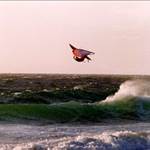
I have seen this setup several times now, and I don't understand it. Why is the rear footstrap off to the side like that? Seems like I have only noticed this on some wave boards.

That set up is primarily for a wave that usually breaks and is ridden in one direction only.
I'd say that the board you posted is meant for waves that are mostly ridden right, it helps with the bottom turn.
I personally have mine in the middle, I've tried that but don't like it.
Another thing you may or may not have noticed is the front foot straps on many but not all wave boards.
For waves mostly ridden right, the front foot strap on that side (which would be the left one) is often a bit farther forward than the other one. When wave riding, it's best to be more up on the board (weight farther forward), so having that foot strap more forward helps with that.
Below is a pic of one of my boards, notice the front foot straps, set up for waves that mostly break to the right.

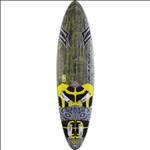
That's interesting and good to know. This pic I found is interesting as well. Never seen this shape of board before. Is this board designed for certain angle of wave sailing too?

It's so you get more foot strap over your foot jumping .goofy foot wave. I'm with master bender .I prefer it centred .
depends how you sail I guess.
that shapes been around for a while ,check out Quatro boards .Angulo ,he's got some nice quad .shapes .
these boards are made for wave sailing ,be nice at the Gorge too.flying high.
That is 2011 Quad - it is a bit slower & slower to plane than the 2012/13 version which came later, but was reportedly great on a wave. Don't judge a board by it's fin count - there are Fast Quads & slow Singles & everything in between... I had the 2013 version & it was a great highwind B&J board - very fast.
It wasn't the quantity of fins I was questioning, it was in fact that the board is asymmetrical and not symmetrical. Is one faster over the other?
Select to expand quoteMagic Ride said..
Is that shape any slower than the traditional shape?
If you mean a traditional wave board, whether it's an asymmetrical or not, will be a bit slower than a traditional shape, whatever that is.
Boards designed for waves will have more rocker in the tail (used to be in the nose also, but not so much with the newer shapes) which makes them more surfy (easy turning off the top or bottom of a wave). Faster boards have flatter tails but aren't near as good on the waves.
Your typical asymmetrical wave board will look something more like this.
This is Mark Angulo on one of his own customs, the asymm. will usually only occur in the tail or foot straps.
This board is designed for mainly left breaking waves, shorter rail line on the right side, you rarely see these anymore, Mark is one of the few hold-outs, but he moved to Florida, not sure how many waves he gets these days.
That Fanatic quad you posted is a symmetrical board, the photos are wonky as suggested above, not looking straight down on them, but from an angle.

That's good to know, because that was throwing me off. So it's a normal shaped board then.
Asymmetrical boards have been made in the past, the straighter rail being for drawn out bottom turns on bigger waves, the curvy rail for snappy cutbacks.
I have my rear strap off set so I can get more weight over the inside rail in my bottom turns. My feet are used to moving around on a bigger surfboard, it feels very strange having the back foot stuck in the middle of the board.
My rear straps have been offset tor years my front strap is less than the standard 45 degree angle to get closer to the centerline.
Through the 80's I had a Precision Equip aso board copied from an Angelo design for a long time. It was a pin tail on one side and a square tail with thruster on the other. It was a lot of fun but reckon it affected my gybing forever. My technique is still completely different one way than the other. If I sail somewhere where the wind comes from the other direction I'll probably be screwed.