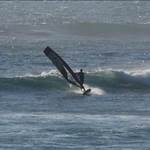
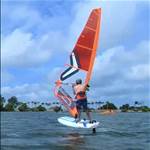
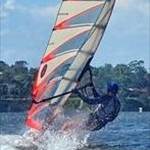
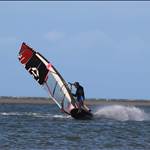
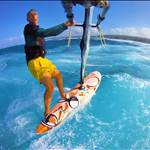
I guess uphauling a 7m race sail on a 100L board is just not meant to be easy? If anyone has any suggestions please share
I tried something very similar the other day. You did better than i did.
i didn't think "dangerously under rigged" was a thing. Ended up gaving to wait for a gust that was just enough to do a light wind water start.
This idea may help of a "Warrior uphaul": www.severnesails.com/dyno-board-setup-with-simon-bornhoft-part-16-how-to-prepare-for-waves/
He calls it a warrior uphaul
Simon Bornhoft has some videos here and there that you can find explaining the warrior stance, and I've been trying to practice it as much as I can when I'm trying to ride wave boards and not foiling. Anyways I've been trying to get the sail up as fast as possible and immediately get power in it to help stabilize. But I'm also on bigger boards as my smaller is 102 and I'm more often on the dyno 115 or now the 135 kode and I'm not pulling up a full luff cam sail on those. BUT the stance tips have helped me a lot on short wave boards and compact foil boards at 200lbs.
You done good doory, I usually sail where I can stand up, otherwise it's "glub, glub" time. Race sails are buggers to uphaul when full of water.
Select to expand quotethedoor said..
I guess uphauling a 7m race sail on a 100L board is just not meant to be easy? If anyone has any suggestions please share
Impressive effort. I only try uphauling my when my board has at least 20 more litres than my sailing weight in kgs. My current sailing weight ( body weight, wetsuit and harness) is 90 to 95 kg, so I only uphaul my 115 lit and 137 lit slalom boards. I've never uphauled my 97 lit slalom and 103 lit freestyle wave board.
Unless in a safe area I won't ride a board less then 15 litres more than my weight . I have a board that sinks to my ankles when uphauling and that is all good . I'm not sure of my board that sinks to my crotch . It would be a good skill to learn .
I get scared taking my 87 litre Patrik slalom board in out in less than 20 knots as its so small i struggle to gybe it and usually fall in despite it being 20 litres more than my weight.
My 100 litre i do my usual slow super wide chicken gybes and rarely if ever fall off so no need to worry about using an uphaul rope.
I struggled once to uphaul my 110 with a 5.6m so quite a feat to uphaul a 100 litre with a 7m.
I guess fear of sharks is the mother of invention.
Thinking of sharks halves your water start time .
Once something brushed against my foot , I believe I water started in les than 2 sec , on the wrong side of the board .
Fisherman catches monster bull shark in Sydney Harbour | Watch (msn.com)
Need to copy and paste
Select to expand quoteImax1 said..
Thinking of sharks halves your water start time .
Once something brushed against my foot , I believe I water started in les than 2 sec , on the wrong side of the board .
Sage advice
Great way to learn to fly, having something brush past your feet.
Select to expand quoteaeroegnr said..
This idea may help of a "Warrior uphaul": www.severnesails.com/dyno-board-setup-with-simon-bornhoft-part-16-how-to-prepare-for-waves/
He calls it a warrior uphaul
Simon Bornhoft has some videos here and there that you can find explaining the warrior stance, and I've been trying to practice it as much as I can when I'm trying to ride wave boards and not foiling. Anyways I've been trying to get the sail up as fast as possible and immediately get power in it to help stabilize. But I'm also on bigger boards as my smaller is 102 and I'm more often on the dyno 115 or now the 135 kode and I'm not pulling up a full luff cam sail on those. BUT the stance tips have helped me a lot on short wave boards and compact foil boards at 200lbs.
Aero,
Many Thanks for this this Warrior "stance" link. It's more than just uphauling. This applies to foiling in so many ways. This is basically how to hold the foil down. Or get in both foot straps before you pump out. Or stay in the foot straps until the next gust arrives and you can pump out.
Select to expand quoteutcminusfour said..aeroegnr said..
This idea may help of a "Warrior uphaul": www.severnesails.com/dyno-board-setup-with-simon-bornhoft-part-16-how-to-prepare-for-waves/
He calls it a warrior uphaul
Simon Bornhoft has some videos here and there that you can find explaining the warrior stance, and I've been trying to practice it as much as I can when I'm trying to ride wave boards and not foiling. Anyways I've been trying to get the sail up as fast as possible and immediately get power in it to help stabilize. But I'm also on bigger boards as my smaller is 102 and I'm more often on the dyno 115 or now the 135 kode and I'm not pulling up a full luff cam sail on those. BUT the stance tips have helped me a lot on short wave boards and compact foil boards at 200lbs.
Aero,
Many Thanks for this this Warrior "stance" link. It's more than just uphauling. This applies to foiling in so many ways. This is basically how to hold the foil down. Or get in both foot straps before you pump out. Or stay in the foot straps until the next gust arrives and you can pump out.
You're welcome! Seemed like some good technique advice hidden away on a board specific page, but as you mentioned, it seems to apply in other circumstances.
I sailed a 100 litre board with a range of full cam race sail sizes for a number of years. My weight fully kitted out about 75kg.
The technique is to stand to the windward side to rail the board during the uphaul which provides a lot more stability.
The energy in up hauling has to go somewhere. In this case it pushes against the water to gain some purchase rather than drifting.
I found the more difficult stage was getting things balanced and underway once the sail was upright. Need to be quick and committed.
No doubt a sailing venue with steady winds would make things easier than the gusty conditions I sailed.
Now on a higher volume (but still reasonably narrow) board I continue to use this up hauling technique.
Select to expand quoteutcminusfour said..aeroegnr said..
This idea may help of a "Warrior uphaul": www.severnesails.com/dyno-board-setup-with-simon-bornhoft-part-16-how-to-prepare-for-waves/
He calls it a warrior uphaul
Simon Bornhoft has some videos here and there that you can find explaining the warrior stance, and I've been trying to practice it as much as I can when I'm trying to ride wave boards and not foiling. Anyways I've been trying to get the sail up as fast as possible and immediately get power in it to help stabilize. But I'm also on bigger boards as my smaller is 102 and I'm more often on the dyno 115 or now the 135 kode and I'm not pulling up a full luff cam sail on those. BUT the stance tips have helped me a lot on short wave boards and compact foil boards at 200lbs.
Aero,
Many Thanks for this this Warrior "stance" link. It's more than just uphauling. This applies to foiling in so many ways. This is basically how to hold the foil down. Or get in both foot straps before you pump out. Or stay in the foot straps until the next gust arrives and you can pump out.
That looks like he borrowed that "warrior pose" name from yoga.
Select to expand quotethedoor said..
I guess uphauling a 7m race sail on a 100L board is just not meant to be easy? If anyone has any suggestions please share
That's quite a heroic effort! I would probably have a second heart attack if I tried it. It might be time for an ACZ?
Thank you aeroengr for the warrior uphaul. Makes a lot of sense, can't wait to try it, if the rain stops!
That video looked really familiar and it's that sort of thing which keeps me off sinkers nowadays - just too close to heart failure.
However, when I was younger I often sailed three-cam sails on tiny boards (Hi-Per-Tech 7.6" anyone?) and I liked to uphaul when the sail was dropped downwind of the board. What worked best for me was swimming things around until the board was more or less pointing into the wind, with the sail luff also windward, just as for a waterstart. It helped to pop the cams or battens so the sail was concave upwards - almost impossible to uphaul with the sail bellied upwards. Then , with one foot just at the mast and the other back between the straps, a little weight on the windward rail to lever the mast up just a bit, the SWEEP the sail to windward as hard as possible and pull it up. I'd be about thigh-deep at this point but the sail would be vertical and from there letting my weight move back to free the nose would get me going not all the time but maybe one out of two tries since as the sail comes up the board tends to get swung downwind a little.
What I want to help you with is reducing the effort to uphaul the sail, the faster you can get the sail uphauled the quicker you get going before board sinks. I made a strap from 1" wide nylon webbing with a loop at each end (one big enough to get hand in with webbing flat across palm), then one end loops around uphaul line on top of a knot about 3/4s the way up the uphaul line (lay uphaul line across webbing loop and then pass other end of webbing between loop and uphaul to lock it in place above a knot, so it will not slip down in next step), then tie a thin bungie cord to other end of webbing through the loop and tie around foot of sail (that keeps webbing strap out of the way). Then when you need to uphaul grab the webbing strap by the loop at the foot of the sail and use it to pull the sail up hand-over-hand "while in a nearly upright stance" (versus bent over) until it is easy to grab the uphaul line and pull sail all the way up. Really helps reduce effort, prevents lower back strain, and is essentially a Chinook Easy Uphaul because you can also place webbing loop on harness hook. But for a 7.0 can just use webbing strap as an aid to get to uphaul line without leaning/bending way over like you do in the video (very inefficient posture). Now for a 9.0 sail it helps to put webbing loop into harness hook, and then you can just lean back and use body weight to pull sail up, but that is slower. Like your Bolt!, and being close to Tampa have to say Go Bolts too! (local ice hockey team)
Select to expand quoteSandman1221 said..
What I want to help you with is reducing the effort to uphaul the sail, the faster you can get the sail uphauled the quicker you get going before board sinks. I made a strap from 1" wide nylon webbing with a loop at each end (one big enough to get hand in with webbing flat across palm), then one end loops around uphaul line on top of a knot about 3/4s the way up the uphaul line (lay uphaul line across webbing loop and then pass other end of webbing between loop and uphaul to lock it in place above a knot, so it will not slip down in next step), then tie a thin bungie cord to other end of webbing through the loop and tie around foot of sail (that keeps webbing strap out of the way). Then when you need to uphaul grab the webbing strap by the loop at the foot of the sail and use it to pull the sail up hand-over-hand "while in a nearly upright stance" (versus bent over) until it is easy to grab the uphaul line and pull sail all the way up. Really helps reduce effort, prevents lower back strain, and is essentially a Chinook Easy Uphaul because you can also place webbing loop on harness hook. But for a 7.0 can just use webbing strap as an aid to get to uphaul line without leaning/bending way over like you do in the video (very inefficient posture). Now for a 9.0 sail it helps to put webbing loop into harness hook, and then you can just lean back and use body weight to pull sail up, but that is slower. Like your Bolt!, and being close to Tampa have to say Go Bolts too! (local ice hockey team)
Actually, the thin bungie line ties to bottom webbing loop, runs through downhaul loop at foot of mast, and then back up to boom head clamp. That gives enough stretch so when you pull on webbing strap there is little stretch resistance from the bungie line (2 mm bungie).
Select to expand quoteSandman1221 said..
What I want to help you with is reducing the effort to uphaul the sail, the faster you can get the sail uphauled the quicker you get going before board sinks. I made a strap from 1" wide nylon webbing with a loop at each end (one big enough to get hand in with webbing flat across palm), then one end loops around uphaul line on top of a knot about 3/4s the way up the uphaul line (lay uphaul line across webbing loop and then pass other end of webbing between loop and uphaul to lock it in place above a knot, so it will not slip down in next step), then tie a thin bungie cord to other end of webbing through the loop and tie around foot of sail (that keeps webbing strap out of the way). Then when you need to uphaul grab the webbing strap by the loop at the foot of the sail and use it to pull the sail up hand-over-hand "while in a nearly upright stance" (versus bent over) until it is easy to grab the uphaul line and pull sail all the way up. Really helps reduce effort, prevents lower back strain, and is essentially a Chinook Easy Uphaul because you can also place webbing loop on harness hook. But for a 7.0 can just use webbing strap as an aid to get to uphaul line without leaning/bending way over like you do in the video (very inefficient posture). Now for a 9.0 sail it helps to put webbing loop into harness hook, and then you can just lean back and use body weight to pull sail up, but that is slower. Like your Bolt!, and being close to Tampa have to say Go Bolts too! (local ice hockey team)
Actually, the thin bungie line ties to bottom webbing strap loop, runs through downhaul bungie loop at foot of mast which traps webbing strap via thin bungie line knot tied to webbing strap loop, and then back up to boom head clamp. That gives enough stretch so when you pull on webbing strap there is little stretch resistance from the bungie line (2 mm bungie). Again, the webbing strap allows you to stand almost vertical giving you good leverage over sail, as you pull up webbing strap hand-over-hand, until you get to uphaul line. And of course, when you get to uphaul line you are again standing almost vertically, so have good leverage over sail. Bending over like you are in the video, almost doubled up, you have very little leverage over sail.
Of course, initially you do have to bend over to grab the webbing strap loop, but you can then immediately stand almost vertically as you pull on the webbing strap and stretch out the thin bungie line. So you are not trying to uphaul sail bent over, only bend over to grab webbing strap end loop.
Three (3) different articles on the question:
1. How To Lightwind Waterstart by Tom Luedecke (AHD/Bombora/Astrasurf/Omega designer, top racer, co-owner/co-promoter KA and Wildwinds and superstar World Cup windsurfer with Tiga/Neil Pryde) , Volume Six Number Five, Sailboard Extra (Australia), 1991 pp47 - 48. Jason Polakow youthful understudy looking on with KA-1111 Wildwinds on Strapper.
2. How to Rope Start Your Shortboard by Rohan Cudmore (legendary Wavesailor, Wally sailor and top racer), photos by Tim Storer, Freesail Oct/Nov 1990 pp68-69.
3. Board Skills: No Wind, No Uphaul, No Sweat by legendary top sailor/designer and nice guy, "Tooheys" Dan Engdahl, Freesail, Winter 1993, pp 68-69. Photos by Mike McGrath.
These were great magazines and I hope sharing these great articles here will help. These will be posted in the next ten minutes or so.


^ Excellent stuff, RichardG. The Tricktionary book also has similar tips but it's a bit pricy, including even more variations of lightwind waterstarts but haven't tried. One in particular caught me off-guard which was with the board upside down, which looks to get you closer to the board at first but maybe one day I'll try it for giggles.
Hey Door, looks like if you just duplicate what you did on that third one you will have it 90% of the time..... seems like first one you had trouble keep the board level, second one it looked like you brought the rig too close & lost the counterbalance, third one you kept the rig at arms length until you were stable & moving ... viola!
Great articles, espescially seeing early documentation of the no wind waterstart
And @gorgesailor. Looks like with my third one I had the rig towards the rear more and the board into the wind, which is similar to what awkard suggested above. Just need to remember to set things up a bit first
It can be really frustrating and tiring to fail uphauling for sure. Here are my tips:
1. Orient and set up your gear perfectly (it'll make everything easier).
2. Spread your legs evenly over the mast foot.
3. Move your feet slightly back of center line to apply pressure on the mast with the boards downwind rail. Control your heel pressure until the sail starts lifting.
4. Stay crouched down with elbows on knees, careful not to stress your back, let your body weight do the work.
5. Do not rush when sail suddenly comes out. Take care to try and orient the board slightly downwind as when you pull on it it'll want to round upwind.
6. patience use balance and technique first, strength at last resort!
7. Work on light wind waterstarts. We can almost always waterstart, especially in a light gust but we must wait for it sometimes.