Scenario:
Wind is strong enough to comfortably plane only when you bear off, just enough power but no more . Stuffed the gybe, drifted down wind during waterstarting. Back up on the board, planing again in the straps but need to make up a fair bit of ground upwind. Pointing the board as far upwind as possible without falling off the plane, pointing more upwind during the gusts and vice versa.
Troubles:
I find that when I'm planing upwind, my upper body feels way too forward and out, front leg kinked at the knee and rear leg almost straight and back foot has a lot more weight on it compared to the front. Sail feels the best slightly sheeted out and the rig raked back a touch, by slightly pulling back with the front hand.
Is the above stance about normal for the conditions OR have I got something wrong? Any tips suggestions to improve and make ground faster upwind?
Thanks!
Depends a lot on the kit you use.
I spend a lot of time working hard to go upwind in marginal choppy conditions on a 100 litre freestyle board with a 16cm fin and a 5.7 Gaastra Manic with 26" lines.
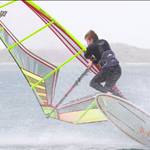
So to do this I have as little weight on the back of the board as possible (to keep me on the plane) - loads of mast-foot pressure through the harness (to keep the front of the board down and the back of the board up to avoid sinking the tail and falling off the plane). Back leg straight, front leg bent.
If I'm really working hard then I'll be railing the board slightly and may even have my back foot out of the straps to take the pressure off the fin.
Don't know if this will work for your kit, but it works for me.
Sometimes I feel really uncomfortable in the straps & find when I take my rear foot out & place it further forward just in front of the rear strap I feel much more comfortable going upwind in marginal just planing conditions..bit dicey if the chop is big though!
Yeah, that's pretty much the right stance for the task at hand.
YOu feel like your back leg is straight and you are trying to look around the mast.
You can't beat a really raily board and a big upright course fin for going upwind.
I'm seriously looking at a slalom board at present, as while I can get going in marginal conditions on my FS board, I spend the whole time just staying upwind.
Hi Gus,
It really does depend on what sort of a board you are using. I use wave gear only, and on the lighter days that you describe it's more efficient not to plane at all, just concentrate on grovelling upwind in the most balanced stress-free method you can. Under these conditions when you bear away to get on the plane you end up losing heaps of ground, and although you are moving faster, it actually takes longer to catch a wave.
Cheers, jens
One of the videos I was watching said grovel upwind in the lulls & bear off a bit to get planing when it picks up.
All of the above plus I find it helps me if I move my hands back a little futher on the boom and keep the sail more upright. This seems to get more power out of the sail.
i spend a lot of my time sailing upwind / downwind from peli-point to lucky bay, guessing around 1.5km in a straight line.
i find sailing reaches all the time or the new craze, down-wind speed runs boring!
if you can get upwind 1.5km in 3 legs you are doing very well [in a 90 degree angle to the wind]
i have being trying for around 20 years to make it in 3 legs, best i have done is 50 metres short of carpark at lucky bay, this was on 69cm wide board,41cm fin and 5.8m.
last week on a 85 litre board and 30cm weed fin in 15/20 knots it took me about 12 legs and one hour plus.technique is secondry to equipment when sailing upwind.
getting weight forward is what i try, as well as trying to rail windward rail up.
i find a bigger board + fin with a smaller sail [rigged full] is a good combo for pointing high.
a bigger sail pushes the fin and board more laterally, so i only use them with a formula board.
Thanks for the responses. The gear in question is smallish freeride board 104 litre (34cm fin) and 5.8-7m freeride sails. I do find smaller the board, harder it gets. 82litre board with 25cm fin makes it quite a bit slower upwind, unless well powered.
Hi Gustee,
I've just gone through a "re-training" process with longer lines and a waist harness (after years in a seat harness) and similar kit to yours. Struggled to adapt intuitively and had to consciously think through it all to adjust, so I've possibly over-analyzed the whole thing!! What I have found that worked well for me in underpowered and/or upwind sailing with respect to the "Troubles" you identified:
- "my upper body feels way too forward and out." This is consistent with the stance I've adopted in marginal and upwind conditions. KenHo explains it well as trying to pivot out and look "around" the mast. Feels a bit unco, but seems to work!
- "front leg kinked at the knee." Yep, and kinked at a much greater angle than I have previously had it. Seems to be the best way of getting forward and "around" the mast.
- "rear leg almost straight and back foot has a lot more weight on it compared to the front." Rear leg definitely straight, but as little weight as possible on it. I found that going out and "around" the mast gives you the chance to put a lot more weight on the harness - not so much downwards hanging off it, more outwards and forwards - choco has called it "slanting forward" and this is how I visualize the movement. Some weight on the front leg, but only really as much as it takes to pivot my weight onto the harness. Back foot weight is limited to whatever it takes to "balance" in this position. So my take on "slanting forward" is about getting as much weight on the harness, pivoting off a bent front leg and stabilizing it all with a straight back leg.
- "sail feels the best slightly sheeted out". I find the slanting forward and around movement automatically sheets the sail in as I'm moving the harness hook in a direction that forces the sail a bit more inboard and upright. I suspect this is the right thing for both marginal and upwind sailing as the apparent wind is moving forward in both cases, so sheeting in is keeping more power in the sail. Happy to be corrected though.....
- "the rig raked back a touch, by slightly pulling back with the front hand". Yes indeed! Found this to be a balancing act between keeping the sail upright for the sake of more power (but less upwind potential) vs raking it slightly back for better upwind (but less power). Still perfecting this on underpowered upwind runs, but to date I've found subtle changes in the angle of rake in the sail can be pretty effective in maintaining speed and upwind direction as the wind fluctuates.
Another thing mentioned by flickyspinny that I find useful is that if I'm still grinding to a halt in this position I'll take my rear foot out of the strap and move it forward. This seems to further push the sail upwards and sheet it in for a bit more power.
All this is predicated on being on the plane or pretty close to it. If not then Jens/sboardcrazy's tip on grovelling upwind until the next gust is gold!
Thanks again for all the responses. Wind in Sydney can be marginal and it's an important skill to master to maximise enjoyment on the water.
Underfinned, just to clarify: "Sail slightly sheeted out" - I meant compared to reaching. I'm going to try rear foot out out strap and forward.
After getting and subsequently learning how to sail my freestyle board lately this is what i do. ( 99L starboard flare with 16cm fin 5.8m sail.)
loads of front foot pressure to almost push the board with and get that front foot in the strap as soon as you can. Lean on the rail to keep the board flat and to stop spinout with a tiny fin. Once planing i striaghten my front leg and almost pivot the sail to the point of catapult so that i'm getting a lot of forward force that I can push through the board.
Seems to work ok and I can go upwind fairly easily when heaps of other people are on bigger gear than me. I'm about 90kg to.
As for back foot pressure, only apply very light pressure, and downward through your tippee-toes. Helps keep the leeward rail down and reduces spin-out sideways pressure on the fin. It's much easier to force yourself to apply only light backfoot pressure when your back foot is out of and in front of the strap. Works for me in marginal conditions on an 86 litre board &x28;I'm 70kg&x29;.