What would you say is the ideal angle for our elbows?
Giving the most strength over the sail and less stress on our arms at the same time.
I'd say not depend how powered up you are.
Overpowered I'd say bent elbows, squatting stance etc.
Not that powered up then straight front arm.
Naish still sails with his front hand under side, palm up.
Theres a good article from Peter Hart in this month Windsurf Magazine all about stance.
Select to expand quoteManuel7 said..
What would you say is the ideal angle for our elbows?
Giving the most strength over the sail and less stress on our arms at the same time.
Z boom 
I sail with 32" lines and a seat harness with arms pretty straight. I broke a boom and used a spare not realising it had 28" lines. Soon I developed golfers elbow in bothnarms (? The one on the inside of the elbow), it could have been brick paving, but it hung around for a year. I'm thinking it was the little kink in my elbows that caused the problem.
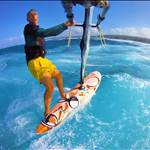
Straight arms gets your body out further, giving a bit more leverage over the sail, for well powered conditions.
Select to expand quoteManuel7 said..
What would you say is the ideal angle for our elbows?
Giving the most strength over the sail and less stress on our arms at the same time.
Surely, you arms are not bent at the elbows at all?
Lengthen your harness ines?
I think we'll balanced harness lines are key.
Arms almost straight, but still bent.
My lines are loose and I adjust constantly .
Im old and fat and it's my number one thing that lets me sail long time 
Select to expand quoteManuel7 said..
What would you say is the ideal angle for our elbows?
15deg
Select to expand quoteManuel7 said..
What would you say is the ideal angle for our elbows?
Giving the most strength over the sail and less stress on our arms at the same time.
There's no reason to think that the same "ideal" angle will give both most "strength over the sail" and less stress. One depends on things like aerodynamics and leverage, the other depends on physiology.
In other forms of sailing, for example, the two of them work against each other and they probably regularly do the same thing in windsurfing generally. Certainly IMHO optimum performance probably normall comes with a dead straight arm but whether you can physically handle that is another issue.
Select to expand quoteManuel7 said..Select to expand quoteWhat would you say is the ideal angle for our elbows?Select to expand quoteGiving the most strength over the sail and less stress on our arms at the same time.Select to expand quote Select to expand quoteThere are two factors that dictate the angle of your elbows when sailing in a straight line. Firstly the length of your harness lines and secondly the spread of your hands on the boom. Your hands should be roughly at shoulder width apart or slightly wider. As for harness line length, this depends mainly on the type of harness you are using and the height of your boom. There are other influencing factors such as mast foot position and board width if using outboard footstraps. While we are sailing along in a straight line we are constantly trimming our sail to the gusts and lulls in the wind. If our lines are too long and our arms too straight it is difficult to sheet out without twisting our body. Similarly, lines too short and arms too bent makes it hard work to sheet in. Ultimately it's a personal thing which ever feels comfortable but I would suggest slightly bent. Practice makes perfect ??Select to expand quote Select to expand quote
I don't know why all these yellow boxes came up. I was addressing the original poster only and not suggesting that anyone else's replies were any less relevant than mine.
Select to expand quoteBasher said..Manuel7 said..
What would you say is the ideal angle for our elbows?
Giving the most strength over the sail and less stress on our arms at the same time.
Surely, you arms are not bent at the elbows at all?
Lengthen your harness ines?
Mine are. When I sail in bumpy water I have to keep my arms bent so I have some immediate response to finesse the sail sheeting.
Select to expand quoteManuel7 said..
-15deg then 

I don't think those photos from Luderitz are a very good example of 'Ideal' for most situations. That is an extremely broad course and a very unique situation. Also, most sailors are wearing a LOT of weight.
I think ideal arm extension will vary with the angle you sail and the conditions and equipment.
In all my 'normal' speed sailing I usually get my arms very straight and body extended away from the rig as far as possible for maximum leverage. But I was surprised to find that that was pretty much impossible for me to achieve at Luderitz (Due to the extreme broad angle of the course), Sailing Upwind I try to have both arms straight, even if I have to reach my back arm further back down the boom, so I can use my stronger shoulder muscles to adjust the sheeting angle. same with max speed reaching , especially in fatter water.
In the rough stuff, that goes out the window a bit and everything, arms, body, legs, are bent to try to absorb the chop and impacts.
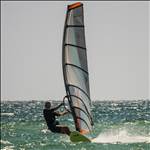
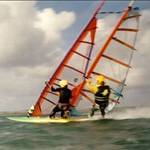
Stance at Luderitz:

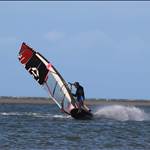
Stance at Sandy Point:


I went for straight arms and long harness lines in 1985 when I read in a magazine that more upright rig meant more speed. Like maybe 25 knots :)
Very interesting feedback you all!
The consensus definitely tends to be slightly bent.
Do you also feel like the front arm should be a touch more bent than the rear arm?
I experienced with pushing on the boom to add more weight to the harness, this works well coupled with stiffening our body to use up the most power from the sail when light.
However, while not a problem with the rear arm, pushing on the front arm can make us vulnerable to the odd gust or irregular piece of chop.
On the earlier speed photos note the break at the hips, this is critical to get hiked out and have good drive on the board. Only possible with good harness lines length.
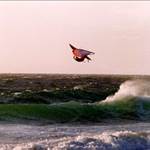
@sailquik: Interesting observations on the difference sailing different courses. I would also assume that personal preference and physique play a role. Ben Proffitt is probably one of the lightest and smallest sailors to ever clock a 50 knot peak. For him a more classic approach with straight arms and butt close to the water seems to work even in Luderitz: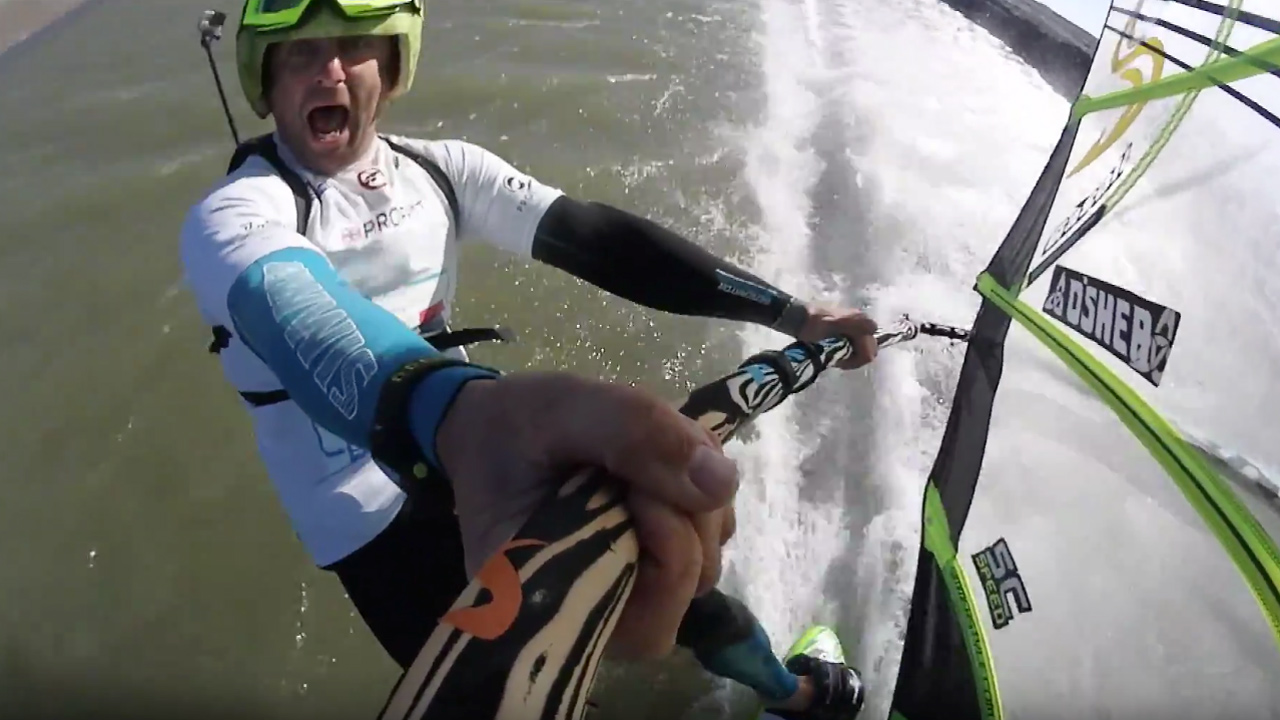 Not the best picture as it was a fun run (Notice the melon helmet), but he displayed a similar riding style in his fastest runs too.
The optimum angle is the one that prevents RSI in elbow tendons, which for me is nearly straight.

It's always interesting reading these technique threads, and especially the responses.
In so many cases, we're left wondering if you are asking the right question in the first place.
Or perhaps my brain just wants to look at the bigger picture.
In this case, I'm not sure concentrating on how bent your arms should be will give you the answer you're looking for. On some points of sailing our arms are slightly bent, but when sailing across the wind it's good to have your arms straight out in front of you.
If you look at pictures of other sailors then sometimes their arms will be bent in that moment, but not at others during that same sailing session.
It also depends on what sort of windsurf gear you are on. For example, when speedsailing on a downwind course - and holding onto a massive rig - your body stance is very different than when sailing recreational gear across the wind.
The key in all cases is to get the rig load acting through your harness lines and the pull should be outwards from your harness hook. You lean back and the body weight then takes the rig load. That rig load is then transferred via your legs to the board, and the amount of load on your back foot controls the percentage load on the fin.
The load on your back hand can then be varied by the load you feel on your back hand. You can increase load on your front foot via your front hand, and to do that you shift the harness lines back a bit on the boom. (By that same argument, people who spin out a lot have too much load on their back hand, either because they have the lines set too far forwards on the boom, or because their body stance is wrong with an overload on the back foot.)
On topic, your harness line length determines how bent your arms can be. With long lines your arms HAVE to be very straight and, equally, if your lines are way too short then you arms will inevitable be bent, with the rig too close to you.
The proper line length to use is a function of your personal arm length, and most of us have lines long enough to keep the rig upright and away from the body, with the arms fully outstretched but just a little bent at the elbows.
The slight bend at the elbows is not anything to aim for in itself, it just means you have the option to alter sheeting angles with your back hand, and you can use the front hand to steer with or to feather the sail.
So think of your harness lines and legs driving the board, and your arms are actually quite relaxed, and just doing little sheeting and steering movements. The load on each hand also allows you to vary the load on each foot.
I find this overview a better way of thinking, than focussing on how bent my arms should be.