I've seen a few comments in topics on here lately in regard to making a board more manageable to sail in chop by moving back and riding more on the tail. But how do you do that?
On all my boards I have the straps set at the rear, not necessarily the last hole available but in the rear section. Sailors at my local sometimes have their sails raked right back almost touching the board. Is this part of the technique?
What are the steps involved in doing this? I.e. change in stance, rig positioning, etc.
I make a point of spending a segment of my sailing session purposely focussing on improving my technique, usually it's in the last half of my session when I get my 'second wind' and the adrenaline rush has plateaued. 
Cheers for any tips.
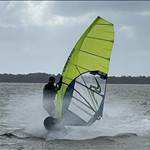
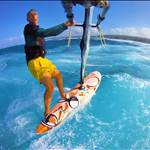
look at this one
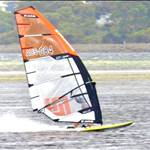
And this:
Wider boards with longer fins are naturally stiffer to turn than narrow wave boards, even freestyle boards are quite directional. So the idea is to defeat chop by powering through it and looking ahead to try and change trajectory.
Speed helps compensate the water roughness by flying over it. There's a certain speed at which you aren't bothered by the chop as much.
That said even the top riders get launched, and when you get launched at these speeds... The worst deal is burying a downwind rail with gust coming in, those two combined are difficult to counter.
Once flying, you may pull up on the board to better position its shape in relation to the chop and chop.
With more time on the water, you'll look for more power and more speed, your legs will automatically work to both absorb and push against the chop to maintain speed. Get your lines well tuned so you can be fully committed into your harness weighing down less on the board, let it fly!
Select to expand quoteOrange Whip said..
Sailors at my local sometimes have their sails raked right back almost touching the board. Is this part of the technique?
Thanks for the topic, I have similar problem, i burn my back leg while riding at the back for long periods like that. Moving back definitely dulls the chop for me. I guess when you move your weight to the back, the sail automatically gets more rake (at good speeds), and reduces mast foot pressure.
I normally place mast base close to rear limit due to my low weight, moving them even more further back makes high speeds too flighty, so i couldn't find a good trim that doesn't burn my back leg for heavy chop.
Do you think moving footstraps to most rear settings would help? They are at mid settings now. And would that cause more spinouts?
I'd say for most freeride/freerace/slalom boards start with the straps at the most rear holes and only move them forward if the nose flies up too much. Not all boards are setup the same. I think Fanatic have theirs a long way back and on their forum Craig recommend using the 2nd plug from the rear (or used to anyway). When I got my 2018 Exocet Cross I noticed the straps/fin was 2cm further back than on the 2005 do I started with the straps in the middle plugs, but then moved them back and it does tackle chop better as there is less board in the water.
For freeride/freerace/slalom sails you tend to have the mastfoot further forward than wave sails for wave sailing, so when blasting along the sail naturally is raked back. With the lower foot on those sails they tend to end up near the deck, its not a conscious thing to put it there. Thats what I've found anyway.
Select to expand quoteManuel7 said..
Burning back leg can be a sign of too large a fin for the sail size.
And going deep off the wind for too long. Nuthin some regular squats won't fix. Lol
Hey OW, I find moving the mast base back helps the nose lift up a bit and soften the ride. But the more you move it back, the more power you'll need.
I find riding the tail in anger really hurts the back leg . Good for a 2 sec peak .
Hey Imax, it depends on what the tail shape is I reckon. The pulled in, low volume tail shape of my Magic Ride softens up heaps in chop when I move weight back but needs more power to get going. I don't even bother trying it with my Go because of the wide tail with high volume and both boards are the same width and volume just totally different shapes.