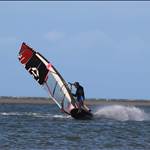
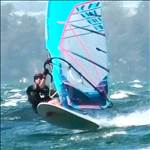
Gybing itself is quite complicated even in ideal conditions.
But add to those:
Low wind: around 10kn or less
not planing
small board, almost sinker
and gybing becomes real nightmare.......
Does anybody has any tips for slow speed gybing, how to keep balance, while there is almost nothing to keep your sail, board hard to balance?
If the trick is to make it fast or slow?
Keep the center of weight close to mast base or rather sink the end?
Flip sail quickly or slowly?
To illustrate let's imagine: board 92-94L, Sailor 88kg, sail 7.8 m2, the wind just enough to cruise not sink,
but not enough to waterstart....and you never know what in the water beneath ( Shark ??? actually you know there are plenty but supposedly do not eta windsurfers often)
big sail for a small board .get a 115 .all your problems will be over .
but yes slow to start then fast throw around .
i come into a pier with fisherman filleting ..i know what you mean .
FEAR WILL TEACH YOU .
Select to expand quoteMrCranky said..
Tack.
Is tack on small board actually easier then gybe? Since I moved to a small board I do not tack at all....
so from this two which one will be easier ( to avoid falling into water) tack or gybe?
This is a video taken in under 10 knots of wind. I'm using a Patrik 115 and a North Warp 7.7. The differences I find in light winds are:
1) Don't oversheet as much going into the gybe and sheet out earlier to keep the sail powered.
2) Play around with your back foot position to get the right spot. On my Patrik I used to step further forward compared to higher winds. On the Falcon, I step further back.
3) Flatten the board off before the rig flip when the board is pointing downwind. It's critical during the flip not to disturb the board too much. Don't worry about losing ground downwind; you will get that back once you've built up speed.
4) Flip the sail fast and keep the board flat as you switch your feet.
5) Don't turn upwind until you feel the acceleration.
Select to expand quotebhc said..
Have a look at this video:
Thanks a lot, The second example is exactly what I have been looking for!! Amazingly and surprisingly completely different to what I have been trying to do ( and always failed) and here why:
-guy switch feets before gybe-
-stand at the back of the board and sink
-turn the board very quickly and sharp
-finish clue first, then flip sail later.
Now all I need is to memorize and try everything in this order and manner....see what happen
Select to expand quoteMacroscien said..MrCranky said..
Tack.
Is tack on small board actually easier then gybe? Since I moved to a small board I do not tack at all....
so from this two which one will be easier ( to avoid falling into water) tack or gybe?
Hehe, neither do I. When you go to Mauritius you'll see everyone tacking in the waves.
Select to expand quoteMacroscien said..bhc said..
Have a look at this video:
Thanks a lot, The second example is exactly what I have been looking for!! Amazingly and surprisingly completely different to what I have been trying to do ( and always failed) and here why:
-guy switch feets before gybe-
-stand at the back of the board and sink
-turn the board very quickly and sharp
-finish clue first, then flip sail later.
Now all I need is to memorize and try everything in this order and manner....see what happen
Not sure what the second example is because that depends on your YouTube profile but if it's the guy on the Gecko I don't think that's right. You shouldn't sail clew first. You need to flip the sail when the board is pointing dead downwind. Foot switch can happen anytime as long as it's quick.
Select to expand quoteMacroscien said..
Now all I need is to memorize and try everything in this order and manner....see what happen
Good luck with that. Or go and practice in light wind with a big board and a small sail until you can do it automatically. Then go to smaller boards, finally to big sails on a small board.
Whether the tack or the jibe is easier depends on how which one you can do better. For me, it's the jibe, but I have friends who'd rather tack. My wife tacks on one side and jibes on the other (since she always tacks on one side and works on freestyle moves on the other - she'll even state that she can't tack or jibe on the "wrong" side).
Select to expand quoteCapie said
Not sure what the second example is ........ I don't think that's right. You shouldn't sail clew first. You need to flip the sail when the board is pointing dead downwind. Foot switch can happen anytime as long as it's quick.
This is one example that matches my requirements. Small board, slow speed, ...So you are saying that is not completely right and you could do it differently?

Select to expand quoteMacroscien said.
This is one example that matches my requirements. Small board, slow speed, ...So you are saying that is not completely right and you could do it differently?
I only gybe like that ^ if I have to either because I'm already not planing or because I need to snap the board around. If you gybe like that you will stop planing and then you will have to deal with an unstable board. In that situation, I agree that you might as well tack.
It is much better in my view to keep planing through the gybe at least until after the rig flip because the board is more stable. For me, if the wind is light, it doesn't work to sail clew first out of the gybe. I lose way to much speed and then have to do the rig flip as the board is coming to a stop. In light winds, I have to sail downwind, flip the rig, then continue the carve. So I would have flipped the rig 90 degrees earlier than the guy in this photo.
For none non planning gybes I come out clew first, I always step gybe, and practice sailing clew first, on bigger boards, clew first beach and water starts when ever I can.
Works for me, wave to big slalom.
Select to expand quoteCapie said..Macroscien said.
This is one example that matches my requirements. Small board, slow speed, ...So you are saying that is not completely right and you could do it differently?
I only gybe like that ^ if I have to either because I'm already not planing or because I need to snap the board around. If you gybe like that you will stop planing and then you will have to deal with an unstable board. In that situation, I agree that you might as well tack.
It is much better in my view to keep planing through the gybe at least until after the rig flip because the board is more stable. For me, if the wind is light, it doesn't work to sail clew first out of the gybe. I lose way to much speed and then have to do the rig flip as the board is coming to a stop. In light winds, I have to sail downwind, flip the rig, then continue the carve. So I would have flipped the rig 90 degrees earlier than the guy in this photo.
Capie, you are talking about a planing gybe, I think the OP is referring to non planing gybe, slow speed, less than 10 knots. When non planing, funky things like feet changing first and sailing clew first can make sense.
The lighter the wind the further onto the new tack the board needs to be before you flip the sail
Select to expand quoteWindxtasy said..
The lighter the wind the further onto the new tack the board needs to be before you flip the sail
Agree, that is possibly crucial because when I try to walk on small board almost stationary and playing flipping huge sail same time, none of that works. Either board flip first or sail fall. So it makes sense for me to do one at the time. On slow moving board, there is almost no stability at all. Additional problem is that sail that usually give you some support when powered , in the very light wind do not. It must be perfectly balanced every time, so possibly attention to keep it very vertical all the time must be crucial.
I find that a 7.8 sail w/ a 92-94 Lt. board would be a terrible combination, just asking for the problem that you're trying to solve.
You need a bigger board for a rig that big, even if the wind is proper for that sail size. Unless you're speed sailing on a board designed for straight line speed.
Select to expand quoteMastbender said..
I find that a 7.8 sail w/ a 92-94 Lt. board would be a terrible combination, just asking for the problem that you're trying to solve.
Yes that is exactly I need to learn, resolve. Find the safest way/technique to turn quite a difficult rig without falling into the water. In our urban environment ( GC) we have plenty of wind to blast on one stretch then suddenly nothing.
It not always possible to find a shallow patch to stop and turn by beach starting.
So this is my ideal setup to the waters here _ maximum power in the sail, the quickest board to blast.
Run is sometimes so short that you don't want to make a u-turn just in the middle because there is still some wind there ( 200 meters long)
I agree that this slow-motion turn seems to be more challenging than planning gybe, to master.
But I could see, it could be done by skilled people that know what there are doing. So far I was trying to learn on mistakes, but few tips should help.
I did yesterday some practice, according to video and tips here on SB.
Used 118L and 8.6 to practice slow turns. What I found that most helpful is " fluidity in motion".Instead to trying to regain and keep balance all the time, flowing movements from one position to another. Possibly need to repeat movements hundred of times to become automatic.
Select to expand quoteMacroscien said..Mastbender said..
I find that a 7.8 sail w/ a 92-94 Lt. board would be a terrible combination, just asking for the problem that you're trying to solve.
Yes that is exactly I need to learn, resolve. Find the safest way/technique to turn quite a difficult rig without falling into the water. In our urban environment ( GC) we have plenty of wind to blast on one stretch then suddenly nothing.
It not always possible to find a shallow patch to stop and turn by beach starting.
So this is my ideal setup to the waters here _ maximum power in the sail, the quickest board to blast.
Run is sometimes so short that you don't want to make a u-turn just in the middle because there is still some wind there ( 200 meters long)
I agree that this slow-motion turn seems to be more challenging than planning gybe, to master.
But I could see, it could be done by skilled people that know what there are doing. So far I was trying to learn on mistakes, but few tips should help.
I did yesterday some practice, according to video and tips here on SB.
Used 118L and 8.6 to practice slow turns. What I found that most helpful is " fluidity in motion".Instead to trying to regain and keep balance all the time, flowing movements from one position to another. Possibly need to repeat movements hundred of times to become automatic.
Peter,
I recon you would be faster on a 107 with your 7.8. It would glide through the lulls and be as fast or faster in the gusts and be easier to gybe in low wind conditions.
If you are in very light winds ( subplaning) I always find that sailing out clew first allows me to get the board going a little and get my balance ok. Once I feel balanced / moving a bit I'll flip. That method helps with the stability on the exit.