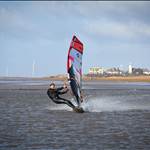
Hi,
It's my first post, so I introduce myself:
My name is Simon and I'm also addicted to windsurfing.
I've just noticed someone has a Patrik Formula4 board to sell at my location, so this idea just came up to my mind:
Would this board be a good idea for someone heavy (96 kg) who is just trying hard to start planning and whose home spot doesn't get windy most of the time?
My home spot is an inland lake, no waves, wind up to 12 kt with stronger gusts but not crazy ones.
Thought of this board as it is said to get plaining in low winds.
But how hard is it to make it plain comparing f ex to boards like Starboard GO?
Of course no learning how to use straps on a formula board.
Just wanted to add some water days in our mild conditions.
What do you think?
Thanks,
Simon.
At your weight a Formula board won't plane earlier than a large Go. Unless you use it with a 11 m sail. And those sails are a big hassle . A super lightwind board would be far better. Another option is a raceboard . They will go twice as fast as either board in non planing conditions. They can go upwind far better . Good for exploring.
I think it would work fine and be little different to a Go. The thing that will be different is the fin size and the corresponding sail size. I would have been around your weight when I was using my formula board.
The Go and similar boards will typically have smaller fins to make them a bit easier to ride. With a 70cm fin a formula board it can be easy for them to want to go hard upwind when planing, but a smaller 50cm fin can make it more manageable.
I have had a formula board planing in around 10 knots or less with a 11m sail, and it was only the gusts that let me pump onto the plane, but once going it was easy to keep planing. Its a pretty cool feeling able to go for so long with the feeling of almost no wind at all.
I have also used smaller, 8.5 and 7.5m sails on the formula board and I think they are much more manageable if you are still to learn how to plane.
I used a formula a lot for freeriding, it added a lot of light wind fun and helped me to improve.
But I think in your case it is too early, you need to learn a bit more , trying to plane outside the straps on the formula will not be pleasant. Better persevere until you are a bit more advanced in the straps and confident in the harness so you can control bigger sails.
An alternative would be learning to windfoil or wingfoil, you can get going with smaller sails and once you are going it is easier to keep going
Agreed. .. it planes early as it is for experts
It is not at all for somebody who is just beginning
Th? straps are a bit more outboard so more technical than a more beginner friendly board. Also they go quite fast with lots of lift. Finally they are a bit more fragile and not meant to take the abuse of frequent falls.
If you can do straps and plane well enough then no problem. Otherwise it's great to use something a bit friendlier early on and then go that route.
If you do want to go the formula route right away then pad the mast. Move the straps forward and the chicken center strap, use a smaller fin and take it easy with your footing.
Formula boards are getting harder and harder to come by. If the price is right do get it because it will definitely be a good fit for your weight and conditions at your lake. Might be weird and feel harder to sail in the beginning but you will get used to it quickly. They are also very stable and forgiving as a result.
Select to expand quoteFormulaNova said..
The Go and similar boards will typically have smaller fins to make them a bit easier to ride. With a 70cm fin a formula board it can be easy for them to want to go hard upwind when planing, but a smaller 50cm fin can make it more manageable.
It's also an option to put a 70cm fin on a Go for better light-wind. I've done that, and it actually works pretty well on an older 170L Go. My main complaint is that the Go is a bit sticky and doesn't "release" to get planing very easily, but that might just be my own improper technique...
The main issue with using a Formula board as a beginner (or something else "lightwind" like the JP SLW or Flacon Lightwind), and this is a SERIOUS issue: they're very fragile. You WILL break the nose doing catapults as you get comfortable. Progression-oriented boards are heavier because of all the extra fiberglass, and they're often covered in a layer of foam for added impact resistance.
Since it is a Patrick, it will be MUCH lighter than the Go. Put a 70 cm fin on it, run it with a 10.0 or 11.0 sq m sail, and you can learn to plane quite easily. Yes, the straps are outboard, but you actually want that with the big fin.
Not only did I race formula, but I also rec sailed formula boards for many years. At your weight (same as mine) I recommend it.
Don't buy the board. As others pointed out, it's not suitable for your current level.
Are some people foiling on the lake? I think many that previously used big boards and sails like these have now transitioned to windfoiling for low wind days.
By the sounds of it, foiling would be the natural choice for the lake. Given that you already have experience with windsurfing, it shouldn't be that hard to learn and you probably develop much quicker on a foil compared to learning to plane and then gybe in very low wind conditions. Apart from the fact it can be super frustrating when there is just not enough wind to plane and I wouldn't recommend massive sails either.
On a foil, you can get away with a nice, light sail and you will be flying with 12 knots (literally :P). Anyway, think about it. Only downside is probably that the foils are quite expensive although you should be able to pick up a cheap, beaten up foil board.
Select to expand quoteptsf1111 said..
Don't buy the board. As others pointed out, it's not suitable for your current level.
Are some people foiling on the lake? I think many that previously used big boards and sails like these have now transitioned to windfoiling for low wind days.
By the sounds of it, foiling would be the natural choice for the lake. Given that you already have experience with windsurfing, it shouldn't be that hard to learn and you probably develop much quicker on a foil compared to learning to plane and then gybe in very low wind conditions. Apart from the fact it can be super frustrating when there is just not enough wind to plane and I wouldn't recommend massive sails either.
On a foil, you can get away with a nice, light sail and you will be flying with 12 knots (literally :P). Anyway, think about it. Only downside is probably that the foils are quite expensive although you should be able to pick up a cheap, beaten up foil board.
+1
Select to expand quoteAusMoz said..
You better learn how to pump the sail if your going to buy a formula board!!!!!
Nah, you only need to pump the sail when you are trying to get on the plane quickly or in marginal conditions. If you fit them with smaller sails and smaller fins, they perform very similar to a Go or equivalent. I would fit a 50cm weed fin if it were me trying to use it in those conditions. Sure, the traps are very outboard, but the shape is very similar.
I swapped the 7.5m sail from my normal freeride board across to the formula board one day when it was marginal, and the formula board became a planing machine and could do everything the freeride board could do except go into shallower water. Alternatively I tried a 12.5m sail with the formula board once and when it powered up all it wanted to do was go way upwind like a train.
One of my favorite sailing sessions was pumping only a little to get on the plane in what must have been 10 knots or lower in Hawks Nest, and I would keep going for ages until I ran out of wind. It was more worrying that you would see dolphins pop up infront every now and then.
At an intermediate level finner/foiler that always uses rear straps on fin and sometimes (depending on conditions) uses rears on foiling, I found a wide tail board on a fin extremely challenging when in anything but marginal planing conditions.
Primarily, the chop was the problem. I could get in the rear straps but it was a bit nerve-racking compared to a 145L (77cm wide) freeride board, which has the next widest rear strap positions of my boards. But once in and having to pick deeper downwind and stronger upwind angles in chop I said screw the fin, switch to a foil, and had a much more enjoyable time on the same board.
Primarily that was after having an awkward fall trying to get in the rear straps that left a nice bruise, likely just due to poor technique with a fin on that board.
That was with the iqfoil with their 68cm drake and 9.0. I haven't ridden a proper formula board that has a bit less width in the tail, but it seems like it would still beat me up in the chop more than a smaller board.
Select to expand quoteFormulaNova said..
One of my favorite sailing sessions was pumping only a little to get on the plane in what must have been 10 knots or lower in Hawks Nest, and I would keep going for ages until I ran out of wind. It was more worrying that you would see dolphins pop up infront every now and then.
Maybe you were one of the sailors who we saw and were inspired back in the day of formula events here..Only really two of us getting out regularly here now at big board heaven. Big board seems needed to get offshore to the wind line.
Cruising over 20kts in 13kts wind feels pretty good to me. 
Select to expand quoteszyki said..
Hi,
It's my first post, so I introduce myself:
My name is Simon and I'm also addicted to windsurfing.
I've just noticed someone has a Patrik Formula4 board to sell at my location, so this idea just came up to my mind:
Would this board be a good idea for someone heavy (96 kg) who is just trying hard to start planning and whose home spot doesn't get windy most of the time?
My home spot is an inland lake, no waves, wind up to 12 kt with stronger gusts but not crazy ones.
Thought of this board as it is said to get plaining in low winds.
But how hard is it to make it plain comparing f ex to boards like Starboard GO?
Of course no learning how to use straps on a formula board.
Just wanted to add some water days in our mild conditions.
What do you think?
Thanks,
Simon.
You are learning, but if I were you I would consider a windfoil instead. It is not the easiest thing to learn (too difficult for me) but I am in principle a convert: a friend of mine spends the season freeriding on a JP foil 120 with no sail bigger than 5. He is your weight, but he is now ridiculously efficient and is up and going before any windsurf (or wing). It is windy around here, bou'll probably never need anything bigger than 6.5 to have fun, where the formula would require a 9 or 10 ... and drop off the plane at every jibe in light air.
Once upon a time, a formula board lived full time in my van for the lighter days. Half the year, it was the only thing I loaded up. At the time I was 72-3 kg and used a 9.5. I toyed with a 10.8 briefly. Rarely pumped. It does take commitment to be fully powered and in the back straps especially off the wind. I would often use a smaller fin (65) and 7.5 on windier days (18-20 kts). I did have some wonderful sessions on the formula board that would have been impossible on smaller gear.
I've been reluctant to comment because I don't want to be "the foil guy" but since the topic has already been broached, foil will be easier (straps and harness can be optional), allow for smaller sails (maybe, max of a 8 or 9) and give you better low end.
There is a bit of a learning curve in the first few sessions but certainly not much worse than getting used to something like learning to use an 11 or being overpowered and having to do downwind.
I'm very fond of my memories of the formula days and compared to the gear that came before it, it was a game changer since I live in a wind poor locale. But what it did, a foil does in every way (imho) better. I have an old Exocet formula board in the garage awaiting some better purpose now (either sell cheaply to someone or convert to foil board).
The older Formula boards (pre 2010 approximately) are great as lightwind free-slalom boards, but I would avoid the later models. By then the sport became too extreme, in my view, and that killed the interest.
But the earlier boards, e.g. Starboard 160, are great when paired with a good 70cm fin and sails of 10m^2 or more. I'm using a Starboard HWR with sails down to 8.6m^2, but below that it doesn't really work (to me).
I would just buy it if cheap enough and give it a go. One thing I learnt from it that you don't need 70 cm fin or 10m + sail. I used 42cm - 50 cm fin and 7.8 m sail usually. In marginal winds I put on the 8.6m sail. Reason for smaller fins was shallow areas. Great boards to help improve your basic skills.
Select to expand quoteSurferKris said..
The older Formula boards (pre 2010 approximately) are great as lightwind free-slalom boards, but I would avoid the later models. By then the sport became too extreme, in my view, and that killed the interest.
But the earlier boards, e.g. Starboard 160, are great when paired with a good 70cm fin and sails of 10m^2 or more. I'm using a Starboard HWR with sails down to 8.6m^2, but below that it doesn't really work (to me).
i agree ; the early generation formula boards would be great and easy to sail, SB175/186, AHD, Bic etc.
The more recent boards are very technical to sail and despite the width and volume require a bit of skill to get them going.
Yes, formula boards generally require more pumping since they have a lot of nose rocker. In slog mode you are pushing a lot of water.
However, once they get planing, look out! They are stupid fast. Upwind/downwind with a big fin and big sail, nothing can touch them. (Except a foil.) When planing they have a short but wide wetted area. The equivalent of high aspect ratio flight. Very efficient.
Because they are short-coupled, they always require a big sail. On really windy days I tried a 7.5 on a formula board. No go. The nose would not stay down; not enough mast base pressure even when sheeted in. So, my formula sails were 10.0, 11.0, and 12.0 and nothing else.
Don't short-change a formula board for light winds. They work.
Here is some old media if you have some time to kill!
Formula and 9.2 with 60 or 62cm fin, super smooth locked in sailing, hovering over the water:
I learned to windsurf on a Starboard formula 147. As a total beginner, i didn't have a clue. I assumed that as it was 100cm wide, it was suitable for a beginner:))
It came with a Drake 70cm fin, so bought a Select 57cm freeride fin, and a Bic Techno 7.8 and 8.8 free race sails. As a beginner, at first I used to use the rear centre chicken strap only, I'd put my rear foot in the chicken strap first, then the front foot. I was accidentally planning within the first few sessions. Although I was not using the formula board anything like how it was intended to be used, and probably looked very stupid with my daft stance, it did get to that planning level very quickly. The following months, I managed to improve enough to use the foot straps correctly.
I still remember clearly that feeling of the first time planning (even if it was only 15/20 knot speeds), I was buzzing for days.
The only potential issue with Patrik is modern formula boards are made with delicate carbon (my F147 was tougher wood). If the Patrik is cheap, go for it.
Select to expand quoteszyki said..
Hi,
It's my first post, so I introduce myself:
My name is Simon and I'm also addicted to windsurfing.
I've just noticed someone has a Patrik Formula4 board to sell at my location, so this idea just came up to my mind:
Would this board be a good idea for someone heavy (96 kg) who is just trying hard to start planning and whose home spot doesn't get windy most of the time?
My home spot is an inland lake, no waves, wind up to 12 kt with stronger gusts but not crazy ones.
Thought of this board as it is said to get plaining in low winds.
But how hard is it to make it plain comparing f ex to boards like Starboard GO?
Of course no learning how to use straps on a formula board.
Just wanted to add some water days in our mild conditions.
What do you think?
Thanks,
Simon.
Don't bother with Starboard Go - I've watched a few people using them and it's not attractive or inviting! Just try a formula - you might be very surprised how much fun they are and how fast you can go. The only way I can explain it- like sailing on you favourite lounge chair but at 25 - 30 knots.