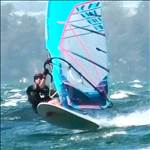
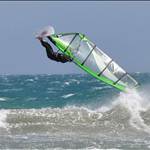
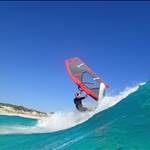
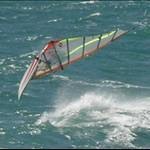
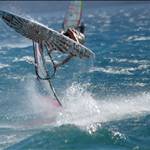
I've started to attempt some basic jumps. Small jumps just enough to get your fin clear of the water. I've been hitting the ramps with the harness hooked in. I'm finding that at times I'm landing with the harness hooked out or sometimes still hooked in and the waist harness is starting to ride up, which is becoming annoying.
What is the correct way? Harness hooked in or out? What do people think from a perspective of starting/learning to jump?
I mostly jump hooked in, but often land out. It depends on the ramp. Aflatter ramp where I don't lose much forward speed, I stay hooked in. If it's a steeper ramp, and I'm going up a lot, I tend tot come unhooked.
If I'm going to attempt any kind of loop, I un-hook.
Staying hooked in and keeping yuor composure will give good results. Initially, if you let the board rotate so the tail swings away, you will spin out on landing. If you pull your feet to windward, you will reduce this. If you pull too far to windward, you will risk a catapult on landing if you are hooked in.
I often spin out on landing, but on my small finned bpoards, that's not a problem, I just yank it back. ON a larger finned free-ride or slalmom, it's more of a problem.
I have a seat harness and decided to try a hooked in jump when I was overpowered..

 Not fun.. massive hooked in stack with whiplash..I dont hook in anymore..
KenHo +1
a good landing entails pulling the back foot upwind - up under your bum - but risks catapault upon landing so when learning, unhooked is a good thing!
Nothing wrong with jumping hooked in, and it helps keep you powered on exit but as Mark said there is a greater chance of catapult on landing until you learn control.
Another disadvantage occurs if you're 80kg +. You will end up breaking aluminium booms. I broke a ton before finally folking out the $ and going carbon.
yeah but you have to jump hooked in to do one handed backloops or one handed double forwards......so worth getting used to it now 
KenHo +2. Usually hooked in unless trying to loop or going vert.
One handed jumps are good to try when you get a bit better, helps you get the hang of stability in the air. Though when learning I did unhook most of the time.
For a beginner, I would definately advise jumping unhooked.
You can feel what is happening more and bail out easier. Its also easier to reposition everything to stay in control and make a good landing.
You just need to make sure that you dont accidentally hook in during the jump. Happened to me once when I got a facefull of water just as I took off and ended up going headfirst through my Naish 3.7m.
I only stay hooked in on long low jumps, but I just do plain jumps albeit as high as I can get.
I'm only a 'chop-hopper' and do basic small jumps, although a particular mate keeps trying to encourage me to start doing forwards. Small jumps hooked-in, big jumps un-hooked (not that I do many of those). I find that I lose speed & power if I unhook on entry (prob bad technique), and use my weight on the harness lines with my hands just for steering the sail in the air. From memory, I've only gone over a few times because of being hooked-in, and would've probably stacked anyways.
That's only what works for me.
Yeah, I concur here. When I started trying forwards last year, I found the immediate loss of speed and stability by un-hooking quite significant.
I have to say, sailhack, that if catapults don't scare you, trying forwards won't, cos the stacks are nowhere near as bad.
On the topic of getting air - that famous footage of R Naish doing bump and jump and just flying forever, then planing straight away - is his sail over powered to do that? Thinking for anyone to be able to do distance airs like that, do you go for over powered conditions, big sail and a slalom/wave board?
Further on the topic..When I'm powered up enough to go for jumps in choppy conditions I'm usually hanging off the side low to the water to keep from being thrown off.Not a good position to try & jump from..I'll have to try it but I suspect that if I get more upright just before I jump I'll have control problems..Any suggestions?
Yup, improve your overall form.
It's a bit like a golf swing. If you have a glitch in your swing that you have to compensate for, then you are juggling too many variables.
DEveloping a pure simple swing is not just better, but simpler and quicker, than trying to compensate for faults.
Like trying to shoot charlies, when playing pool.
When going fast in choppy conditions, if you commit your weight to teh harness and keep your upper body quiet while allowing your legs to move, then you will get air at some stage. Then it's just a matter of keeping your cool, and holding the tail of the board a little upwind for the landing.
If you are committed against the fin, the tail will spin out in the air, so you just need to anticipate that a little, and hold a nice position for the chop-hop.
The main thing is not to freak out and loose your composure.
I admit to being terrible at that when snow ski-ing. I would just lose it and become a flying frog whenever I got air. I spent some time on a trampoline learning how to "keep myself in one piece" while in the air, and it helped enormously.
Just keep your form and trust it to get you up and down.
Un-hooking feels safer, but breaks up the good form.
Essentially, you want to be a good passenger on your rig.
If you are hanging too far off the side, you are not driving the power of the sail through your legs too, which means you are going too slow for the power you have, which is a good place to start a catapult, but not a good place to jump from.
I jump in the harness for chop hops and even jumping small waves to keep speed up for larger waves.. It's easy with long lines..
It depends a lot on the conditions as to how difficult the jump is.
The more onshore the wind, the more difficult I find it to make a good jump. There's no point in trying to force the jump upwind too much as you lose too much power, get a weak jump and have to lean a long way out to force the nose off the wind for landing.
Better to just keep the power and do a longer low faster jump.
Unhooking is just a matter of developing the skill to not unsettle everything, and having long enough harness lines that little movement is required to release them. I also have selected my harness lines to have just the right amount of swing that they swing out of the way when I unhook, but they are not swinging around a lot when unhooked. I use Gaastra fixed lines.
Ideal conditions are anything around sideshore, where you can hit the wave with maximum speed and fully powered, and there is less adjustment to do during the jump. For beginning jumping, its best to be comfortably powered. In the air, you want to feel you are controlling the jump - power on to push the nose forward or down, sheet out to drop the tail of the board.
You also need to lean out and push the sail forward to direct the nose of the board off the wind for landing. That bit feels like when you are recovering the board on the water from fin spinout.
landing - you extend the legs and absorb the landing. I normally sheet out just before landing and then pump the sail as I'm absorbing the landing. If there is enough wind, this can take a lot of my weight off the board to maybe make a planing landing even from a fairly vertical jump.
It would be easier in the surf than with wind chop where you have to head up into the wind to get a ramp and lose speed as a result..They always seem to be upwind..[}:)]
KenHo - Can you please explain further what you meant below, the part about going too slow for the power you have? I'm trying to picture the stance that would cause this. Cheers.
I'll try. Describing what I feel on the water is not always easy and sometimes stuff just comes out.
I'll try to approach it from what feels "right" to me.
Say I'm getting on teh plane in well-powered or over-powered conditions. I'm out tehre for a ong time, my arms are a bit tired, or I just want to conserve energy. I don't want to hang onto the boom for a long time while a tiny board decides to get on the plane.
So, I'll hook in straight away, as soon as teh board is heading off downwind, before i'm properly planing, and sheet in.
At that point I have too much power in the sail for my speed, so a catapult is imminent, like falling off the front of a skateboard (which I do a lot while learning tricks).
I'm face with 2 choices. I can either sheet out or I can direct that power into accelerating the board. That's what I choose.
I commit my weight to the harnes and stay sheeted in, and use my core muscles to tilt my pelvis do I can straighten my font leg and drive the board forward, using the rocker to jet i onto the plane.
It's critical to be able to do this at a place like Currumbin when the shorebreak down at Palmy is slamming into you and you want to keep the power in the sail to get going between waves. If you un-hook and sheet out there, you just get flogged. You have to stay hooked in and keep the pedal down hard. Often as I come over a wave, I'll land tail deep nearly stopped, but fully sheeted in, and just drive it out again.
So, back to hanging off in over-powered conditions. If you are hanging off too far, you are not driving the power through your core and into the front leg. You will be bogging along too slow with too much fin pressure, on the verge of spinning out, and closing the leech at the top by pulling the mast sideways.
I know Sue is a light-weight, and is gutsy enough to go out in conditions that over-power her, but to jump in those conditions, you need to have the board running freely and be muscling the sail with your upper body and core.
It's that core cohesion that lets you survive a landing that's too down-wind without going over the bars.
A ski instructor in a powder lesson explained taht to me.
She made us form our body into a tight "C", then went around trying to break it by pushing on our shoulders. She wanted us to stay curled into that tight cohesive "C", critical for sking the pow-pow or steeps. If you stand up and open up, you lose control and die.
It's exactly the same thing here.
Addit.
When I say "straighten the front leg", I don't mean to lock it out. Remember this is a high-wind, rough water scenario here. My knees are always bent, esp in that first few secs where I am hooking in and not moving fast. I need to hang on the harness to get mast-foot pressure to balance the board. I'm almost pulling the tail of the board up to me sometimes if it's well windy and I'm really over-powered.
I think one reason the long harness line advocates have been vocal, is that the longer lines let you bend your knees more with your weight over the board, and maintain a strong core.
The classic "7", looks kinda cool on dead flat water, but is an intrinsically weak stance that will break very easily, and is total crap in rough water.
A few people have noted that Barn should not care about his line length, as he's never hooked in anyway. I think the editing gives that impression, but I'll bet he's hooked in every second he does not need be out.
Experienced wave sailors pretty much only unhook when they are on the wave or going for big moves. Takes too much energy to sail with your arms.
My chiro says I have to use my core muscles sailboarding to save my upper back..I can use my core muscles lying on the floor doing exercises but its a bit different flying along over chop at 20kts + overpowered.. I've got other things to think off like staying in control! Next time Im out & not overpowered Ill try & think about using my core muscles..One thing I found is that usually my old seat harness isn't adjusted tightly enough so its more like using a waist harness..If I come in & really tighten it so it pulls from the seat.. Wow ! What a differnce!Feels almost cruisy!
Yup, core is really important in sailing.
It's about getting the power from the sail to the board.
It does not have to go through your upper body. Sail to boom to harness to legs through your core. Piano fingers on the boom are just fine tuning.
Think about your core when you are getting hooked in, and before you jump. That makes it a habit, at a time when you can think about it. YO can also practise it by locking yourself in, and running down-wind a bit. I often need to do that at Palmy to avoid big walls of white water, and it's easy to go over the front.
Staying in "one piece" in the air is really important, and it's locking your core together that enables that.
If you are on the verge of a catapult, that's a good time to think "core" and curl yourself into a "C", rather than letting yourself break open.
It would be easier to show you in person, of course.
A seat harness wants to lift you up, so you really have to muscle your pelvis under, so you can drive into the front leg. One reason why waist harness are more popular with wave sailors.
I've got other things to think off like staying in control! Next time Im out & not overpowered Ill try & think about using my core muscles..One thing I found is that usually my old seat harness isn't adjusted tightly enough so its more like using a waist harness..If I come in & really tighten it so it pulls from the seat.. Wow ! What a differnce!Feels almost cruisy!