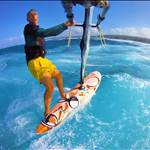
With this setup there's less wear on the strap (unlike sliding bar), has more direct connection with the rig. The harness doesn't keep on tightening itself. It doesn't drag when being pulled under water. Doesn't slide off accidently or choke us.
it's as bad as fake AI when someone posts bad tips like this to gullible windsurfing forum readers.
None of the advice given here will help you stop catapulting.
A catapult happens when a surge of power overwhelms your sail, and that's usually an incoming gust of wind, or else you hitting a wave or some chop which stops you dead. The board stops, but the rig carries on forwards.
In both those cases, you need to anticipate the gust and the wave, by watching what is happening. When driving (when driving anything), you need to develop good awareness and fast reaction time. Focus.
The other reason newbies and learners catapult is because they have often their rigs set with too little downhaul, meaning the sail can't adjust to a new power surge. An open upper sail leech is your friend.
The guy in this video has a sliding spreader on his harness, and that's always a bad idea which no pro sailor would use - because for fast reactions, as for fast transitions, you need to know where the hook is when hooking in, so as not to unsettle the board.
This guy also has a hook on the spreader bar which is way too long - possibly meant for kiting.
Note that in good windsurfing stance, the pull on your harness lines is outwards, not upwards. If your harness is moving then this is a stance issue, or one that has too much buoyancy, so it floats up higher when you fall in.
I'm probably sounding horrible, but we need to teach stuff properly.
Haha... yes, I did wonder what on earth was going on in this. I think my reaction was :puzzled-face:
To be fair though, Manuel7 also has a tacking tips video on his channel, which actually does seem genuinely useful.
This one, less so...
Thanks for your feedback. The ION harness bar failed after less than a year. I replaced it with what I had which was a bar from a sliding harness yes.
The concept described in the video is similar to how a sliding bar works but with a fixed bar harness instead. The whole harness rotates instead.
Have you tried the tip? You may never go back!
Select to expand quoteManuel7 said..
Thanks for your feedback. The ION harness bar failed after less than a year. I replaced it with what I had which was a bar from a sliding harness yes.
The concept described in the video is similar to how a sliding bar works but with a fixed bar harness instead. The whole harness rotates instead.
Have you tried the tip? You may never go back!
I think you'll find I never catapult - because I know what actually causes it. And that's nothing to do with any harness.
I think whatever you are debating if you don't respect the others how can you be respected ?
Select to expand quotepowersloshin said..
I think whatever you are debating if you don't respect the others how can you be respected ?
So true.
And clickbait crap is also annoying.
Imagine suggesting you can solve catapulting with a harness tip. It's like suggesting if we elect Trump, we'll get world peace, because he'll sort it out. Or we can stick to truth and facts and to science.
Select to expand quoteBasher said..
it's as bad as fake AI when someone posts bad tips like this to gullible windsurfing forum readers.
None of the advice given here will help you stop catapulting.
A catapult happens when a surge of power overwhelms your sail, and that's usually an incoming gust of wind, or else you hitting a wave or some chop which stops you dead. The board stops, but the rig carries on forwards.
In both those cases, you need to anticipate the gust and the wave, by watching what is happening. When driving (when driving anything), you need to develop good awareness and fast reaction time. Focus.
The other reason newbies and learners catapult is because they have often their rigs set with too little downhaul, meaning the sail can't adjust to a new power surge. An open upper sail leech is your friend.
The guy in this video has a sliding spreader on his harness, and that's always a bad idea which no pro sailor would use - because for fast reactions, as for fast transitions, you need to know where the hook is when hooking in, so as not to unsettle the board.
This guy also has a hook on the spreader bar which is way too long - possibly meant for kiting.
Note that in good windsurfing stance, the pull on your harness lines is outwards, not upwards. If your harness is moving then this is a stance issue, or one that has too much buoyancy, so it floats up higher when you fall in.
I'm probably sounding horrible, but we need to teach stuff properly.
Reminds me of the forward loop thread - didn't listen to any of the quality advice given, he did eventually get there after a few months however he could have done it in one or two sessions if he listened
Select to expand quoteBasher said..Manuel7 said..
Thanks for your feedback. The ION harness bar failed after less than a year. I replaced it with what I had which was a bar from a sliding harness yes.
The concept described in the video is similar to how a sliding bar works but with a fixed bar harness instead. The whole harness rotates instead.
Have you tried the tip? You may never go back!
I think you'll find I never catapult - because I know what actually causes it. And that's nothing to do with any harness.
You're nor trying if you never get catapulted (-; it happens to me far less than it used to but when it does it's generally because I'm pushing a bit to hard, so they are quite spectacular. I agree twisting the bar would do nothing to stop them.
I remember about 20 years ago i forgot my harness and i borrowed a seat harness that had a fixed hook.
I only ever use a harness with a sliding hook.
The wind was maybe 18-24 knots and i felt super uncomfortable in the gusts as i was unable to get as much of my upper body weight forward to keep the nose down when i hit max speed.
After half hour i packed up and went home.
Sliding hooks on harnesses are especially beneficial to lighter sailors.
They also help greatly in sailing upwind.
Using a shorter hook will increase the amount it slides forward and back.
Select to expand quoteausbinny said..Basher said..
it's as bad as fake AI when someone posts bad tips like this to gullible windsurfing forum readers.
None of the advice given here will help you stop catapulting.
A catapult happens when a surge of power overwhelms your sail, and that's usually an incoming gust of wind, or else you hitting a wave or some chop which stops you dead. The board stops, but the rig carries on forwards.
In both those cases, you need to anticipate the gust and the wave, by watching what is happening. When driving (when driving anything), you need to develop good awareness and fast reaction time. Focus.
The other reason newbies and learners catapult is because they have often their rigs set with too little downhaul, meaning the sail can't adjust to a new power surge. An open upper sail leech is your friend.
The guy in this video has a sliding spreader on his harness, and that's always a bad idea which no pro sailor would use - because for fast reactions, as for fast transitions, you need to know where the hook is when hooking in, so as not to unsettle the board.
This guy also has a hook on the spreader bar which is way too long - possibly meant for kiting.
Note that in good windsurfing stance, the pull on your harness lines is outwards, not upwards. If your harness is moving then this is a stance issue, or one that has too much buoyancy, so it floats up higher when you fall in.
I'm probably sounding horrible, but we need to teach stuff properly.
Reminds me of the forward loop thread - didn't listen to any of the quality advice given, he did eventually get there after a few months however he could have done it in one or two sessions if he listened
Loving all the new answers here, funny, but tragic as they are.
(How can we politely tell people, including the YouTube guy, they are thinking ****?)
Catapulting is something you do when a gust hits, and when you don't/didn't anticipate it.
The board can't move forwards because, either you are standing too far forwards, or a wave is in the way, like a crash barrier.
So, best watch what's coming, and then bend your knees, and lean back a bit to anticipate the surge of power in the rig.
To better help deal with that surge in power from the rig, make sure you have the sail set properly, with enough downhaul.
These are basic skills.
PS. If ausbinny wants helps with his technique issues, then ask away. There was certainly a lot of **** in the forward loop thread.
In my experience, the main issue with forward loop technique, is where the posters don't deal with cross off versus cross on wind conditions.
Select to expand quotePcdefender said..
I remember about 20 years ago i forgot my harness and i borrowed a seat harness that had a fixed hook.
I only ever use a harness with a sliding hook.
The wind was maybe 18-24 knots and i felt super uncomfortable in the gusts as i was unable to get as much of my upper body weight forward to keep the nose down when i hit max speed.
After half hour i packed up and went home.
Sliding hooks on harnesses are especially beneficial to lighter sailors.
They also help greatly in sailing upwind.
Using a shorter hook will increase the amount it slides forward and back.
So untrue for most people. And nothing to do with your weight.
What you found was your stance was expecting a sliding hook, and you didn't give the time to adapt to something different.
This is what we call a stance trap, and to be fair it happens to all learners, and to older people, and probably me..
At least you are not posting a video, telling people how to sail, or what to use.
20 years is not too late, by the way, to find a better way.
It's also important to distinguish between a short hook and a shorter-length spreader bar. In this video, the rider is using a longer hook, a kiting hook, which is causing spreader bar twisting issues. Kiters generally use a longer hook.
When windsurfing, you should ideally use a short reach hook, but a long spreader bar - and that makes sure the pull is outwards, without the load squeezing the harness tight, and the spreader bar shouldn't move on any webbing.
So that's then a fixed hook, with a harness that doesn't act like a corset.
With a fixed hook, you can still twist your hips, when heading upwind.
Make sure your harness lines are long enough, 30inch, or longer if you are tall.
Please try these tips. You can always go back. A Tesla owner can also appreciate driving a Cadillac.
Select to expand quoteBen1973 said..
You're nor trying if you never get catapulted (-; it happens to me far less than it used to but when it does it's generally because I'm pushing a bit to hard, so they are quite spectacular. I agree twisting the bar would do nothing to stop them.
"You're not trying if you never get catapulted"?
I'll have to think about that.
Several people on my beach think: 'You're on the wrong board, if you never do a walk of shame'
And I never do a walk of shame.
I think they sail too small a board for our local 'rippy current' conditions. But hey. It's not like I'm on a big board anyway. I just know that float underfoot is good.
Similarly, sliding hook harnesses are for race boards, sailing upwind, and possibly from the old school days, but not recommended for anyone on a modern short board, hoping to plane through a gybe. When you un-hook or re-hook, you need to known where that hook-in point is.
Good too to see there is some discussion in this windsurf forum, when everywhere else seems dead.
Feel free to disagree with anything I write, even though I think I'm right.
in my case a slight concussion.
If you never catapult, you don't sail interesting places with unknown somethings lurking in the weed.
I think my favourite catapult was Hansen bay/Cervantes. The nose of the board looked quite serene through the crystal clear wave it went into.
violence ensued.
"Slidey" bars are more comfortable, because you can twist your body around to face forwards a bit easier.
First harness I had was "slidey", so I knew no different. Second one was "fixed", and I'm still not sure I like it. I dunno about catapulting more or less. There is more "slack" in in the "slidey" ones, thus the comfort, and the "fixed" are tauter so faster to react. I guess.
But 99% less catapults with "fixed"? Yeah. Nah. Maybe 5%.
Also, maths: 99% less with "fixed" means you'll have 9,900% more catapults with "slidey". It's easily provable hyperbole, man.
ps yes, I live.
We don't see enough of you^^^
where've you been hiding? Chewing too much tasty bamboo?
Select to expand quoteevlPanda said..
"Slidey" bars are more comfortable, because you can twist your body around to face forwards a bit easier.
First harness I had was "slidey", so I knew no different. Second one was "fixed", and I'm still not sure I like it. I dunno about catapulting more or less. There is more "slack" in in the "slidey" ones, thus the comfort, and the "fixed" are tauter so faster to react. I guess.
But 99% less catapults with "fixed"? Yeah. Nah. Maybe 5%.
Also, maths: 99% less with "fixed" means you'll have 9,900% more catapults with "slidey". It's easily provable hyperbole, man.
ps yes, I live.
I like my old school wider lines as I can slide the hook forward sailing overpowered upwind..I can face my body forward, get me more over the board , the rig more upright and luff it slightly
There's more to it than that but when I get it right it's effortless.
This is flatwater sailing on my slalom boards.
being able to twist the body, is easier on the neck, especially if you really want to see where you're going, instead of staring at the sail.
Select to expand quotePcdefender said..
I remember about 20 years ago i forgot my harness and i borrowed a seat harness that had a fixed hook.
I only ever use a harness with a sliding hook.
The wind was maybe 18-24 knots and i felt super uncomfortable in the gusts as i was unable to get as much of my upper body weight forward to keep the nose down when i hit max speed.
After half hour i packed up and went home.
Sliding hooks on harnesses are especially beneficial to lighter sailors.
They also help greatly in sailing upwind.
Using a shorter hook will increase the amount it slides forward and back.
That makes sense.. I'm light and I find sliding the hook up and down the harness lines helps.