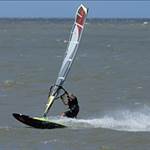
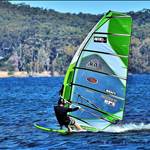
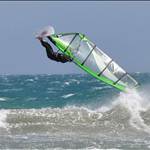
Watch some good "how to gybe" vids before you go out, youtube has plenty, get em in your head, it needs to come naturally, and never, never give up, everytime you need to turn, attempt a gybe, so practice, practice, practice. They do come eventually.
Learn to sail in a broad reach out of the harness and having heaps of speed. If you are barely planing into the gybe its going to be hard to be planing out of it.
Beg, borrow or steal a copy of "Turn for the better" by Peter Hart...
Everything you need to know (and more!) is on there.
i reckon find some dead flat water also, that will speed up your efforts plenty.
thomsons beach up near the creek gets flat enough (SE)
wello in near the shore low tides (NE)
pebble beach near bribie (SE)
Don't do super long runs. This way u get more practice . A place where u can touch ground is great to. I learnt down thomsons beach up near the creek mainly cause i could touch the ground, but watch out for the patch of rocks near the soft mud sign i reckon ive hit them nearly everytime.
look thru the turn, dont look down at your feet, kind of "let it happen"
visualisation is good
wide arc
carry good speed
wide exit
bend zee knees, lean forward
Don't forget to apply MFP
...which means either "Mast Foot Pressure" or "More F*****g Practice", depending on who you ask...

Rig your kit on the lawn, and practice your rig flip until you can do it 10 times in a row with your eyes shut. That way you won't be tempted to look at your hands instead of where you're going when you're on the water.
1- read articles, look at pictures / dvds / and other people gybing, until you can mentally visualise what you have to do.
2 - find flattish shallow water to practise.
3 - use a wide board.
4- never, ever, give up.
Get the Guy Cribb DVD called Intuition. It goes through all the stages from low wind gybes to high speed lay-down gybes. There is also a section on how you can practice the routine at home.
Don't try and do it all at once, try a step at a time or you will get confused.
Of course flat water is the best place (Sandy point in a SW is ace) and practice, practice, practice. Its taken me about two years to be able to go in at speed and come out planning. Good luck.
Make sure you are comfortably planning in the foot straps, take out the rear foot and place it just infront of your rear strap and just past the middle line of the board towards leeward, this will help you to dig the rail in and carve around, keep leaning forward though and not back otherwise you will stall, round up and sink. You can now either switch stance and flip as you go through the wind, or flip the sail first and switch later, depends on your preference, however I would think switching stance first is easier to learn. When you are baout to flip the sail, grab the mast with your back hand and bring your front hand around to the otherside of the boom, then move your other hand back onto the new side on the boom. As you get better you can flip boom to boom and skip the mast in the middle part. If you feel like your going too fast, oversheet slightly before initiating the gybe to wash a bit of speed off.
Key point: keep your weight forward through the entire turn to keep on the plane.
Dont flip the rig too late or you will find the rig ending up being behind you and may catch the water with the clew.
Make sure your boom is set up as high as you can, go in fast, bear away, sheet in, keep your head up, stay low, look where you are going, and take in plenty of determination and a fair bit of aggression (show that damn board who's boss).
But don't take my advice I'm cr4p. The above works for me 50 percent of the time. The other 50 I'm swimming!!!! ha ha.

Agree with nebbian
Don't grab the mast if you can help it.
Also agree with the Zen comment.
I went for a late sail last night on a borrowed isonic board. Sometimes I need reminding just how much fun a full on fast gybe can be in flat water. Get it right and the reward is enormously good for the soul.
After 25 years of sailing a fast laydown gybe at full speed is still one of the most enjoyable moves to do. The bigger the gust of wind, the bigger the power in the sail the better. I can't wait for tonights effort.
When learning you need to fully commit - don't go at it with a half effort.
Check out the DVD
i only have one piece of advice,
When stepping out of your back strap, dont lay your foot across the board, place it pointing towards the nose
I have no idea why this helps, But it helped me alot, and the first time i tryed this technique i went from 2 in 10 gybes to 6 or 7 in 10!
so try it out, it may work
Good Luck!!
Not too sure about that one Jord. You dont want to confuse the poor bloke now do you.
Release your back hand early and flick your front hand towards your body as you jybe. This helps the sail to rotate and you can then do "no hand" jybes when you get better.Failing all this advice find Vando and "watch and learn"
Hey Elmo lol good vid but not what Nebs was thinking. Peter Hart Turn for the better is really good. Carve nice smooth arcs and don't hang on with the back hand too long, I try to let go and start the rig rotation as soon as the board has gone through downwind and is starting on the other reach.Practice the rotation on dry land so it becomes automatic when on the water.
Well, the "boomshaka" is sort of like grabbing the mast, only faster...
Jord sez "When stepping out of your back strap, dont lay your foot across the board, place it pointing towards the nose".
Is good, this allows "hip shifting" to keep the board turning, yes?
The nicest gybes tend to look a bit gay because of this helpful move, which you can't do unless facing a bit forward.
Come to think of it, the zero success punters always have zero hip movement..
Give up the next two years of your life. Eat, sleep, dream and meditate the gybe and you will one day do it!