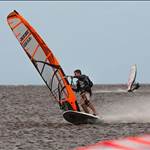
Lots of good stuff posted here: www.seabreeze.com.au/forums/Windsurfing/General/Carve-Gybing-2/
I have no problem step gybing in relative smooth water. However I suspect my technique is challenged in 20+ knots, choppy conditions, which is often the norm at my local sailing spot.
I generally find the carve maintains speed and the edge of the board digs in when I adhere to the advice of:
1. bending the knees
2. keep rig forward and sheeted into the turn.
However when I come out of the turn the board feels unstable when I execute the step and rig flip. Hence I often leave the rig flip until I'm facing in the return direction, and by then I'm no longer planing out of the turn, and almost at a standstill. The feeling of instability is due to the fact the board is planing, no longer carving and riding over lumpy water sometimes down a wave face.
Any tips to improve are welcome.
keep the pressure on the rail.
it sounds like your un-committing mid turn and losing your speed!
flip the rig earlier and step right forward as you do!
Speed=stability!
A few random thoughts...
Keep your speed UP on entry, you will need your momentum to help you through the turn. (Often people slow down too much for the gybe then wonder why they stall).
Bend your knees - lots. The bumpier it is the more shock absorption you need.
Pull DOWN on the boom. As you gybe you lose mast foot pressure. Compensate by hanging off the boom.
Try to time the gybe so that you can use a swell to gybe on, as this can help push the board through the turn.
Finally, if you catch the foot of the sail in the water, instead of sheeting out, sheet in like the racers do in a power gybe.
As I mentioned in my posting I'm not losing speed during the exit of the turn unless I leave the rig flip late. When I come out of gybe on smooth water I flip the rig at point so that I complete the turn planing. In choppy conditions I tend to hold the carve all the way around and not bail out early. The advice from the experts is to not leave the rig flip until 180 degrees of the turn. I guess if I can step and rig flip while the board is carving then things are better, because while the board is carving it feels stable. Perhaps gybing strap to strap is a better approach?
Select to expand quoteHazzelbanger said..
As I mentioned in my posting I'm not losing speed during the exit of the turn unless I leave the rig flip late. When I come out of gybe on smooth water I flip the rig at point so that I complete the turn planing. In choppy conditions I tend to hold the carve all the way around and not bail out early. The advice from the experts is to not leave the rig flip until 180 degrees of the turn. I guess if I can step and rig flip while the board is carving then things are better, because while the board is carving it feels stable. Perhaps gybing strap to strap is a better approach?
You need to flip earlier. Keep your head up, eyes on the horizon (or even look up at the sky) and you'll find the flip will come at the right time. You need to start the flip before you bring the nose of the board up into the wind again (ie. halfway through the turn).
Okay I know I don't do it in the ocean myself but the late rig flip is how the pros seem to do it. Watch any slalom race and their feet are in the new tack position as they flip the sail I.e. they sail clew first out of the gybe, change feet and flip simultaneously.
This strap-to-strap video (
) ~30 sec in actually mentions some folk feel unstable when doing rig flip with a step gybe (that's me ), hence why they prefer strap to strap. The fact that the feet don't move during the rig flip means the stable carving action is not interrupted by the stepping action of the feet in s step gybe.