HI All,
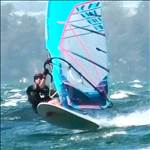
I just got a Isonic board and its the first slalom board I use. I found that it goes way faster if i put as much mast pressure as possible. To do so, I end up clamping with my entire body and require to bend my arms quite a lot to pull the boom down with elbow pointing down. Its quite demanding but it goes faster than if I just sit in the harness with extend arms somehow. Is there a setting that I overlook that would do the same but using the harness and get a more relaxed stance? One thing I need to mention is my waist harness does creep up quite a bit so maybe doesn't put as much pressure via the lines as it should. Here is a link if a mate that took a footage. (I have the green/blue sail) I am on a broad reach and start to head upwind as I met him. It seems like his body position is more normal...If anyone pick something on my setup please let me know. much appreciated.
www.instagram.com/p/B7hCH3Fnqny/?igshid=riuofspgz9ao
Seat harness might help?? I don't use my isonics in chop much so others will have more up to date advice..
Cool, im kind of happy this might be the issue. To be fair I tighten my harness to the point that almost throw up and it still ride up. So maybe not a good fit to start with. I was trying to move boom and lines around but wasn't improving anything. I might try to borrow a seat harness and see what happen. cheers
Nice looking place to sail! Looks like you're enjoying the new isonic 
what length lines are you using? You might just try shortening them when using the waist harness so you can lean out without harness riding up
Sailing with your arms bent at the elbows, pulling down on the boom is a recipe for tendonitis in the elbow. As others have said, try a low hook seat harness, with 30 inch harness lines. Also try raising your boom, bend your knees, sit in your harness with arms straight, loosely holding the boom. Use your hips to pull down the boom. As you power up and fly the fin, straighten your front leg.
I find I can exert more MFP on my slalom board by moving the lines back a little and moving my body forward, I can load the harness no problem with straight arms. I use a waste harness.
Select to expand quoteWaiting4wind said..
I use a waste harness.
Did you get it cheap ? 
Select to expand quoteseanhogan said..Waiting4wind said..
I use a waste harness.
Did you get it cheap ?
Dad, get off the internet...
Select to expand quoteWaiting4wind said... I use a waste harness.
Even a poorly fitting harness is never a waste! 
The first part of the video clip shows us you are happy planing along at speed.
The second part shows us your stance -- which is not good because your shoulders are leaning in too much towards the boom.
If you thinking of a planing/blasting stance as a 'perfect 7' shape then your legs and body (when seen from the front or rear of the board) should be straight and your arms outstretched.
Your shoulders should be square to the boom but with your head turned to face more towards where you want to go.
This better stance loads the harness lines outwards, and stops any tendency for the waist harness to ride up.
What you are doing wrong is to lean/curl your upper body towards the boom, whilst bending your arms. That in turn makes you want to stick your bum out to load the harness lines.
The rig load should be on the lines, not on your arms.
This issue is very common when sailors move towards using longer lines - and they often end up thinking that 28inch lines are long when in fact most people (with average arm length) should be on 30 or 32inch lines. .
A waist harness doesn't ride up once you have the stance sorted - the pull should mostly be outwards, except when slogging off the plane, or when initially hooking in with a bigger sail.
.
I agree with the bent arms causing tendinitis/tennis elbow comment made earlier. I went from 30cm to 32cm for free riding with a seat harness and it helped stop my tennis elbow as I had straighter arms. I find a seat harness better for free riding/blasting, 6m sails and above, waist harness for smaller sails.
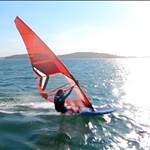
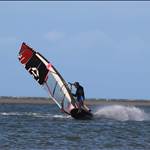
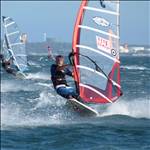
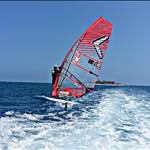
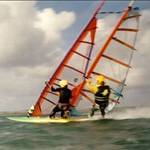
To me it looks like both you legs are a bit too bent as well, but we can only see them later in the video when you are heading upwind. Downwind/across the wind, the front leg should be straighter to power the board. Have a look at the PWA site for photos of slalom sailors. The 1st one here is from 2005, "super-7" stance as Basher calls it. Its from Fuerteventura, so fairly windy. 2nd photo from the same event in 2019. The 3rd is Korea 2019, lighter winds and larger sails, but a similar stance to 2019 Fuerte. A noticeable change in stance from 2005 to 2019, the torso is no longer in line with the legs, it is more upright. I dont know the reason for the change in stance, maybe the wider boards and larger fins these days. But either the older Super 7 or a modern stance would be preferable to bent arms and legs. The thing about comparing styles with PWA sailors is they are very good, and only sail slalom flat out in 4 minute bursts. In recent interviews I've seen, they have generally said 28-30cm lines with larger sails, 34cm lines when its howling and choppy. They all seem to use waist harnesses now, even slalom with big sails, although I think I heard Ben Proffitt say for the next Defi wind long distance event he does he will try a seat harness for prolonged sailing.
ps Nice sailing spot.
2005 photo

2019 photo

2019 photo large kit

Interesting comparison on PWA slalom pictures. Maciek Rutkowski gives some background about the "why" behind the change at easy-surfshop.com/do/blog/post/waist-or-seat-harness-maciek-rutkowski-explains-the-differences
One thing to keep in mind is that PWA slalom sailors will generally be on significantly larger and more powerful gear than someone (of similar size) who just starts out on slalom gear. The difference is easily 1-2 sail and board sizes, plus more powerful fins. This requires the stance adjustments that can be seen in the pictures Phil posted. When getting started on slalom gear, a stance more similar to the straight 7 or super-7 stance as in the 2005 picture is probably better. You can even see the PWA guys switch to a straighter stance when the wind drops, and on flatter stretches of water.
Select to expand quoteseanhogan said..Waiting4wind said..
I use a waste harness.
Did you get it cheap ?
After every session with my stomach suitably compressed I can process a lot of waste, isn't that why they call them a waste harness. 
There is a recent UK windsurf magazine interview with Sam Ross (coach) on stance which is now online. www.windsurf.co.uk/sam-ross-technique-stance/
In the pictures it looks like he is using a twin cam and an Isonic (maybe Futura, but the footstraps look too far out on the rail).
He only really mentions feet once;
More powered up, the head shoulders and hips are still in line and upright. There is more flex in the back leg, and pressure through the heels to deal with the power.
On boards with the straps right out on the rails it is easier to transfer power to the board via the feet. If you are used to wave or freeride boards with inboard straps and a flatter deck its not as easy or as comfortable to do this as there is nothing to really push against. Its something I really notice when changing from my freerace board with outboard straps on a very domed rail to my 94l freeride with flatter deck under the feet for flat water blasting.
So thats something else to think about.
OK I got offline for a bit and just noted a lot of reply. Thanks for your interest and taking time to help out.. I managed to sail 5 days in a row with that exact kit in pretty steady conditions. The first thing I did the next day is to spend one more minute fitting my harness and it hardly came up. I soaked it with water and also made my wetsuit wet around the waist. Tightened everything where I wanted it to be and it worked very well. I can now comfortably load the harness and extend my arms. I was more careful not to load the harness too much when below the boom and try to keep the boom away. I also changed my front hand from over grip to undergrip. It really relaxed my posture. The last sail I had was in 18-20kts. I had to switch back to a overgrip and use my arms more, not just sitting in the harness. I got tired much faster but also going much faster too. I also extended my lines by 1 in. I think I can extend them more but happy to go 1inch at the time at the moment.
On a different note, I feel that there is no one technique to windsurf is the best. It seems that all pros have different opinion. And then you have conditions, body shapes, gear... Jem Hall want you to power up out of a jibe with clew first. For other (most) its a big no. Sam Ross want you to keep your front hand next to your harness lines. Check out the PWA boys on the pictures above...Harness lines way back and frond hand much forward. Look at Albeau's front arm. Its hurting my tendon! And funny in that clip, my position was all wrong, I was still faster than my mate who had a much better posture. I am certainty not arguing with any comments and advices I get from much more experienced sailors, but I still find it interesting that there is still so much variety in technique and what people believe work the best. It certainly make the sport fascinating.
Cheers again for all the great advices.
Select to expand quoteBennn said..
On a different note, I feel that there is no one technique to windsurf is the best. It seems that all pros have different opinion. And then you have conditions, body shapes, gear... Jem Hall want you to power up out of a jibe with clew first. For other (most) its a big no. Sam Ross want you to keep your front hand next to your harness lines. Check out the PWA boys on the pictures above...Harness lines way back and frond hand much forward. Look at Albeau's front arm. Its hurting my tendon! And funny in that clip, my position was all wrong, I was still faster than my mate who had a much better posture.
I think the Jem Hall gybing tips are for those intermediates leaning to do it. Once you have cracked it, if you increase your board speed into the gybe you dont need to sail clew first to keep planing on the way out. Another difference is where the feet go when you step. His technique is to put the front foot in front of the back foot and step forward so the new front foot is near the mast track (to keep the board level fore/aft). Once you have cracked the gybe, its quicker/easier to put the front foot behind the back foot and just put the new front foot just in front of the front strap. From there, it is easy to put your feet straight in the strap as they are nearer. On wide boards with wide tails, you have to put your back foot just behind the front footstrap on the rail to get enough leverage to turn the board. Putting your front foot ahead of that and you will be way too far forward on the board.
I dont do foiling, but have noticed lot of people mentioning they are very sensitive to fore/aft weight changes which can send you crashing. The good foil gybers put their front foot straight into the strap. So Jem's technique might have to be swiftly relearned for foiling. Just a guess.
I think you are right about where to place your hands on the boom, it can be anywhere within reason, as most of the load will be in the harness (or should be). My back hand is usually right next to the harness lines, front hand much further forward.
Sam Ross has just released a video on stance to go with that article I linked to earlier.
Select to expand quoteBennn said..
On a different note, I feel that there is no one technique to windsurf is the best. It seems that all pros have different opinion.
Not really. You have to understand the context of the suggestions and actions fully. Like Phil explained, sailing out of the jibe clew-first is something that many pros teach anyone learning the jibe, while the sail is flipped earlier once they can keep speed. If you learn to jibe at a fast flatwater spot, you can even skip the clew-first part. If you sail at a very windy and choppy spot, you may keep doing clew-first jibes for a long time, or go to sail-first jibes rather than step jibes. If you see differences in the teaching, it is often a result of mostly teaching in one specific set of conditions that favors a certain technique.
To give an example: one of the best all-around windsurfers and windsurfing teachers I know has a strong preference for a straight 7 stance. Every time I have giving him my gear for a couple of runs, his top speed from those runs was faster than my speed the entire day, so this clearly works for him. When he did slalom races in high wind and chop, he went really fast .. until he totally blew up (repeatedly). There's a limit to what can be done with a straight stance, and no amount of skills can get around that limit. At some point, a technique adjustment is necessary. If you watch the stance of top PWA guys in races, you can see them adjusting their stance quite often within a race to adjust to the conditions.
Select to expand quoteboardsurfr said..Bennn said..
On a different note, I feel that there is no one technique to windsurf is the best. It seems that all pros have different opinion.
Not really. You have to understand the context of the suggestions and actions fully. Like Phil explained, sailing out of the jibe clew-first is something that many pros teach anyone learning the jibe, while the sail is flipped earlier once they can keep speed. If you learn to jibe at a fast flatwater spot, you can even skip the clew-first part. If you sail at a very windy and choppy spot, you may keep doing clew-first jibes for a long time, or go to sail-first jibes rather than step jibes. If you see differences in the teaching, it is often a result of mostly teaching in one specific set of conditions that favors a certain technique.
To give an example: one of the best all-around windsurfers and windsurfing teachers I know has a strong preference for a straight 7 stance. Every time I have giving him my gear for a couple of runs, his top speed from those runs was faster than my speed the entire day, so this clearly works for him. When he did slalom races in high wind and chop, he went really fast .. until he totally blew up (repeatedly). There's a limit to what can be done with a straight stance, and no amount of skills can get around that limit. At some point, a technique adjustment is necessary. If you watch the stance of top PWA guys in races, you can see them adjusting their stance quite often within a race to adjust to the conditions.
I guess this is in line with my comment. Perhaps when Instructors put up tutorial videos online, they could put more emphasis on the context. I would find that helpful. I am still super grateful that instructors are happy to share videos of their technique for free basically (minus couple of adds). But too often it appear like a must do technique every time all the time. It might be my interpretation of it.
Select to expand quoteBennn said..I guess this is in line with my comment. Perhaps when Instructors put up tutorial videos online, they could put more emphasis on the context. I would find that helpful. I am still super grateful that instructors are happy to share videos of their technique for free basically (minus couple of adds). But too often it appear like a must do technique every time all the time. It might be my interpretation of it.
One of the first principles of good skiils teaching to to 'Keep It Simple'.
One does not want to give the student too many instructions or learning points at once, or they won't know what to focus on and wil be confused.
Context, subleties and adjustment follow later when the basics are established.
There are basic priciples that drive what is most efficient. Around those basic priciples there are many adjustments and subleties that are learnt and made according to the many variables of equipment, conditions and discipline.
Using analysis of forces and their application, one could come up with an ideal stance for speed in the perfect set of conditions. But conditions are never perfect or constant and compromises have to be made for control and lots of other reasons. That is why perspectives and emphasis on skills varies.
Select to expand quotesailquik said..Bennn said..I guess this is in line with my comment. Perhaps when Instructors put up tutorial videos online, they could put more emphasis on the context. I would find that helpful. I am still super grateful that instructors are happy to share videos of their technique for free basically (minus couple of adds). But too often it appear like a must do technique every time all the time. It might be my interpretation of it.
One of the first principles of good skiils teaching to to 'Keep It Simple'.
One does not want to give the student too many instructions or learning points at once, or they won't know what to focus on and wil be confused.
Context, subleties and adjustment follow later when the basics are established.
There are basic priciples that drive what is most efficient. Around those basic priciples there are many adjustments and subleties that are learnt and made according to the many variables of equipment, conditions and discipline.
Using analysis of forces and their application, one could come up with an ideal stance for speed in the perfect set of conditions. But conditions are never perfect or constant and compromises have to be made for control and lots of other reasons. That is why perspectives and emphasis on skills varies.
Very true. I think we are all in agreement.