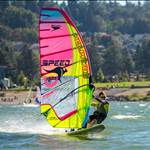
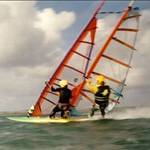
Recently scored a really nice F2 Thommen 285 from circa 1996, and was interested to know a little more about it.
The description of this model in the brochure in the link below suggests it was designed for windward/return courses, and the smaller models like 270 and 275 were for downwind racing:
www.windsurfing33.com/forum/viewtopic.php?p=755781
What style of courses did they use these boards on ?
Did the modern formula boards evolve from these early course racing slalom boards?
Yes these were the course boards, pre Formula. The course was first a upwind leg and then a downwind M , twice around.
i myself used a Drops 9'6/2.
Thanks. I had a break from sailboard comps from 1996-2016 so just filling some gaps 
In the 80's we sailed PanAm style raceboards around an M shaped course (min wind was 12 kn I think), and raced wave slalom boards in the surf usually on a downwind course.
By the mid 90s there had been quite a bit of improvement in board, sail and fin design. I suppose these improvements allowed slalom boards to go upwind better, and enabled them to compete on an M course with enough wind.
The brochure mentions that the larger and wider 290 model was developed for racing in 8kn min wind limit.
I suppose over time this would have led to larger volumes, wider boards, and larger fins.
I understand Formula boards were introduced in early 2000s.
What triggered the move to a 1m wide formula board, with 70+cm fin, and 12.5 sails?
Was it a change in course format from M course to windward/return courses?
I'v got the same board in Mint almost unused condition.
Built for Dunkerbeck as his racing board.
Awesome
In '97 Swein Rassmassen dropped by our shop to borrow a rig from me to sail at Berkeley. SOA then were Mikes Lab course slalom boards of 68 to 72 cm width.
His Sonic was 75, with an ultra wide tail. I laughed, and later found out he blew the fleet away with my rig. Laugh was on me, what did I know?
What's that got to do with an F2? If your gonna name drop try and spell his name right.
The F2's were mega fast and were the most desirable boards back then. The earlier F2 Sputnik 270 was the worlds fastest production board, as most of the slalom crew used customs, not many really brought off the shelf boards. I reckon cut the nose off it so it fits in your car, strap on a gps, (on your arm) and fang past dudes on modern boards.
I sold my old Thommen 295 for a carton. Wish I didn't now!
The 285 is 110lt, pretty narrow with long nose. Modern slalom boards have very different volume distribution. It feels strange to sail it for a while then swap to a more modern wide board with short nose. Modern board does pop onto the plane easier, and plane out of gybes easier. But the Thommen is still pretty fast, and great build quality. Would be interesting to see two top level sailors compete on old and new gear.
I think I know the bloke that wrote that article, good looking young fellow...really fast!
Thanks for posting the article. I'm a big fan of Thommen boards. His CrossX is still my favourite board. Great shaper.
Worked at a F2/Mistral dealership, and had 265, 270's. 275, 280, and 295 for course racing. Plus Axxis 262, 272, and Waves 250 and 254.
But this thread also concerns the HISTORY of course racing on short boards, so Swein and Starboard get credit for the 1st production competitive course racing board.
Not a out ME, but about when I first saw the W75, about 7 months before it was introduced at the AWIA trade show in Orlando.
The comment from the Tiga designer that the "only problem came when the reaching legs were too low" is interesting. Today's raceboard and formula courses are mostly windward/return where optimum downwind VMG is attained through deeper angles.
In a recent club race a good (PWA level) Slalom sailor on a 133 isonic/8.6 reflex tied with myself on a raceboard (phantom 377) in 15+ kns. If the course would have been an M course, he probably would have been miles ahead. It appears that even modern slalom boards can't achieve much better VMG around a windward/return course compared to a raceboard, and their optimum wind range is much narrower.
Have had some interesting mixed sailboard fleet racing at our club this season with Raceboard, RSX, Formula, Foil, etc. The club applied a mixed board yardstick to rank the different boards. It has been interesting to see how the various board designs compared when racing around a course in various weather conditions. results.rqys.com.au/otb1718/SGrp61.htm
Raceboards still prove to be the most consistent performer across a wide range of wind conditions. While the Foils, Formula and even RSXs had their good days they were not as consistent overall.
Still, in 10 knot minimum course, kitefoil foilers win by huge margins over Formula foilers who are close to kite board riders barely edging out Formula sailiors who all destroy big slalom riders on fin or foil.
Raceboard results depend on power around the course and sea state. Skills being similar.
The Foils and Formula needed min 10kns to go upwind, Foil achieved much better angles. When wind strength dropped below 10kns they both struggled to get around the course. Then over 20 kns tws they also require good skills.
Haven't had any kites racing.
That's why most courses have a wind minimum.
Foil kites are used for their upwind angles and lower wind minimums over inflatables.
Erik and Hughes were pretty clearly the first to be competitive on a course slalom board as far as I can recall, as in KR's article.
I wonder if most courses do in fact have a wind minimum? I looked into it years ago and back then hybrids and longboards were more popular in terms of the number of regular racers around the world. It's probably still the same.
This article came up in another thread recently.
In the early days of course-slalom boards, these adjustable fins generated a bit of interest.
It was at the time when fin design in general was advancing very rapidly (prior to this the biggest slalom fins were not much over 30cm deep). There was a very detailed article in the UK magazine at the time looking at the design of depth adjustable course slalom fins. One of the big issues was sealing the sleeve where the fin slides through the deck to prevent air getting in and hence spin out.
Same writer again, he seems to have gotten around a fair bit...wonder what happened to him!
I remember this article from back then,
It also struck me that the text seems to describe an adjustment system that is not shown in the photo. The photo seems to be just a simple foot strap to lift the fin directly. Did they publish the incorrect photo Roo? Do you have a photo of the system described?
It seemed like a great idea that was not further developed, I am guessing that there were problems were too hard to solve?
Bard sailed out of Berkeley Ca. and his first proto's were around '91. Staying in downwind mode was always a problem. Upwind worked pretty good, but advent of 42cm and wider tails used 42 cm fins..which worked for up or downwind sailing. Downwind angles are usually "as LOW as you can go" so less need for smaller fins.
Select to expand quotesailquik said..
I remember this article from back then,
It also struck me that the text seems to describe an adjustment system that is not shown in the photo. The photo seems to be just a simple foot strap to lift the fin directly. Did they publish the incorrect photo Roo? Do you have a photo of the system described?
It seemed like a great idea that was not further developed, I am guessing that there were problems were too hard to solve?
That's the correct photo for Bard's board. Patrice was using the adjustable system with pedal, have a photo buried deep in the archive...don't hold your breath on me finding it soon! There was also a system with adjustable fin angle Peter and I developed but we underestimated the load and snapped the shafts fairly regularly. Then there was the carbon honeycomb hollow board (still have one of them in the storage container) we did and..........