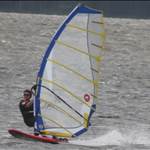
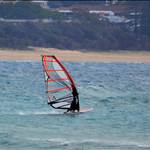
Now, from the looks of things this is a very common question but i want to know what size board to get.
I weigh 75kg and I've been windsurfing since december last year since i acquired and old (1985'ish) long board and a sail that could predate the dinosaurs. Heavy, floaty gear that was good to learn on but now i have bought myself an 80L slalom board that came with: 4 cambered sails (4, 5, 6, 6.5 m^2), carbon mast and boom. ($200)
I have never even attempted a beach start before with my dinosaur board i have only up hauled it.
How steep is the learning curve for water starting on such a small board and with the cambered sails?
Will i be able to teach myself to water start on the slalom board or will i need lessons?
Should i buy a bigger board to learn on?
Any help would be much appreciated.
Moose.
very steep learning curve.
lessons would help.
you should get a bigger board.
Short and sweet moose. good luck.
While learning to water-start ideally I would still like to be on a board I could uphaul just in case. Down to an 80L board is a pretty big jump.
Learning the art of water-starting varies person to person but generally takes a fair amount of time to get it all sorted. Cambered sails are the hardest to water-start so may be worth investing in 1 general size free ride sail to hone the technique before trying to fly and water-start a race sail.
Lessons are great and a mate to point you in the right direction is very handy, youtube videos are a great tool. Start in shallow water and work up to it.
Agree with the above and also - cambered sails are hard enough for experts to water start don't even think about it.
Given the great price, keep it all! Just maybe try for a 120L ish freeride board and a wave sail of about 5.5m
yep board waaaaay too small
you want to get planing, you want to learn beach starts and water starts and get used ti getting into the footstraps
all of which you can do on a 120ltr board (including uphauling)
i am 75kg and use a 121ltr in light weather up to about 12-17 knots, it goes really fast and i can uphaul on it if i need to, waterstart and beach start
get the right board and you'll keep it when you're ready for a smaller one (I reckon around 100ltrs next)
Mark is correct about cambered sails being harder to water start, but the 4 and 5 shouldn't be too bad.
If you have somewhere to sail where you don't get out of your depth, and enough wind to get planning on the 4 or 5, then it would be vaguely possible to learn to beach and water start, especially if you're young fit and keen. But I wouldn't advise it unless there's somebody there who can tell you what you're doing wrong, because it's fairly counter intuitive. Marks suggestion of a bigger board and uncambered sail will be much easier.
I have just learnt to beach and water start I'm no expert butim on my way beach starts were probably harder because there was no way to cheat I just tried them for 5-10 min every time I went out about 20 times,for deep starts I burried a bucket on the waters edge and tied a rope from it to the tail of my board,about 15 m long,then I was able to sit on the bottom and learn how to steer my rig and board.it seems to be mostly about flying the sail in a controlled manor.once you can do that the wind will pull you up easy.hope this helps
I like the idea of an anchor while you learn board/rig control, I haven't seen that before.
Why are the cambered sails harder to water start? Is it the fact they fill with water in the 'pocket' bit next to the mast or is it something else?Select to expand quotedecrepit said..
Mark is correct about cambered sails being harder to water start, but the 4 and 5 shouldn't be too bad.
If you have somewhere to sail where you don't get out of your depth, and enough wind to get planning on the 4 or 5, then it would be vaguely possible to learn to beach and water start, especially if you're young fit and keen. But I wouldn't advise it unless there's somebody there who can tell you what you're doing wrong, because it's fairly counter intuitive. Marks suggestion of a bigger board and uncambered sail will be much easier.
I am young and im keen :P I live 5 minutes walk from the yacht club at swan bay (shallow everywhere) you can stand up anywhere in swan bay except in the middle on some of the deepest channels at high tide.
I was thinking that seeing as i got the kit for so little that another, larger board isn't out of the question at all. Is around 100-120L ok?
And would i definitely have to get some uncambered sails to water start?
Anyway, im going out to day, there seems to be a pretty good 20knt NW. I'll tell you how it all goes later.
Moose.
Cambered sails are not suitable for a beginner. They are heavier. They are harder to rig. They have a stiff foil so change tack with a bit thud. This is all apart from the fact they are generally harder to water start or uphaul. Of course there are cammed sails and there are cammed sails. A wide luffed full on race sail is quite different to a single cam free ride sail.'
Have fun today.
Hey Moose, 120 litre will be a great size- assuming it's the newer wider / shorter style. I weight the same as you and use my 110 litre (Futura) 80 percent of the time, and a 136 litre (Super Sport) the rest. They may be "big" boards but they're fast and fun- and quite forgiving and very stable. Those old boards are hard work, very unstable and will definitly slow your progress. An 80 litre board will stop it! Hunt around a 120 litre freeride (Starboard Carve, Fanatic Hawk, JP All-ride etc) and you'll progress much quicker- and have a sweet board for bigger sails (6-8 metres) for the light days later on.
Put in plenty of hours at shallow locations with steady wind and you'll go forwards in leaps and bounds. Have fun and don't be affraid to ask lots of questions. 
Cheers
Select to expand quoteTheSailingMoose said..
Anyway, im going out to day, there seems to be a pretty good 20knt NW. I'll tell you how it all goes later.
Moose.
Let us know. I'm curious if someone can actually learn faster by being thrown in the deep end. And you surely are in the deep end.
Learn to body drag first. That is drag yourself around in the water under the sail, without stepping onto the board. Do this until you can comfortably go as long as you like (although you'll get physically tired).
This will teach you excellent sail control. This will make it a lot easier to do everything else.
I was going to teach a friend this way but never got around to it. He can snowboard, water-ski, etc. etc. really well. I thought that, perhaps, he'd be planing and in the straps very quickly using this method; skip uphauling completely.
I think you should get a bigger board and keep the sails. Will make learning a lot easier. The 80 will only be good for windy days, even when you're an expert, so you need a light wind board. Cammed sails are actually easier in strong winds.
Reports from the field:
Been out for 4 hours D: my arms/legs/entire body is fairly tired.
Went down to the yacht club. Starts raining. Oh well, i set up my 5m anyway. As i finished setting up the rain cleared so i got out on the water.
Beach starting is something i had never done and i figured it was probably the stepping stone to learning about board control and spinning the board by putting pressure on the mast.
Sure enough, rookie error, i didn't go out deep enough to account for my weight and immediately sunk the fin of the board into 10 inches of mud when i tried to beach start and didn't go anywhere.
I got out a bit further and after some wrestling with the sail i worked out how to change the tack that it was on by pushing the board to the left or the right of me (still downwind though) and letting the sail flip over. (It did take me ages to work out that). Getting into slightly deeper water and finding a bit of hard sand amongst the mud i managed to get up onto the board and sailed for about 10m before i realised i had no idea how to get back apart from swimming so i dropped the sail and swam/walked it back.
I kept up this for maybe half an hour. Getting up on the board, sailing for a very short distance then dropping the sail, turning around and stepping back onto the board to come back.
Beach start *tick*
I thought i might be able to launch of the closest sandbar so i sailed out to it, but this proved a little bit disastrous as the mud was knee deep and i couldn't get out of it to get my feet up on the board. Swam back 50m to the club. :\
The wind started to drop off a little bit so i changed sails up to the 6m had some lunch and went back out to try properly water starting. I was trying to water start like i was trying to beach start (ie. I was doing it completely wrong), and it didn't work at all.
I finally managed to get the sail in the right place but didn't quite make it out of the water but still was being pulled. I now know this is kind of body drag.Select to expand quoteevlPanda said..
Learn to body drag first. That is drag yourself around in the water under the sail, without stepping onto the board. Do this until you can comfortably go as long as you like (although you'll get physically tired).
This will teach you excellent sail control. This will make it a lot easier to do everything else.
I worked out that to get up properly onto the board i need to have my feet on the board and tuck my butt up to the board/feet once the sail is in the air. I did manage to water start quite a few times and was sailing back and forth (no turning at either side of the channel just getting off, turning the board around and going back).
Some mistakes i'm pretty sure i was making at the start.
-Not tucking butt in to the board to get up and being body dragged as a result.
-Not putting feet dead in the middle of the board (for water start and beach start) which resulted in the board tilting, turning up wind and losing power.
-Making sure the sail is balanced so the board doesn't turn once i get going (its in a different spot to my old longboard and i keep turing it upwind
So i can water start now with a moderate degree of difficulty in water where i can only just touch the bottom. :)
Apart from that the board is very unstable off the plane but i can stay on. I think i may have gotten it planing but i had to stop otherwise i would have hit the sandbar. Hopefully we'll get some northerlies soon and i can crank along the channels without running into the sandbars.
Side note 1: HOLY COW THAT BOARD GETS GOING FAST!!! :D
Side note 2: How do i get the board going more up wind without a centreboard? It has a big tendency to go downwind.
tl:dr - I got up from a water start and beach start with a 6m sail after 4 hours of trying. Some tips for going upwind would be helpful.
Select to expand quoteTheSailingMoose said..
tl:dr - I got up from a water start and beach start with a 6m sail after 4 hours of trying. Some tips for going upwind would be helpful.
On an 80l slalom board with a cambered 6m sail.
Based on the mistakes you listed I recommend another half an hour of body dragging. 
Also take the fin off your board and attach the rig to it. Play around with the sail on land, with a bit of wind. Get really, really familiar with it. Learn to flip it. Try duck gybes, anything. You want the sail to be an extension of your body. Keep practising the sail flipping you were doing; that's gybing!
Alas I can't recommend much to get familiar with the board 'cause I grew up with small boats and surfboards and water-skis and such so the board was always kinda familiar to me.Select to expand quote
Side note 1: HOLY COW THAT BOARD GETS GOING FAST!!! :D
Are you planing? No! Surely not.
Yes they do. Especially the slalom boards. I might get one.Select to expand quote
Side note 2: How do i get the board going more up wind without a centreboard? It has a big tendency to go downwind.
If you think about it everything in windsurfing is done with your body; its position and they way it leans. It's pretty cool I think.
You go where you look. If you try to "project" your body in the direction you want to go the rig and board seem to follow.
You want to kind of lean forwards (I want to say "around" but that seems odd). I think I'm likely in front of the mast when really pushing upwind (on FreeStyleWave gear, not screaming on a 50cm finned slalom board).
Hmmmm. Around. Imagine you're a stripper on a pole, and to your left someone is waving some money to put down your top. While still holding onto the pole with both hands how far "around" can you lean towards that cash. The movement is something like that.
Note that you probably want to build a little momentum first, so point downwind for a few seconds first, to get going.
Select to expand quoteevlPanda said..
Based on the mistakes you listed I recommend another half an hour of body dragging.
Also take the fin off your board and attach the rig to it. Play around with the sail on land, with a bit of wind. Get really, really familiar with it. Learn to flip it. Try duck gybes, anything. You want the sail to be an extension of your body. Keep practising the sail flipping you were doing; that's gybing!
Thanks for the excerpt from Cool Runnings 
I did play around a bit to get familiar with the rig on land. I was so worried that i was going to break something though.
It was really good though to get familiar with how the sails felt as compared with my old batonless triangle sail. Cambered ones are so much more stable and SO much more powerful.
For the planing, i may have, i don't really know at this point. The board was just pushing through the water and really unstable then the nose dropped and it kind of 'rose up'? It took off like a bloody rocket i almost fell off the back. But then because of the sandbar i had to stop.
Can you gybe off the plane or do you need to be planing to carve the board into the gybe?
EDIT: Thanks for the tips on going upwind, now that i think about it, it just makes sense that everything about windsurfing is done with your body.Select to expand quotepowersloshin said..
I think you should get a bigger board and keep the sails. Will make learning a lot easier. The 80 will only be good for windy days, even when you're an expert, so you need a light wind board. Cammed sails are actually easier in strong winds.
I definitely agree with all of this. I think that getting a bigger board that i can uphaul on would be good for going further afield if the wind drops out. I would also want a board that can cope with chop and swell (I'm not sure what a board needs to be able to deal with that) for going out on Port Phillip bay.
Moose