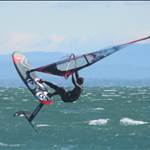
Making a shallow water fin for my big sails because you cant buy one.
Modelling between a Drake shallow water fin and a Black Project FreeDelta RE fin.
Not for weed.

Start with a sheet G11 ( one more than G10 ??? ) 250mm x 350mm x 12mm thick. ( 2kg ) !!!

Build up thickness for powerbox ( 16mm )


Tight as a fishes ass !

Shaping the foil.

Done !
Will it work ? , id give it a fifty fifty .
Final size , 30cm high , 19cm wide.
1.1kg
Will test this arvo.
Perfect test complete.
Gusty 10 to 20kts
NP slalom mk3 ' 9.5
Surprised , overall happy considering I have no idea about fin dynamics.
More than enough lift , fast , turns good enough and goes upwind well.
Only gripe , I have to be gentle on my back foot pressure or it will occasionally spin out but it's easy to pull back in. I do like pushing on a fin with gay abandon to get that boost in speed but with this fin I have to lean more forward and use the rail. Not as fast as a slalom fin but not bad and I'm in shallow water without catapulting 
Im happy considering no one really likes shallow water fins.
Total cost $100 , 10 hours. << that's a chuffed face.
Cool!
Tell us more about the construction, I assume that is not CNC, but Imax1 behind the controls of some king of lathe?
What is the average weight for a classic 30cm G10 fin?I was surprised with the 1.1 Kg.It looks like a giant freestyle fin by the way
Love the give it a go attitude,
Small price, a bit of time, a great outcome!
Proving that you never know until you try
Keep up the mad scientist work
Awesome!!!
A foil with a slightly larger radius on the leading edge may have less tendency to let go.
Where did you buy the panel from??
Awesome!
How did you shape the head so cleanly? CNC?
Where did you get the G11 slab?
I got the panel from a local supplier in melbourne $80 delivered ( ill give details in a couple days ,im away ).It is G11 , better than G10 im told . I dont know how fast , no gps. Its a manual milling machine , no cnc , thats over my head , i still use a flip phone. I clamped a fin to the machine table and clocked up the angles for the machine head ( cant go wrong ) the powerbox fit was almost perfect only had to sink it half a mm. The leading edge is quite dull and im scared to modify it. It only let go when backhand overpowered and pushing hard over chop. The drake shallow fin has a scallop cut out at the trailing edge at the base , wonder if that may help ?
G-11 and FR-5 (G11 with bromine to act as fire retardant) have higher operating temperature and improved strength at higher temperatures than G-10and FR-4.
But we are talking 140*C to 148*C so basically irrelevant for windsurfing. Down side is bond strength is reduced about 20% (so maybe G10 better than G11 for fins) but other than that they are identical in properties according tohttp://www.plastic-products.com/Laminate G10 G11.htm
(NB redirect from seabreeze does not work but link still good. I think it is because of space after laminate)
I like the idea of adding some thruster side bites, they could be smaller than the main fin and allow you to take some more off the main fin. This is what I'd consider after reading your first try on the water. I'd cut the tip off at the line shown below, cut it parallel to the base of the fin, that way you'd be getting rid of that angled trailing edge which is creating additional turbulence, which adds to the fin wanting to spin out. Really good job on the foiling, it looks very professional.

Select to expand quoteMastbender said..
I like the idea of adding some thruster side bites, they could be smaller than the main fin and allow you to take some more off the main fin. This is what I'd consider after reading your first try on the water. I'd cut the tip off at the line shown below, cut it parallel to the base of the fin, that way you'd be getting rid of that angled trailing edge which is creating additional turbulence, which adds to the fin wanting to spin out. Really good job on the foiling, it looks very professional.
The top of the fin is parallel with the base , its just the angle of the shot.
Select to expand quoteiMax1 said
The top of the fin is parallel with the base , its just the angle of the shot.
No it is not . The leading edge is raked and the base is 90 degrees to that. But I wouldn't take anymore off the length. Studies have shown that a tapered tip which is about 40% of the root chord length gives a good approximation (ie is not much worse than) the much more complicated elliptical spitfire planform. As most of the induced/vortex drag is from your long chord tip all you need to do is nip a bit off the bottom trailing edge to shorten the tip chord.
Yes the tip does look to be square to the leading edge. But judging the foil by the light shinning thru the fin, It looks like the foiling is parallel to the base not the head. So there shouldn't be too much turbulence there.
Depends how close the rear of the fin base is too the back of the board, as to how much a rear cut out is needed, it's a matter of air getting sucked back to the fin causing ventilation.
Have you looked at the Fangy fin thread?
I've found his fillet idea helps my highly raked low aspect ratio fins, makes them much more solid, before they were as you describe too much back pressure and they just let go.
The addition of the fillet changed them completely.
It would be very interesting to know if the idea also works on a low aspect upright fin as well.
My theory is, that with low aspect fins there is more water flowing from base to tip than on a high aspect ratio fin. When the water crosses the board-fin junction it creates a low pressure area. There's a vid on fangy's thread showing cavitation bubbles at a similar junction between a hydro foil and it's strut. The fillet fills in this low pressure area. But that's only my supposition, and I suspect this effect is more likely with a raked than an upright fin. So please do it, you may be very pleasantly surprised by the difference it makes, and will give us more data about what's going on here.
Id hate to spoil your fun Mastbender and yoyo but the top edge is absolutely and exactly parallel to the board not square to the leading edge. The top edge is untouched as the panel mounted to the board pic . It is a crazy optical illusion , promise  It is also more upright than it appears in the last pic. I will post another pic directly side on view tomorrow. I took the shot with light behind it so it would show the foil shape. The whole length is foiled parallel to the leading edge and the rear top half 90 degrees to the board. You can see this in the pic where I'm cutting it on the mill. My thinking was that it tapers the thickness on the top half. The position back to front compared to the powerbox was determined from a drake shallow water fin ( which has a base cutout ) with equal overlap front and back. That was a stab in the dark. It does feel directly under my back foot ( even a little in front , a bit strange but I kind of like it ) , but not like a weed fin feeling like its hanging out the back. Mabee that's why it goes good upwind ( not like a weedy ).
Still thinking of cutting a scollop out the rear at the base to reduce fin width at the board.
Any more ideas on this before I start hacking into it ? I'm scared !
Select to expand quoteId hate to spoil your fun Mastbender and yoyo but the top edge is absolutely and exactly parallel to the board not square to the leading edge. The top edge is untouched as the panel mounted to the board pic . It is a crazy optical illusion , promise
Now that is just embarrassing (on my part)
I have to apologise for my whacko photography. I try to get in close but it obviously gives it a fish eye view . I should stand further away and zoom in. I believe this to be " parallax error ". Hows that for a tekko word and that !
It is also obvious in the milling pic . The top half of the trailing edge of the fin is square to the mill table although the bottom half looks so.
Hey eyes been an engineer not a photografist 
Honestly I'm disappointed you didn't sail it like this first. Aerofoil profiles is probably just marketing wank from windsurfing companies to sell more fins! Select to expand quote
Select to expand quoteswoosh said..
Honestly I'm disappointed you didn't sail it like this first. Aerofoil profiles is probably just marketing wank from windsurfing companies to sell more fins!
Hey I thought about it,
laughed on the inside.....
then said naaaaaa !
Select to expand quoteImax1 said..
Any more ideas on this before I start hacking into it ? I'm scared !
I would consider a very small tapering of tip, and the fillet idea suggested by decrepit, I would try the later first.
I think both these are related because with a fin like that, very low aspect, and nearly square (maybe... ). You will not have a even distribution of pressure changes across the span, in particular that shape is likely to influence the loading in the area closest to the head, so cavitation, ventilation, maybe the issue...
Bear in mind my practical experience is limited to sanding fins But I would be careful not to loose too much area as you may make the fin unusable for the purpose it's intended.
Select to expand quoteImax1 said..
Id hate to spoil your fun Mastbender and yoyo but the top edge is absolutely and exactly parallel to the board not square to the leading edge.
Nothing was spoiled for me, because I wasn't trying to have fun, just commenting upon your request, but the picture appears to be different, and I will believe it's an optical illusion if you say so.
Select to expand quoteMastbender said..Imax1 said..
Id hate to spoil your fun Mastbender and yoyo but the top edge is absolutely and exactly parallel to the board not square to the leading edge.
Nothing was spoiled for me, because I wasn't trying to have fun, just commenting upon your request, but the picture appears to be different, and I will believe it's an optical illusion if you say so.

A more proper angle.
Select to expand quoteImax1 said..
I got the G11 from:
Insulcut Sevices
Thomastown VIC
( 03 ) 94663033
Thank you.
Select to expand quotewaricle said..
Hey imax1, you didn't say how well your fin works. Did you add a fillet?
It works great , very happy. I haven't cut the fillet yet . It turns surprisingly good.
It only spins a little on my 8.7 and 9.4 when im over powered , on smaller sails its fine.
I will cut the fillet , im just a little slack in that department because it works quite good as it is.
Ill copy the cutout on the pictured Drake fin.