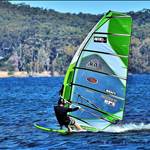
Like a plane wing, designed to have less drag and more lift on the prefered tack.
They can be extreme at places like Luderitz where you don't have to sail back.
I make mine much less extreme because where I sail you have to tack back to the start.
I have my PB on a 60/40 assy.
Do most speed sailors favour a particular tack when bearing away on a normal symmetrical fin ?
Select to expand quotejn1 said..
Do most speed sailors favour a particular tack when bearing away on a normal symmetrical fin ?
Yes.. The fast tack 
^^^
1990, 30kn
2000, 40kn
2022, 53kn
and yes they are stoopid rough guesses its all the little things
It's actually the asymmetric nads that cause one tack to be faster than the other
case in point, I'm slightly faster on port tack than starboard tack. And on a cold day I'm not very fast on either tack.
Come to think of it, I'm not actually very fast at all
Select to expand quoteImax1 said..
How much difference do these fins make ?
On any tack/run, the fin needs to angled at a few degrees so that some lift is generated so that it can counteract the sideways pressure of the sail. ie: for a given sail+wind, a small fin needs more angle of attack vs a big fin wont need much angle. The more angle of attack, the higher the drag. The board thus needs to also travel at a few degrees off dead-ahead - this causes some extra drag.
On the speed-run an assy-fin will naturally have more lift on that speed-run-side, so the board can then be set closer to zero-degrees ahead (the "camber" of the fin gives a close estimate of the number of degrees that you can straighten up).
You could just use a fin which has high-lift on both sides. However on that speed-run, the other side will be creating more drag.
To try to put those "more drag" and "more lift" statements into context -> lets assume we have two identical fins with the only difference being that one is 20cm and the other is 18cm. Given all other things being equal (wind, water, etc) the 18cm will be say 1-2kn faster ( at 40+kn ). Thus a similar generalised statement can be said for "slightly-assy fin will be faster than the same non-assy fin". ... but remember -> there is always more to going faster, than just having an assy vs non-assy fin.... its more about "if you are that serious at investing so much money on gear and time on water, then you should also invest in all aspects including best fin designs".
Select to expand quoteSubsonic said..
It's actually the asymmetric nads that cause one tack to be faster than the other
case in point, I'm slightly faster on port tack than starboard tack. And on a cold day I'm not very fast on either tack.
Come to think of it, I'm not actually very fast at all
Same here.
Select to expand quotemathew said..
. The board thus needs to also travel at a few degrees off dead-ahead - this causes some extra drag..
It doesn't actually "need" to, well it kinda does but there is nothing stopping you from mounting your asymmetric fin( or symmetric) twisted in the box so that your board runs straight (er). If you believe the leeway drag of the hull to be significant. I'm not sure it is significant enough on a planing speed board.
Did do this with some f18 daggerboards as the drag of the hulls was pretty horrendous at the natural leeway angles. Worked well on them.