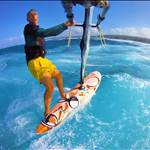
Silly question of the day: how would you add volume to a board? (Without increasing width or length.)
Place a very thick pad in the back?
Build an "outer skin" that somehow "bolts" to the top?
A combination pad + outer skin?
Any other suggestions? 
Select to expand quoteduzzi said..
Silly question of the day: how would you add volume to a board? (Without increasing width or length.)
Place a very thick pad in the back?
Build an "outer skin" that somehow "bolts" to the top?
A combination pad + outer skin?
Any other suggestions?
lose weight
Select to expand quoteLeeD said..
Full length deck pads.
Good idea but only works if the pads are submerged. Otherwise, they reduce float by adding weight - not much, of course.
You could put them on the bottom to get around this but I'm not taking any responsibility for the lack of planing performance. 
Reducing rider weight is both the simplest and possibly hardest.
Rob Rock's take
Select to expand quotePaducah said..LeeD said..
Full length deck pads.
Good idea but only works if the pads are submerged. Otherwise, they reduce float by adding weight - not much, of course.
You could put them on the bottom to get around this but I'm not taking any responsibility for the lack of planing performance.
Reducing rider weight is both the simplest and possibly hardest.
Rob Rock's take
Oh my! That's the way to do it!!!!!!!! To answer a couple of questions:
Weight loss in not an option, I am 70Kg and 172 cm tall. Almost zero fat all around, maybe I could shave off 1 Kg. ...
Why do it? Because I will soon retire my old Isonic 111 and it will be available for (probably life ending) mods.
Select to expand quoteduzzi said..Paducah said..LeeD said..
Full length deck pads.
Good idea but only works if the pads are submerged. Otherwise, they reduce float by adding weight - not much, of course.
You could put them on the bottom to get around this but I'm not taking any responsibility for the lack of planing performance.
Reducing rider weight is both the simplest and possibly hardest.
Rob Rock's take
Oh my! That's the way to do it!!!!!!!! To answer a couple of questions:
Weight loss in not an option, I am 70Kg and 172 cm tall. Almost zero fat all around, maybe I could shave off 1 Kg. ...
Why do it? Because I will soon retire my old Isonic 111 and it will be available for (probably life ending) mods.
Another take: www.facebook.com/groups/271504922974281/permalink/2358030004321752/
You can also square off the back part (add material to the sides and back deck) and make it a high wind foil board but it's a pretty big project. If you are handy you can end up with something pretty neat.
Depends on which goal you're trying to achieve. Using a lighter sail will result in more volume available for buoyancy, same with boom and mast. A bigger fin will leverage a larger sail.
Otherwise you need to add wider rails. Something you would strap on or lock on. This sounds like way more work than finding another near new jewell from the used market.
Select to expand quoteManuel7 said..
Depends on which goal you're trying to achieve. Using a lighter sail will result in more volume available for buoyancy, same with boom and mast. A bigger fin will leverage a larger sail.
Otherwise you need to add wider rails. Something you would strap on or lock on. This sounds like way more work than finding another near new jewell from the used market.
No goal in particular other than making a "bigger" board for the fun of it. Strap on rails do not work, unless you are in slow displacement. Bolt on rails can be a solution, but they are hard to engineer because they need to withstand the stress induced by max speeds of 25-28 knots. The most solid option seems to be a perpendicular or horizontal cut across the length of the board as shown above. It is true that the volume has to be "below the water line", but adding volume in the back above the water line might have a dividend simply because in displacement the back of my Isonic 111 is almost completely under water. Any addition is "below the water line". So a third option could be a bolt on "deck", thicker in the back strap area it thins out toward the front. No cutting of the board but it would be heavier than the first two options ...
A winter job!  unless I just sell the board ...
Duzzi, it sounds to me like you're ready to become a board builder. I reckon (I've just done #26) it's not much more work than Rob Rock's mods here. What a star he is, bloody clever bloke. I'm expecting him to find a cure for covid
Select to expand quoteTe Hau said..
Duzzi, it sounds to me like you're ready to become a board builder. I reckon (I've just done #26) it's not much more work than Rob Rock's mods here. What a star he is, bloody clever bloke. I'm expecting him to find a cure for covid
That is quite a video indeed! I built two boards during my windsurfing career, and changed boxes plus mods the noses of a few. But I am very far from that level of skill!
On a similar note, I have a board that I would like to remove about 4 mm of tail rocker from, so it would be zero at 400off to 4mm at the tail. What would be the best way without adding a massive amount of weight?
^^ Vac on 5mm corecell then sand it from tail down to nil at 400, glass over.
200g.
(in practice its not that easy, thats the very short version)
The issue is then your fin sits low so you may need to shim it up to be ideal.
Select to expand quoteMark _australia said..
^^ Vac on 5mm corecell then sand it from tail down to nil at 400, glass over.
200g.
(in practice its not that easy, thats the very short version)
The issue is then your fin sits low so you may need to shim it up to be ideal.
That's exactly what I've done to my Quattro FSW95 and it's way quicker to plane
Interesting question.
But the first question back would be: What are you hoping to achieve?
here are a few thoughts:
1) Adding volume to a board does not usually help it plane any earlier if you don't increase width, or maybe length, or change the rocker line or rail shape.
2) If you just increase board thickness then the volume rating would increase but the extra buoyancy would only help a little at slogging speeds. Adding floatier deck pads seems like a lame solution.
3) Laminating an extra layer of foam on the bottom of an existing board would increase thickness, but at a weight penalty which might negate any advantage gained from extra volume.
4) Second-hand boards are relatively cheap and so why not buy a bigger (wider) board instead.
5) As already suggested, losing weight can help any sailor with early planing as that changes your weight to board volume ratio. You might also consider using a lighter rig, and wearing a lighter wetsuit and minimalist harness - to load up the board less.
6) In terms of board size we tend to look at the excess volume in litres over the sailor weight in kilos. So a typical 80kgs wave sailor will use a board of at least 85litres to give +5 extra float which then carries the rig weight. +10 is often better for marginal wave conditions as that gives positive float when slogging. For slalom sailing the sailor usually goes for +20 or even +30 to carry the heavier weight of a camber'd rig.
Great question and useful answer from Mark. For me, I have Kiteraceboard (North 69) converted to small windfoiling board, but I miss 5 - 10 liters of volume for uphauling when there is not enough wind for waterstart. I just need the 2) from Basher. I have to try to the Mark's answer.
Thought that North race board was 85 liters.
Full length double pads might only add 3-5 liters.
Adequate for 75 liter riders, but more would be nice for bigger wingers.
Select to expand quoteLeeD said..
Thought that North race board was 85 liters.
Full length double pads might only add 3-5 liters.
Adequate for 75 liter riders, but more would be nice for bigger wingers.
85 kg (maybe more, but the batteries in the scale died :). ).
Select to expand quoteMark _australia said..
Pool noodles?
But ummm - why?
I have similar idea, to add volume to the board.Quite often we may go sailing in strong wind on a sinker.
Suddenly wind drops and there is nothing we could do, to get back .
I thought about inflatable.
Something small that can be kept in the pocket, but in emergency when wind die , attach to the under the board and inflate to increase boyancy by required margin 40-50kg?
Then we could even uphaul the smallest speed board and slowly but safely return to the base.Ideal could be thin , rubber ducky material , that fit perfectly bottom of our board,.
First you slip nose of the board into pocket in our inflatable, extend to the back, secure ropes to the foot straps.
Then inflate. Or maybe you could do even more universal for most of small small boards .
Similar design with front pocket , but averaged width 40-50 cm and 5-10 cm depth, length ~ 210.Whole process should take only few minutes, but save hours of trothing , swimming in the water.