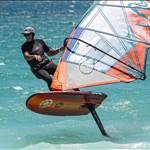
Hi guys, just got my i99 and mounted it on my Wizard 150L 2018 (Green Model with deep tuttle).
Its with the 48 rear wing and the 78 fuse.
Let me say that I just started foiling with the i76 in B (arrow pointing forward) and it works out pretty well. However, still want more :-)
And here comes my assessment - hope someone will benefit and can ev. answer some of my questions at the end.
>> Also consider that Slingshot insists the i99 works only on the new Wizard boards with the rails on it.
Below pics: the Front Wing is always on the LEFT side.
I mounted the mast first in C Forward as shown below:

That did not work right. I was not able to lift the Foil out the water. Seemed to stick.
So I went back to shore and remounted the whole thing to: C backwards (means the arrow pointing to the back).

That actually did work out. The foil came out the water and I was able to foil flying quite a while.
Unfortunately as soon the wind picked up a bit, gusts and so on, .... the foil became very bitchy!
I think that this position is giving the foil an uncontrollable touch.
Mounting it on B backwards will make things worse, so I do not even try it!

To use B forward will make it stick even more than in C forward. So this I also do not need to try.

Based on above trials ... C Forward and C Backwards work.
However:
In CForward I had troubles lifting the foil out the water.
In CBackward I had the feeling the foils is flimsy or not very well controllable.
Sooo.....................
Optimally, there would be C2 Forward mid-waything with one hole drilled further back:

That is my conclusion. But before I go an drill that hole (and eventually f* up the fuselage), I wanted to ask:
1st: if someone else has done this and how are the results (is it worth)?
2nd: does it also work for you in C Forward with the green 150 board? This would mean its just my skills and it would save me some serious drilling.
3rd: Any other solution to make the i99 work for the green Wizard?
Let me know if you know :-)
Thanks.
Try C and the small rear stabilizer. The large stabilizer resists early flight.
I could not make the 99 work on a wizard but I am not the heaviest dude (75kg). Heavy dudes can make the 99 work on the wizard.
You should try shimming your rear stabiliser angle for more fine tuning. It's what every other brand does. And much quicker and easier than flipping the fuselage.
You probably only need to adjust in the range of 0.5deg if you are already pretty close to a balanced point, which depending on bolt spacing will mean a 1mm or less shim under one of the bolts. The ghetto option is just a washer.
Select to expand quoteswoosh said..
...The ghetto option is just a washer.
The ghetto option is a galvanized washer.
The hack option is a stainless steel washer
The titanium washer is a $25 optional upcharge on the premium version.
Another option would be to install twin tracks in the board, allowing you to push the 99 forward.
I use on the 125 Wizard deep tuttle mount in the C position. It works with both 42 and 48 stabilizers but I REALLY like the 48 stabilizer in choppy or wavy conditions, the control is amazing and it really minimizes the breach. I didn't notice a difference in lift between the 42 or the 48 but the control is definitely better in the 48.
DC
Select to expand quotePaducah said..swoosh said..
...The ghetto option is just a washer.
The ghetto option is a galvanized washer.
The hack option is a stainless steel washer
The titanium washer is a $25 optional upcharge on the premium version.
Nylon washer, maybe.
I use I99 with 2018 JP Hydrofoil Pro 155. If you don't care about the rear foot straps, it is totally doable with position "C". I tested it in position "D" with an extra hole in the fuse which you are thinking about. IMHO it results in some directional instability. I think it happens because the front part (in front of the mast) becomes longer than the tail with the stab.
Select to expand quoteoscardog said..Paducah said..swoosh said..
...The ghetto option is just a washer.
The ghetto option is a galvanized washer.
The hack option is a stainless steel washer
The titanium washer is a $25 optional upcharge on the premium version.
Nylon washer, maybe.
Plastic shim machined/sanded would probably be the best option once you figure out what angle you need. Similar to what a lot of the manufacturers supply with their foils
I'm a newbie and have only recently got hold of a Slingshot foil to use with my 2nd hand formula board. I've spent winter on a NP glide foil & was only able to foil with the back of the board dragging in the water.
I'I'm now using the Slingshot 78 wing with fuselage in C position and can now get the board up out of the water. Front wing is about 30 mm forward of the NP.
Some other fine adjustments worth trying before you drill extra holes in the fuselage (as well as angling tail with washers) are:
1. Move front footstraps - back for more lift or forward for control. I'm yet to use rear foot straps.
2. Move Sail mast as above.
Good luck.
I'm a newbie and have only recently got hold of a Slingshot foil to use with my 2nd hand formula board. I've spent winter on a NP glide foil & was only able to foil with the back of the board dragging in the water.
I'I'm now using the Slingshot 78 wing with fuselage in C position and can now get the board up out of the water. Front wing is about 30 mm forward of the NP.
Some other fine adjustments worth trying before you drill extra holes in the fuselage (as well as angling tail with washers) are:
1. Move front footstraps - back for more lift or forward for control. I'm yet to use rear foot straps.
2. Move Sail mast as above.
Good luck.
I've shimmed my rear stabiliser using Slotted Shims. I've shimmed for less lift, so I've got a 0.508mm thick shim under the front bolt and 0.254mm thick shim on the rear. This gives me -0.5deg reduction in AoA of the rear wing.
Shims are stainless.
You'd need to shim in the opposite order thin at the front, and thick rear. That combined with the C position, mast track all the way back, surely should get you flying.


By moving from an S48 to S42 stabilizer I'm thinking "door" has an idea of merit. The neutral point of the foil may move up to an inch forward.

Disclaimer: These numbers are based on an old rule of thumb from the 1930's on designing general aviation aircraft. They take into account wing area, tail area, and the distance between them. It's worthy to note that old school general aviation aircraft and today's windfoils operate with similar Reynold's numbers even those one flies in the air and the other in the water.
Agree with trying the 42 rear, but also put your mast track right at the back, dont use a big heavy sail, and put the footstraps as far back as they will go. With all that, on my ancient formula board the i99 just about works in C - but not ideal.
Select to expand quoteCarvstar said..
Optimally, there would be C2 Forward mid-waything with one hole drilled further back:
I have done that - drilled a hole in the fuse to move the front wing (i84) 2 inches further forward. I did that because the C position was to backfoot heavy on the old slalom board I used.
It worked well for about 50 sessions. Then, the fuselage broke at the front hole of the C mount that was empty, and between the front wing and the mast. Pretty much a "Sollbruchstelle".
I ended up spending $150 or so for a new fuse, and installing tracks in the board. Now, I have the foil mast pretty much before the tuttle box, which moves the front wing even further forward. That works nicely, and hopefully will last for more than 50 sessions.
Select to expand quoteboardsurfr said..Carvstar said..
Optimally, there would be C2 Forward mid-waything with one hole drilled further back:
I have done that - drilled a hole in the fuse to move the front wing (i84) 2 inches further forward. I did that because the C position was to backfoot heavy on the old slalom board I used.
It worked well for about 50 sessions. Then, the fuselage broke at the front hole of the C mount that was empty, and between the front wing and the mast. Pretty much a "Sollbruchstelle".
I ended up spending $150 or so for a new fuse, and installing tracks in the board. Now, I have the foil mast pretty much before the tuttle box, which moves the front wing even further forward. That works nicely, and hopefully will last for more than 50 sessions.
Good point. He should probably just spend $150-200 putting tracks in now than $150 for a new fuse later plus another $150 for a track install.
Hi Carvstar
The i99 wing is very much like a pair of shoes, no one size fits all, so you will have to experiment with fuse settings, mast base setting and foot strap locations to dial it in.
Our local foiling group weight ranges from 150 to 200+ lbs with an array of foiling boards, mostly tuttle box and one rider that has twin tracks and the i99 works for every single rider and ANY board type (Houre slant 145, SS 115, SS 125, SB Hypersonic , Horue Tiny, JP 135 etc)
I made this video after foiling the i99 for a good long while and prefer to use the W125 in position B, 90cm mast, 42 rear wing.
I weigh 200lbs. I personally felt the 48 felt draggy and quite slow in the turns, the 42 rear also feels slightly less back foot pressure.
Other foilers prefer the 48 in fuse position C.
From testing the W150 that board is more sensitive to mast base pressure, so pick a fuse position and adjust the mast base 1-2cm at a time.
Take your time and have fun trying different settings, once you hit the sweet spot, you'll be smiling all day :)
This video was the very first time on the i99.
The wind had dropped and I was using the i84, came straight in and bolted on the i99, took off it next to nothing, awesome foil wing
Hi guys, .... Thanks a bunch for all your feedback.
I understand its me :-) .... I went out yesterday and it worked well enough. Its just those damn gusty winds at our lake are so difficult to learn anything new because everything changes all the time ---- even the direction of those gusts change from one end to the other end of the lake!
But I think that shimming could improve it for me. I will explore this a bit. VERY good idea!
Select to expand quotelakeeffect said..
By moving from an S48 to S42 stabilizer I'm thinking "door" has an idea of merit. The neutral point of the foil may move up to an inch forward.
Disclaimer: These numbers are based on an old rule of thumb from the 1930's on designing general aviation aircraft. They take into account wing area, tail area, and the distance between them. It's worthy to note that old school general aviation aircraft and today's windfoils operate with similar Reynold's numbers even those one flies in the air and the other in the water.
Yea, will also try the smaller wind this afternoon.
It probably will make quite a difference for me. Thanks for the tip.
Select to expand quotelakeeffect said..
By moving from an S48 to S42 stabilizer I'm thinking "door" has an idea of merit. The neutral point of the foil may move up to an inch forward.
Disclaimer: These numbers are based on an old rule of thumb from the 1930's on designing general aviation aircraft. They take into account wing area, tail area, and the distance between them. It's worthy to note that old school general aviation aircraft and today's windfoils operate with similar Reynold's numbers even those one flies in the air and the other in the water.
Yea, will also try the smaller wind this afternoon.
It probably will make quite a difference for me. Thanks for the tip.
Select to expand quoteCoreAS said..
This video was the very first time on the i99.
The wind had dropped and I was using the i84, came straight in and bolted on the i99, took off it next to nothing, awesome foil wing
Top stuff Dean, it amazes me how you get going with no whitecaps, I can't figure out how you pump the sail without any wind pressure.
Obviously everything isn't always bigger in Texas