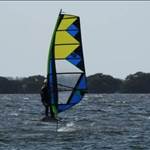
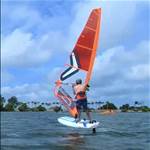
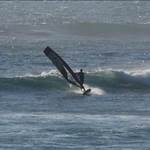
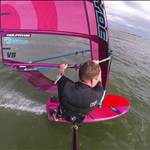
Just thought I would point out two things that I am noticing in my foiling gybe attempts. I can get all the way around in the air with enough wind pressure to keep going, but the times I have am still so surprised I lose my concentration/balance for a split second and fall backward into the water after completing the foiling gybe.
1) After many attempts I now have a good feel for how much wind pressure/speed I need to stay up through the foiling gybe using my AFS W95 and F1080 cm2 wing with 1 AFS carbon stab shim. So I need to be going fast to get around in the air, and that has kinda intimidated me. And I need to have either a balanced stance, or be front footed. But what I now realize is once I initiate the gybe I slow down and if I fall at the end no big deal because I am not going that fast. Obviously a bigger lower aspect wing would make things a lot easier, but AFS never made a wing bigger than the F1080 for windfoiling, and I really like going fast so not up for a slow low aspect wing. So as people here have said, "speed is your friend" and I agree!, just realize things will slow down after entering the foiling gybe.
2) I have many successful "initially" foiling gybes that start out in the air, flip the sail and get all the way around in the air but then land flat on the water due to a lack of speed going into the gybe. And that is due to the fact I can foil in winds too light to do a foiling gybe in with my foil and skill level. I now know when that is the case because I am somewhat back footed or even neutral when foiling cross wind and then going into the gybe. Someone here said you cannot do a foiling gybe if you are back footed and I agree (but see next). So what I am going to do next time is when I enter the gybe somewhat back-footed or neutral and not powered up and fast like I need to be, I will try pumping the foil 1x as I start to head downwind and as the board lifts up flip the sail then step around and pump the foil again. I am very comfortable with pumping the foil to connect gusts, and the F1080 wing really pumps good. Just need to pump as I turn down wind on the foiling gybe, in the same way I do when foiling cross wind and the gust passes me and I would come down if I did not pump the foil to get to the next gust I can see rippling the water farther in front of me.
And as Andy Brandt said in one of his videos, do the foiling gybe in a gust, and I agree, but now I am wondering if a pump or two of the foil will get me around closer to the end of the gust so that I can fly as long as possible.
Good steady wind would be a big help too, and I get that, but not as often as I want with flattish water. Waves definitely add another dimension to the foiling gybe.
Select to expand quoteSandman1221 said..
And as Andy Brandt said in one of his videos, do the foiling gybe in a gust, and I agree, but now I am wondering if a pump or two of the foil will get me around closer to the end of the gust so that I can fly as long as possible.
Listen to Andy on this one. Any attempt to pump the foil will keep you from going as fast as you need to. The key to lighter air jibes is minimizing the time spent going offwind by making a quicker turn, flipping the sail sooner and exiting downwind to get the power in the sail as soon as possible (instead of losing more momentum by continuing the carve further upwind).
And, yes, front foot pressure helps. When you step up and across on the jibe, you still have enough angle of attack on the wing to fly level. Gwen Gourlay said it a long time ago, for easier jibes, your kit should fly level when you step across. If not, move something so it does. That makes the jibe be on almost autopilot.
Select to expand quotePaducah said..Sandman1221 said..
And as Andy Brandt said in one of his videos, do the foiling gybe in a gust, and I agree, but now I am wondering if a pump or two of the foil will get me around closer to the end of the gust so that I can fly as long as possible.
Listen to Andy on this one. Any attempt to pump the foil will keep you from going as fast as you need to. The key to lighter air jibes is minimizing the time spent going offwind by making a quicker turn, flipping the sail sooner and exiting downwind to get the power in the sail as soon as possible (instead of losing more momentum by continuing the carve further upwind).
You know, it's funny, I was having a lot of similar issues with getting the radius/timing right (and still do get it wrong a lot), but it cleaned up and smoothed out when I started looking over the new shoulder and where I was going instead of staring down the board and through the sail.
Select to expand quotePaducah said..Sandman1221 said..
And as Andy Brandt said in one of his videos, do the foiling gybe in a gust, and I agree, but now I am wondering if a pump or two of the foil will get me around closer to the end of the gust so that I can fly as long as possible.
Listen to Andy on this one. Any attempt to pump the foil will keep you from going as fast as you need to. The key to lighter air jibes is minimizing the time spent going offwind by making a quicker turn, flipping the sail sooner and exiting downwind to get the power in the sail as soon as possible (instead of losing more momentum by continuing the carve further upwind).
And, yes, front foot pressure helps. When you step up and across on the jibe, you still have enough angle of attack on the wing to fly level. Gwen Gourlay said it a long time ago, for easier jibes, your kit should fly level when you step across. If not, move something so it does. That makes the jibe be on almost autopilot.
Paducah, thanks, that makes sense for light wind will give it a try, but still want to try pumping the foil since it will increase my speed with a minimum required wind pressure, Will get back after I give both a try!
Select to expand quoteaeroegnr said..Paducah said..Sandman1221 said..
And as Andy Brandt said in one of his videos, do the foiling gybe in a gust, and I agree, but now I am wondering if a pump or two of the foil will get me around closer to the end of the gust so that I can fly as long as possible.
Listen to Andy on this one. Any attempt to pump the foil will keep you from going as fast as you need to. The key to lighter air jibes is minimizing the time spent going offwind by making a quicker turn, flipping the sail sooner and exiting downwind to get the power in the sail as soon as possible (instead of losing more momentum by continuing the carve further upwind).
You know, it's funny, I was having a lot of similar issues with getting the radius/timing right (and still do get it wrong a lot), but it cleaned up and smoothed out when I started looking over the new shoulder and where I was going instead of staring down the board and through the sail.
That is what I remember Andy saying, look were you want to go. But I feel pretty good about where I am, just need a few more decent days. Biggest thing for me was getting comfortable going into a foiling gybe really powered up on my own (versus when Andy was watching me), now that feels okay, not fun yet, but okay.
Balz will pump through his maneuvers but he is balz. I would really focus on weighting your back foot more after you are past 6 and are slowing down. this might allow you to keep flying through the gybe. Also perhaps step back with the front foot more when you initiate your gybe?
Sandman, for sure pump to speed up at the intro to the turn. Or in other words, find a gust and floor it before you gybe. Then focus on turning.. Never stop carving with increasing foot pressure as the turn progresses. Back foot moves All the way across to get the leverage to finish the turn. Once approaching dead down wind, let go of back hand. Any pressure on back hand after a broad reach fights the turn. The reason you floor it at intro is so you can release the sail power mid turn (back hand fights turn) and have enough speed to coast through. The need for active ride height control never goes away... Ever!!!!! Just because your pushing your limits learning a new move doesn't mean you can ignore ride height. If your coming down at the end, learn to shift your weight aft at the end. Pumping mid gybe is not realistic at the level you present your skills. Ideally you learn to walk before you run. Pumping mid gybe before you consistently make your gybes is equivalent to running before you walk. Your getting close bud! Keep at it!????
Select to expand quotethedoor said..
Balz will pump through his maneuvers but he is balz. I would really focus on weighting your back foot more after you are past 6 and are slowing down. this might allow you to keep flying through the gybe. Also perhaps step back with the front foot more when you initiate your gybe?
Man you got it thedoor, that is what I was doing when just powered up enough, stepping my front foot back about halfway, did not do it intentionally, just noticed I was doing it sometimes, now I know why!, thanks Andy taught me to pay attention to what my feet are doing.
And good to hear pumping can work, when I pump to just keep going straight when the wind drops, I get in a rhythm and it really stabilizes the whole kit while increasing my forward speed, that is what I am hoping it will do in a light wind foiling gybe, add some stability while providing forward speed. Gotta do it when I still have enough momentum, if I wait just a little too long and lose the momentum before starting to pump, can not keep it going.
Select to expand quoteutcminusfour The need for active ride height control never goes away... Ever!!!!! Just because your pushing your limits learning a new move doesn't mean you can ignore ride height. If your coming down at the end, learn to shift your weight aft at the end.
+1, good description. Ride height can also be adjusted by tilting the board. If I go into a tight turn jibe and the nose starts to drop, I flatten the board with my back foot to bring the nose back up. Light air, big sail I'm ready to get my back foot far back to keep flying as things slow down. Also stay powered up as long as possible before the sail flip. Fast forward to 3:42.
The main feedback I'd give here based on my observations is in general people give a little too much attention to what they're doing during the gybe, foot change / rig flip, without getting the entry right first which sets everything for a successful gybe (foil or fin)
Get the back hand back, get the back foot in the correct position (just at the front of the opposite back strap for me) and then to initiate the gybe just let the front hand gently extend forward and away from you while keeping the back hand sheeted. This pulls the rest of the body into the correct position over the board, naturally giving the correct amount of foot pressure and most importantly encouraging the hips and upper body to lead into the turn and then lead out of the turn. I also find this helps me to more naturally adjust the radius of the turn to match the wind strength / sea state.
In the beginning you'll probably get some planing touchdowns during the gybe but this is nice and safe and easy to correct with subtle foot pressure, trim, changes as confidence builds.
With a smaller sail v bigger foil combo I prefer to flip the rig first then change feet, with a bigger sail v smaller foil combo I go foot change first and then rig flip.
A couple of little clips I put together a while back just to illustrate, I learned on the same set up as you @Sandman first vid is the W95 with the 1080 second is with the S800
Select to expand quoteutcminusfour said..
Sandman, for sure pump to speed up at the intro to the turn. Or in other words, find a gust and floor it before you gybe. Then focus on turning.. Never stop carving with increasing foot pressure as the turn progresses. Back foot moves All the way across to get the leverage to finish the turn. Once approaching dead down wind, let go of back hand....
A point of clarification: this only works where the apparent wind is faster than your board speed at that point. Granted, that's where a lot of windfoiling is done, especially in winds 15kts and higher. Also, as you mention, a good reason to go as fast as one can tolerate entering the jibe.
However, do that in light air and things will not turn out well. In worst case, the sail will slap you off the board. In those conditions, the sail has to rotate around the back hand or the back hand has to push; and it's the front hand that essentially releases first.
Not disagreeing with your general points. Managing ride height is a very important point, especially in swell. That's another super big reason to spot the exit which allows you to judge not only the exit point but height as well. Ride height can be managed by weight shifts, foot shifts and sail mast shifts. In swell, ignore ride height at your peril. 
Select to expand quoteDaithidmg said..
The main feedback I'd give here based on my observations is in general people give a little too much attention to what they're doing during the gybe, foot change / rig flip, without getting the entry right first which sets everything for a successful gybe (foil or fin)
Get the back hand back, get the back foot in the correct position (just at the front of the opposite back strap for me) and then to initiate the gybe just let the front hand gently extend forward and away from you while keeping the back hand sheeted. This pulls the rest of the body into the correct position over the board, naturally giving the correct amount of foot pressure and most importantly encouraging the hips and upper body to lead into the turn and then lead out of the turn. I also find this helps me to more naturally adjust the radius of the turn to match the wind strength / sea state.
In the beginning you'll probably get some planing touchdowns during the gybe but this is nice and safe and easy to correct with subtle foot pressure, trim, changes as confidence builds.
With a smaller sail v bigger foil combo I prefer to flip the rig first then change feet, with a bigger sail v smaller foil combo I go foot change first and then rig flip.
A couple of little clips I put together a while back just to illustrate, I learned on the same set up as you @Sandman first vid is the W95 with the 1080 second is with the S800
two epic videos!