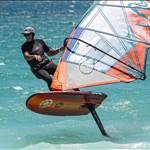
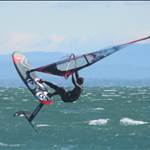
We were going to film a step-by-step duck gybe tutorial but Mr Smooth cranks out so many epic turns in fifteen minutes I couldn't decide which was best - so I've included them all.
I hope you can see the hands and feet movements clearly.
WSW gusty 20-30 knots
Slingshot Phantasm carbon 103W mast, PFI 730 wing.
Very nice to see the 730 in action and ripping those duckys 
Looks a bit chilly there guys, glad to see you do suffer a little bit from time to time 
Nice video.
Sorry, the following isn't duck jibe related..
As I am learning jibing, one thing that happens to me is that the sail gets backwinded. Two pieces of advice given to me have been to start flipping the sail earlier and I might have to give the sail a good push with my back hand. I started having some success by actively pushing the sail with my back hand right after sheeting in briefly. However, looking at the 2nd jibe at 12s, it looks like the sail flip is not done particularly early, nor does the sail need much of a push. All his jibes are like this.
Can anyone explain what might be happening with jibes in this video and why his sail doesn't get backwinded whereas a beginner jibe does? The one thing that pops into my head is if you have good speed and are now moving in the new direction (you've passed through direct downwind), your apparent wind will want to rotate the sail, provided you're not still sheeting in.
Select to expand quoteshmish said..
Nice video.
Sorry, the following isn't duck jibe related..
As I am learning jibing, one thing that happens to me is that the sail gets backwinded. Two pieces of advice given to me have been to start flipping the sail earlier and I might have to give the sail a good push with my back hand. I started having some success by actively pushing the sail with my back hand right after sheeting in briefly. However, looking at the 2nd jibe at 12s, it looks like the sail flip is not done particularly early, nor does the sail need much of a push. All his jibes are like this.
Can anyone explain what might be happening with jibes in this video and why his sail doesn't get backwinded whereas a beginner jibe does? The one thing that pops into my head is if you have good speed and are now moving in the new direction (you've passed through direct downwind), your apparent wind will want to rotate the sail, provided you're not still sheeting in.
You are much more likely to get backwinded in light winds. i.e. in 12kts, you might be entering a gybe at around 18kts, and mid gybe you are still doing 15kts, so therefore as you turn downwind, you will have 3kts of wind in front, backwinding you. Even if you aren't quite going that fast, its still pretty easy to be thrown off balance when you are learning
If there are stronger wind conditions, typically your board speed doesn't increase that much, so for example in video above it might be blowing 25kts, gybe entry speed would still be around 18-20kts, and you might be still around 16-17kts mid-gybe, so you will still have 8-9kts of wind blowing from your back, and therefore not be backwinded.
Select to expand quoteshmish said..
Nice video.
Sorry, the following isn't duck jibe related..
As I am learning jibing, one thing that happens to me is that the sail gets backwinded. Two pieces of advice given to me have been to start flipping the sail earlier and I might have to give the sail a good push with my back hand. I started having some success by actively pushing the sail with my back hand right after sheeting in briefly. However, looking at the 2nd jibe at 12s, it looks like the sail flip is not done particularly early, nor does the sail need much of a push. All his jibes are like this.
Can anyone explain what might be happening with jibes in this video and why his sail doesn't get backwinded whereas a beginner jibe does? The one thing that pops into my head is if you have good speed and are now moving in the new direction (you've passed through direct downwind), your apparent wind will want to rotate the sail, provided you're not still sheeting in.
If you are using smaller sails and freeride foils consider the following ways to manage the sail, both work
1) let go with your back hand early and focus on gybing the board around, eventually you catch up to the sail
check the gybe at the 8min mark here