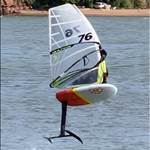
Hi, just a few days ago we had an improvised foiling clinic with an ex olympic sailor who is now helping other guys train for Paris 2024 on the iQFoil gear.
He told us that the rules changed and now they can shim to rake the fuselage, instead of shimming in the board box (foil mast)
This way, they are setting up the mast to be as vertical as posible, in order to extend the front wing more forward, gaining power.
Then to have some rake (cause it goes 0? or almost negative when putting the mast vertical) they shim into the fuselage to give about 1.4? of rake there
Any one tried this already?
We're starting to test it around here.
I took a look at Patrik foil from a friend here, and it seems it's made out of factory like this, straight vertical mast, and the fuse is already with some rake (not perpendicular to mast).
Select to expand quoteaeroegnr said..
How are they dealing with the bolts at the fuse to mast?
Yeah, that was my first thought too.
the starboard evolution race foils already have some angle built in, but the iq gear is as it was when it first came out (as it should be if it's Olympic equipment). There's literally no room for a shim at the fuse junction. If they want to fit one they are going to have to elongate the horizontal screw holes to make room for it, then possibly modify the mast where it junctions with the fuse to keep it all smooth flowing.
What could possibly go wrong?!
Maybe not the right/most recent doc but this at least doesn't seem to contemplate this kind of "tuning":
www.iqfoilclassofficial.org/_files/ugd/297cf0_fea0ba5b9b9a439bb7b2898f6a36076f.pdf
I guess it is possible to shim the fuselage if the cross bolts are not being used.
I guess it is possible to shim the fuselage if the cross bolts are not being used.
Select to expand quotebel29 said..
What could possibly go wrong?!
Maybe not the right/most recent doc but this at least doesn't seem to contemplate this kind of "tuning":
www.iqfoilclassofficial.org/_files/ugd/297cf0_fea0ba5b9b9a439bb7b2898f6a36076f.pdf
Interesting, the bit about impact vests. It's a step in the right direction, changing the requirement to impact protection rather than floating assistance for competition events. But the rule would omit them from being able to race in a lot of locations (in Australia at least) where pfds are a legal requirement.
What are the rules like in other countries?
There is a good old youtube about shimming the mast-fuse connection. Granted it is about a kite foil, but the principles are the same. The net effect of shimming here is to move the center of lift fore or aft. It also adjusts the nose trim of the board. Note that the angle-of-attack relationships of front wing, fuselage, and stab do not change.
Hello!
I am new in this and i want to know which "is the correct angle" to put de mast in very light conditions, because i am seeing that my phantom borad fits the iq foil in 3.5 degrees without any shrim.
Less degrees means more lift power.. isnt it?
Don't confuse shimming the mast-fuselage joint with shimming the stabilizer.
Shimming the stabilizer changes the lift profile. You can read dozens of discussions about this.
Shimming the mast-fuselage joint does not change lift at all since the angle of attack relationships of wing and stab do not change. Look at his youtube carefully. The wing-fuse-stab "airplane" does not change. The only thing that changes it the airplane's angle wrt to the mast, and, therefore, wrt to the board. You can use this to tune how high or low the board nose rides in level flight. As shown in the youtube, you can also use this to tune the position of center of lift wrt the board and your feet.
Educaesantes, take in mind what Segler just said, the mast rake changes board position relative to the water, it does not provide more or less lift. That is achieved with the stabilizer angle.
Nevertheless, changing rake mast does affect power, because it moves the front wing position relative to the foot. Take a look at these 3 drawings, comparing mast rake and fuselage rake:

Select to expand quoteManilo said..
Educaesantes, take in mind what Segler just said, the mast rake changes board position relative to the water, it does not provide more or less lift. That is achieved with the stabilizer angle.
Nevertheless, changing rake mast does affect power, because it moves the front wing position relative to the foot. Take a look at these 3 drawings, comparing mast rake and fuselage rake:
Manilo and Segler, thank you so much for the explanation. 
Hi, are you able to update us on this if you tried it?
What did you use to shim the fuselage and did it lead to in the fitting or stiffness of the connection?
Select to expand quoteManilo said..
Educaesantes, take in mind what Segler just said, the mast rake changes board position relative to the water, it does not provide more or less lift. That is achieved with the stabilizer angle.
Nevertheless, changing rake mast does affect power, because it moves the front wing position relative to the foot. Take a look at these 3 drawings, comparing mast rake and fuselage rake:
Your diagrams don't allow for the fact that the fuselage and wings will travel through the water at the same angle, i.e. raking the mast back makes the board ride more nose up hence tilting the weight of the rider further back. This probably means the front wing is not moving back significantly relative to the centre of gravity of the rider.
I've been using a 2 degree plate shim to rake the mast back when winging. If anything it feels more front footed than before. The two big differences are:
1) The board rides more nose up making the touch downs gentler and reducing the tendency to bury the nose into chop when riding low on the foil
2) The AoA on the front wing is reduced when the board is on the water and I'm trying to take off. This seems to help with high aspect foils. I think this is because it allows me to pick up more speed before engaging the foil. Otherwise it seems too easy to stall the foil as I'm trying to get the board moving fast enough to take off
My board has a really flat tail rocker. Boards with some tail rocker might not benefit in the same way.
P.S. also the stabiliser angle doesn't control lift. It affects how front / rear foot pressure changes with speed
Select to expand quotesimonp65 said..Manilo said..
Educaesantes, take in mind what Segler just said, the mast rake changes board position relative to the water, it does not provide more or less lift. That is achieved with the stabilizer angle.
Nevertheless, changing rake mast does affect power, because it moves the front wing position relative to the foot. Take a look at these 3 drawings, comparing mast rake and fuselage rake:
P.S. also the stabiliser angle doesn't control lift. It affects how front / rear foot pressure changes with speed
Completely agree with the rest of what you've said, but "lift" is not a separate variable from front/rear foot pressure. More lift causes more front foot pressure. Less lift causes less front foot pressure, or more back foot pressure, to put it another way.
lift is not necessarily provided by a positive angle of attack from both foil wings, it's an overall representation of what direction the foil goes to, given more wind (and thus speed), up or down.
Select to expand quotesimonp65 said......
P.S. also the stabiliser angle doesn't control lift. It affects how front / rear foot pressure changes with speed
I beg to differ. It determines the angle of attack of the wing. Lift is a function both of wing shape and angle of attack. More angle of attack -> more lift and vice versa. That's why when you pull the "stick" back on an airplane (increasing stab angle), it goes up.
"The lift coefficient of a fixed-wing aircraft varies with angle of attack. Increasing angle of attack is associated with increasing lift coefficient up to the maximum lift coefficient, after which lift coefficient decreases.[7]"
en.wikipedia.org/wiki/Angle_of_attack#Relation_between_angle_of_attack_and_lift_coefficientSelect to expand quoteSubsonic said..
Completely agree with the rest of what you've said, but "lift" is not a separate variable from front/rear foot pressure. More lift causes more front foot pressure. Less lift causes less front foot pressure, or more back foot pressure, to put it another way.
lift is not necessarily provided by a positive angle of attack from both foil wings, it's an overall representation of what direction the foil goes to, given more wind (and thus speed), up or down.
+1 on your first statement. But, to be clear, in conventional wing/stab configurations, the stab is providing downforce (ie negative lift, negative AoA) to balance the teeter-totter of the foil since the CoL is behind the CoG for longitudinal stability. Only the front wing is providing positive lift and has a positive angle of attack.
Select to expand quotePaducah said..
I beg to differ. It determines the angle of attack of the wing. Lift is a function both of wing shape and angle of attack. More angle of attack -> more lift and vice versa. That's why when you pull the "stick" back on an airplane (increasing stab angle), it goes up.Subsonic said..
lift is not necessarily provided by a positive angle of attack from both foil wings, it's an overall representation of what direction the foil goes to, given more wind (and thus speed), up or down.
+1 on your first statement. But, to be clear, in conventional wing/stab configurations, the stab is providing downforce (ie negative lift, negative AoA) to balance the teeter-totter of the foil since the CoL is behind the CoG for longitudinal stability. Only the front wing is providing positive lift and has a positive angle of attack.
correct.
what i was trying to convey with that sentence was actually what you've said in your first above^^^.
i wrote it that way as some people get hung up on the idea that the negative angle of attack of the stabiliser is not producing lift on the overall scenario, because its on a negative angle of attack. I guess because they forget that its actually part of a lever, as you described. A positive angle of attack on the stabiliser actually results in negative lift..
Select to expand quoteSubsonic said..Paducah said..
I beg to differ. It determines the angle of attack of the wing. Lift is a function both of wing shape and angle of attack. More angle of attack -> more lift and vice versa. That's why when you pull the "stick" back on an airplane (increasing stab angle), it goes up.Subsonic said..
lift is not necessarily provided by a positive angle of attack from both foil wings, it's an overall representation of what direction the foil goes to, given more wind (and thus speed), up or down.
+1 on your first statement. But, to be clear, in conventional wing/stab configurations, the stab is providing downforce (ie negative lift, negative AoA) to balance the teeter-totter of the foil since the CoL is behind the CoG for longitudinal stability. Only the front wing is providing positive lift and has a positive angle of attack.
correct.
what i was trying to convey with that sentence was actually what you've said in your first above^^^.
i wrote it that way as some people get hung up on the idea that the negative angle of attack of the stabiliser is not producing lift on the overall scenario, because its on a negative angle of attack. I guess because they forget that its actually part of a lever, as you described. A positive angle of attack on the stabiliser actually results in negative lift.. No worries. Good distinctions to make in both looking at the individual components and understanding how they affect the overall system.
Select to expand quotePaducah said..
I beg to differ. It determines the angle of attack of the wing. Lift is a function both of wing shape and angle of attack. More angle of attack -> more lift and vice versa. That's why when you pull the "stick" back on an airplane (increasing stab angle), it goes up.
For a given front wing when you're foiling at a constant height - the angle of attack is determined by your weight and speed. As a rider you automatically adjust this to ensure the lift from the front wing matches the weight of you, board, rig etc. A windfoil board rides nose up at slow speeds and flatter when going faster. This is because the rider is adjusting the angle of attack to keep the lift constant.
Therefore the angle of the stabiliser doesn't determine the angle of attack of the front wing in level flight. It just varies how much downforce the stab creates which modifies the front / rear foot pressure balance. The downforce on the stabiliser creates a correcting torque that balances the tendency of the nose of the board to be pulled down by the drag on the foil.
Select to expand quote
Completely agree with the rest of what you've said, but "lift" is not a separate variable from front/rear foot pressure. More lift causes more front foot pressure. Less lift causes less front foot pressure, or more back foot pressure, to put it another way.
lift is not necessarily provided by a positive angle of attack from both foil wings, it's an overall representation of what direction the foil goes to, given more wind (and thus speed), up or down.
In level flight lift must be constant even at varying speeds. Otherwise it would not balance the weight of you, rig and board and you would either touch down or breach.
The balance of the foil can change though, requiring different proportions of your weight on each foot. Changing the shim angle allows you to control how this varies with speed.
Select to expand quoteManilo said..
Hi, just a few days ago we had an improvised foiling clinic with an ex olympic sailor who is now helping other guys train for Paris 2024 on the iQFoil gear.
He told us that the rules changed and now they can shim to rake the fuselage, instead of shimming in the board box (foil mast)
This way, they are setting up the mast to be as vertical as posible, in order to extend the front wing more forward, gaining power.
Then to have some rake (cause it goes 0? or almost negative when putting the mast vertical) they shim into the fuselage to give about 1.4? of rake there
Any one tried this already?
We're starting to test it around here.
I took a look at Patrik foil from a friend here, and it seems it's made out of factory like this, straight vertical mast, and the fuse is already with some rake (not perpendicular to mast).
I had a play around with mine yesterday and managed to achieve about 0.6deg rake between the mast and the fuselage without much trouble by using a flat piece of plastic 0.6mm thick around the front vertical bolt. The horizontal barrel nuts went in fine. I've not been able to try it on the water yet.
I expect with a bit more fiddling I can get some more rake out of it but I think getting to 1.4deg between the mast and fuselage would be too difficult to get all the bolts in.
I've got an iQFoil but just use it for some Formula Foil racing so don't have to be so strict with the equipment restrictions.
Select to expand quotesimonp65 said..
For a given front wing when you're foiling at a constant height - the angle of attack is determined by your weight and speed. As a rider you automatically adjust this to ensure the lift from the front wing matches the weight of you, board, rig etc. A windfoil board rides nose up at slow speeds and flatter when going faster. This is because the rider is adjusting the angle of attack to keep the lift constant.
LTMFTFY: For a given front wing- and stab angle, mast base position, boom height, footstrap position -when you're foiling at a constant height - the angle of attack is determined by your weight and speed. It's a complex and interdependent system.
My bad that I should have said that the stab helps determine AoA.Select to expand quotesimonp65 said..
Therefore the angle of the stabiliser doesn't determine the angle of attack of the front wing in level flight. It just varies how much downforce the stab creates which modifies the front / rear foot pressure balance. The downforce on the stabiliser creates a correcting torque that balances the tendency of the nose of the board to be pulled down by the drag on the foil.
The downforce of the stab by its very nature will affect the AoA. As I said above, AoA is a factor in the amount of lift generated and, very importantly, therefore will change the front/rear pressure balance because of the inherent design of the system ie CoG is in front of CoL.
The inherent design of the teeter-totter requires the downforce of the stab. The downforce of the stab somewhat corrects the torque but the primary function remains. Take a moment and look up the forces that balance an airplane in flight. We are doing the same. Yes, there are nuances like the torque you mention but airplanes have similar issues, e.g. the torque generated by the engine placement which is significant with engines mounted under the wings like the 737 MAX. But you will never find a pilot who would say the stab is solely to balance out the torque of the engines. That's a secondary effect. The primary effect is to control the AoA of the wings. In windfoiling, the drag torque caused by the foil is also secondary. We know this because as we go faster, we feel more front foot, not back foot, pressure.
This is a helpful article from Glissattitude posted a few years back:www.glissattitude.com/en/blog/windfoil-1/reglage-windfoil-le-calage-du-stab-5518 "Stabilit? de l'?quilibre/Balance Stability" It shows how the stab self-corrects back to the desired AoA (given all else is equal).
Select to expand quotePaducah said..simonp65 said..
For a given front wing when you're foiling at a constant height - the angle of attack is determined by your weight and speed. As a rider you automatically adjust this to ensure the lift from the front wing matches the weight of you, board, rig etc. A windfoil board rides nose up at slow speeds and flatter when going faster. This is because the rider is adjusting the angle of attack to keep the lift constant.
LTMFTFY: For a given front wing- and stab angle, mast base position, boom height, footstrap position -when you're foiling at a constant height - the angle of attack is determined by your weight and speed. It's a complex and interdependent system.
Mast base, boom and footstrap positions only modify the proportion of weight you apply to your front or rear foot. They change the weight distribution but they don't add to or reduce the amount of weight that the lift of the front wing has to balance. The same mostly applies to the stab angle although the amount of downforce it creates would add to the force (i.e. weight) that the front wing has to lift against. The downforce from the stab should be small though compared to the weight of the rider, rig, board etc.
Select to expand quotePaducah said..
The inherent design of the teeter-totter requires the downforce of the stab. The downforce of the stab somewhat corrects the torque but the primary function remains. Take a moment and look up the forces that balance an airplane in flight. We are doing the same. Yes, there are nuances like the torque you mention but airplanes have similar issues, e.g. the torque generated by the engine placement which is significant with engines mounted under the wings like the 737 MAX. But you will never find a pilot who would say the stab is solely to balance out the torque of the engines. That's a secondary effect.
Foiling is very different from aircraft because the centre of thrust (the sail) is perhaps 8+ feet above the centre of drag for the foil. This creates a massive torque compared to the aircraft situation. It would be like mounting the engines on a 737 Max 200 ft above the wings! (i.e. roughly twice the fuselage length).
Select to expand quoteWe know this because as we go faster, we feel more front foot, not back foot, pressure.
That only happens if the stab size or angle is too large creating more downforce than necessary to balance the drag induced torque from the foil. If the downforce is too small you get the opposite effect - it becomes more rear footed at high speed. This is what happens when you pick up some weed on the foil and it becomes more rear footed.
It is possible to minimise foot balance changes across the speed range by picking a suitable stab size or angle. If you change down to a small front wing without modifying the stab you'll probably notice that it becomes more front footed. That's not caused by extra lift or speed (as a rider you always balance the lift with board angle). It's because there's less drag on the small front wing and the stab is creating too much downforce to balance it.
This is the only video I've seen that mentions tuning the stabiliser to minimise balance changes across the speed range:
Select to expand quote
I think the diagram explains how the stabiliser creates pitch stability by opposing dynamic changes in the board angle. However, the foil will not always fly in level flight with the stabiliser in a constant, neutral position. Take a look at someone windfoiling and make a note of the board angle when they're going 8 knots and when they're doing 20 knots. The difference might be 5 degrees or more. The rider is controlling the board angle (and foil AoA) to create constant lift and maintain level flight.
Select to expand quotesimonp65 said..
Foiling is very different from aircraft because the centre of thrust (the sail) is perhaps 8+ feet above the centre of drag for the foil. This creates a massive torque compared to the aircraft situation. It would be like mounting the engines on a 737 Max 200 ft above the wings! (i.e. roughly twice the fuselage length).
Each engine of the MAX puts out about 28,000 lbs of thrust (125 kN). It's an entirely different magnitude to what we are talking about here. It's a very common with engines mounted below the wing that when flying slow and nose up, they have to be careful when applying thrust or the plane will go even more nose up. The MAX had such an issue (plus the engines affecting the CoG) that the whole "fix" that caused the crashes was implemented.
simpleflying.com/rear-vs-wing-mounted-engines-advantages-and-disadvantages/
"It negatively affects the longitudinal (pitch) stability of the aircraft: When engines are mounted below the wings, they are below the CG of the aircraft. Thus, when power is added, it generates a nose-up moment, which reduces pitch stability. This may require a larger horizontal stabilizer design. "
Select to expand quotebel29 said..
What could possibly go wrong?!
Maybe not the right/most recent doc but this at least doesn't seem to contemplate this kind of "tuning":
www.iqfoilclassofficial.org/_files/ugd/297cf0_fea0ba5b9b9a439bb7b2898f6a36076f.pdf
To go back to the main question: how can they tune the fuse-mast angle in this case?
Such tuning (increasing at bit the size of mast's side-holes to allow putting a shim under the junction) would be rejected for sure.
If new fuses are produced with an angle ... does it mean the whole fleet can mix both format? It starts going beyond the "one design" philosophy.
Select to expand quoteLezardo said..bel29 said..
What could possibly go wrong?!
Maybe not the right/most recent doc but this at least doesn't seem to contemplate this kind of "tuning":
www.iqfoilclassofficial.org/_files/ugd/297cf0_fea0ba5b9b9a439bb7b2898f6a36076f.pdf
To go back to the main question: how can they tune the fuse-mast angle in this case?
Such tuning (increasing at bit the size of mast's side-holes to allow putting a shim under the junction) would be rejected for sure.
If new fuses are produced with an angle ... does it mean the whole fleet can mix both format? It starts going beyond the "one design" philosophy.
Looking up the most recent update to the class rules:
www.iqfoilclassofficial.org/documents
This seems to be the only wording that relates to the suggested alterations allowing for mast to fuselage shimming:

So (e) at the top suggests shimming allowed, but is ambiguous as to whether shimming for angle change is allowed.
(g) at the bottom suggests the transversal holes can be modified.
the whole pictorial section in the middle paints a clear picture that the mast mini Tuttle must fit flush with the fuselage, so it's not going to be legitimately possible to shim at the fuselage junction if you ask me.
Whoua! thanks for the doc! Indeed, it sounds very confusing "may be shimmed, may be modified" but it goes against the pictures! 
Or, it suggests you can shim the fuselage, enlarge the transversal holes for screw adjustments ... but you would need to sand/fill the mast base so that it visually looks at the same level as the fuse, may be???
Sorry for my ignorance, why does Patrik produce also the IQFoil class ... are these equipment allowed for official IQ Foil events? I thought it was Starboard only!
I would think the way the rules are written up, the mods they've allowed for would be more a case of being able to fix manufacturing indescrepencies rather than a mod to shim angle at the fuselage. I doubt they'd let it pass if there was a chunk of carbon/build material missing off the fillet at the top of the junction. They pretty much specify what sanding is allowed and not allowed elsewhere, and it pretty much says for polishing only.
they have a "whiteboard"? Rule, which means other manufacturers can construct iq foil boards. Not sure of the exact rules there, but yes, they are valid for competitions.