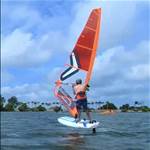
Bit more than clueless when it comes to the technical aspects of foil. Are the stabilizer wings designed to generate lift, down pressure or either depending on pitch? Assuming larger and further from center of lift of foil wing results in a more stable platform? Does a longer distance (longer fuse) allow for higher top end assuming all else is the same?
Vestas Sailrocket 2, the fastest wind powered watercraft in basically all categories has a foil that generates down pressure vs. lift. Bit counter intuitive to what would seem to generate higher top end speed.
Wonder if tech in the future will develop a foil wing that "twists off" lift without rider input or anything mechanical/electrical and generates downforce to enhance top end speed. Bit like sails. The day when foil is faster than fin under any condition.
I did a little bit of math on this with starboard foils a while back, but the stab will generate negative lift at low angles of attack, pushing the nose up, and positive lift at higher angles of attack, pushing the nose down. That angle where the lift direction flip depends on the shim settings and a few other things, like downwash from the front wing.
Something likely has to change for foils to totally beat out the fin top speed that is somewhere over 60mph at luderitz. I think maybe if they figure out how to stay under control when really hiked out on the board, such that the sail is actually generating most of the upward force, then maybe it'll reduce the needed lift on the foil and maybe that will cut down drag enough for it to make a difference but there's a limit somewhere. The higher speed hydrofoils are designed to go past cavitation from what I recall, and I don't know if the scaling of that effect really works on small windsurfing hydrofoils, but I haven't done the math on that.
Speed...
Tiny thin wings.....300 front, 170 rears.
Fuze length for rider stability...around 90-130.
Slight downturn on stab.
Needs 25+ steady wind to get up on foil, with skilled pilot.
Select to expand quoteOldGuy3 said..
Vestas Sailrocket 2, the fastest wind powered watercraft in basically all categories has a foil that generates down pressure vs. lift. Bit counter intuitive to what would seem to generate higher top end speed.
The Sailrocket 2 design is that is has 2 "foils": the sail above the water generates an up force, and the foil in the water a down force.
The beauty here is that the forces are in balance, and remain in balance as speed increases, since both increase similarly (with the square of the board speed resp. the apparent wind). Since most of the force of the sail is directed forward, that allows for very high speeds (after solving issues like cavitation).Select to expand quoteOldGuy3 said..
Wonder if tech in the future will develop a foil wing that "twists off" lift without rider input or anything mechanical/electrical and generates downforce to enhance top end speed. Bit like sails. The day when foil is faster than fin under any condition.
I first read that as "sails generate downforce", but I assume the "like sails" refers to the "twists off". Right?Select to expand quoteOldGuy3 said..
Are the stabilizer wings designed to generate lift, down pressure or either depending on pitch?
I rather consider the stabilizer wings as the element that determines the pitch (angle of attack) of the front wing.
For foils in light wind setting, the back end of the stab is higher than the front end, and if this moves through the water, it wants to tilt so that it is flat (so generates a local down force). That pushes the front of the front wing up, giving the front wing a higher angle of attack. Higher AOA at a given speed means more up force from the front wing, but also more drag.
I'm not sure it still applies to modern race foils with 115+ or 115++ fuses and high wind shims. At high winds (and speeds), it could make sense that the stab generates and up force to reduce the AOA of the front wing, limiting lift and increasing efficiency.Select to expand quoteOldGuy3 said..
Wonder if tech in the future will develop a foil wing that "twists off" lift without rider input or anything mechanical/electrical and generates downforce to enhance top end speed.
You may be onto something here. One possible solution would be a shim that compresses only in the back part. As speed increases, forces on the stab wing increase, the shim gets compressed, and down forces reduced. As a result, the front wing flattens out (lower AOA) and becomes more efficient. That could be a pretty simple self-regulating system. It might require different shims for different sailor weights or skill levels, but would not need any electronics.
With the front edge of the stab. tilted downward (to increase wing AOA for light winds) the water will try to pull stab. front edge more downward. So need maybe an electromechanical screw system to move the front edge of the stab. upward with increasing speed to reduce the wing's AOA.
Select to expand quoteboardsurfr said..
You may be onto something here. One possible solution would be a shim that compresses only in the back part. As speed increases, forces on the stab wing increase, the shim gets compressed, and down forces reduced. As a result, the front wing flattens out (lower AOA) and becomes more efficient. That could be a pretty simple self-regulating system. It might require different shims for different sailor weights or skill levels, but would not need any electronics.
I like this idea. The challenge will get it to be stiff enough so that it doesn't vibrate and then feed back into the hydrodynamics and flutter.
As with windsurfing, there is only so much you can do......
Wind speed range seems the most important criteria, once pilot skill and size is established.
To go fast in one wind range, you GIVE UP in others.
Say, 20-27. Your foil will not lift in 14, and it tops out at 30.
Multiple foils are needed to handle various wind speeds.
Just like your car, MORE than one gear is needed.
Select to expand quoteLeeD said..
Multiple foils are needed to handle various wind speeds.
Just like your car, MORE than one gear is needed.
Interesting comparison. The first cars had only one gear, and pretty limited top speed. It did not stop there, nor did it stop at 4-gear manual transmissions.
Compared to windsurfing "one gear" shortboards, freeride foils already have 3 gears - with respect to wind range. A single sail covers the range of 3 windsurfing sails. We've had many, many days this summer where the windsurfers rigged three sails, spending most of their time on shore, while foilers staid out, perfectly happy.
But windsurf foiling is still a very young sport, with plenty of room for improvement. Foils can work over quite a large range regarding angle of attack - I'd guess at least a 3 or 4-fold range with respect to the amount of lift produced for a given speed. I don't think we're even close to fully using that potential, even on foils that have a 3 degree adjustment range with shims (Starboard GT-R+, from +1 for 7 knots to -2 for 25+ knots of wind). Maybe we'll see rapid improvements once we see more open class foil racing.
Maybe two gears.
6.0 sail and 109 Supersport planes in 14, pretty much history at 25. Maui Sails Switch.
4.2 sail and 122 Naish with 1150, can foil up in 15 with lots of pumping, history at 23.
Maybe the same.
About 180 days windfoil, about 2000 windsurf.
I just see way too much hype in wingfoil and windfoil ranges.
Every decent foiler I know has 3+ wings. I have 2.
Every windfoiler has at least 3 sails. I mainly use 6.0, 5.0, 4.2, and 3.7....which should be 3.2.
Select to expand quoteLeeD said..
I just see way too much hype in wingfoil and windfoil ranges.
Every decent foiler I know has 3+ wings. I have 2.
Every windfoiler has at least 3 sails. I mainly use 6.0, 5.0, 4.2, and 3.7....which should be 3.2.
Now I know why I'm not a decent foiler. I only have 2 wings . I do have 3 sails. 5.5, 4.5, and 3.7M. Only foiling in lighter wind. Gear covers my current needs. Once the wind is a steady +17kts it's windsurfing time. 3.7M might have been a waste of money.
3.7 is fine for 14-23.
4.2 does not cover 22 for me, 160lbs, Naish 122, 1150, 310.
A 6.0 windsurf sail covers that range.
Select to expand quoteOldGuy3 said..LeeD said..
I just see way too much hype in wingfoil and windfoil ranges.
Every decent foiler I know has 3+ wings. I have 2.
Every windfoiler has at least 3 sails. I mainly use 6.0, 5.0, 4.2, and 3.7....which should be 3.2.
Now I know why I'm not a decent foiler. I only have 2 wings. I do have 3 sails. 5.5, 4.5, and 3.7M. Only foiling in lighter wind. Gear covers my current needs. Once the wind is a steady +17kts it's windsurfing time. 3.7M might have been a waste of money.
Hey I am with you, two wings are enough for 8-25 knots.
Not so sure...talking wing now.
My 6 meter Naish is fine from 10-18, but around 15+, my 4.6 is better.
At typical 5-15, something bigger than 6.0 Naish is warranted. Maybe a Slick or Armstrong 6.0.
Naish 6.0 doesn't fly in 5.