Hi all
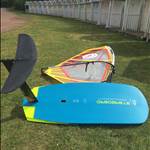
I'm having problems with gybing my small board and sail...a foilX / SC and typically a 5m
I am ok with gybing on my large foil board stbd 150 and 8m, as I've been programmed into doing the feet first, sail flip second from slalom sailing.
However I'm trying to move into the flip sail first, then feet technique, as it stabilises the board through the gybe exit.
it seems as I'm flipping the sail it's too far in front of me and as I sheet in it's trying to pull me over the front of the board.
Any advice on tips or techniques would be welcome.
Hopefully I'm not too old to reprogram the muscle memory
Thanks in advance
It sounds like you have not turned enough before you sheet in on new gybe.
This is very often the challenge, completing the turn.
Keeping the carve on while sailing switch stance is not intuitive but It can be learned.
If you find yourself turning back the way you came from it is often because you have not eased/opened or started rotating the sail around soon enough. You want to start with great speed then ease early or the board just won't turn.
On the finish, around the time of the flip and just after the flip you have to REALY focus on turning.
I am starting to realize a great benefit from this gybing style, I can now sail switch stance! And it's a ton of fun because you can surf waves in both directions carving back and forth without switching your feet.
Keep after it, you'll be stoked when you can gybe both styles!
Two tips:
1) I always find the sail flip less de-stabilizing if I over sheet a lot before going into the gybe (think foot of sail on your inside leg). This gets harder if you are over powered and then I just let the sail flag out.
2) Halfway through the gybe I move my back foot further to the outside of the rail to keep the board turning
As UTC said you are effectively sailing switch at the end of the gybe. I have been trying to practice getting into switch while riding along and it is a very similar feel to coming out of the gybe so practicing that could help.
To get into switch the easiest might be to come off the foil first and then weight the back leg to pop the board again
PS: as you are low on speed at the end of the gybe you will need to increase back foot pressure to keep flying. This is the main reason why I like to have things set up with a heavy front foot for regular riding, so that you can shift weight back when you are dropping off the foil
Hi Rod,
Try to think about gybing around the sail rather than flipping it. If you're making a conscious effort to flip the rig at some point you may be holding onto to it too long and got too much pressure in it when you rotate it. The key is to let the back hand go as soon as you have enough speed to make it round the gybe.
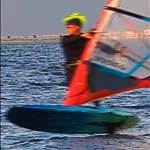
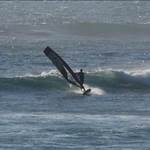
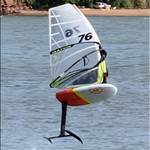
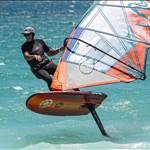
Try letting go of your back hand really early as you enter the gybe and let the sail flag out with your front hand near the mast. You can then concentrate on carving the turn and the sail will naturally come round so that it's in the right place. You only need light finger tip pressure on the rig or even no hands at all (see Emily Ridgway in the first picture). You should be able to put your back arm next to your body through most of the gybe (see Tony Logosz in the second picture).
I wouldn't attempt this type of gybe initially unless you've got a solid 12 knots or more of wind through the gybe. Use the foot switch first gybe instead when the wind is light. I found that keeping the mast angled into the turn was important to stop the board straightening out. You can see that in both pictures.
Sailing switch on the exit and gradually powering up the sail is tricky. I learned to duck gybe first as the rig flip is faster and you've got constant power through the gybe and into the switch stance. Once I got the hang of that I could then do the normal gybe into switch.
As the thedoor says above having the board setup to be front footed makes things easier.


simonp123,
Gybing around the sail rather than flipping it really resonates with me. That is a great way to describe it. The feeling of just carving while the sail is so light is just amazing and surfy. You're right that this sail handling technique only works when the true wind is greater than your board speed. However its possible to successfully sail out of the gybe switch stance even in light air. The sail handling is different, it is more of a slice and flip move like Sam Ross demonstrates rather than let it flag out and carve.
As they say, the sail has to come to you! If the sail feels far away you have to head upwind more out of the jibe.
Thanks, some useful tips and insights there.
my board and foil seems pretty well balanced. I have it set up, so that I've got front foot pressure and can keep on the foil when I move my rear foot slightly forward and sideways to initiate the turn.
My thoughts
I'm trying the advice by really extending the gybing arc, so everything is very stable and steady. So my speed maybe falling, which as I flip the sail, it is starting to load up again.
I've been trying to keep my front arm really straight to keep the rig away from me.
Does the rig have to be leaned into the turn at a greater angle than the board or similar to the board?
Is the rig flip a simple rotation or more complicated slice and flip? Or is this dependant on the load generated?
As the rig rotates, is it rotating around the mast or around a point on the boom, as happens with the larger sails?
Could I be using too large a sail?
I've been using a 5m with the Starboard SC in gusty winds up to 20mph but flat water.
Unfortunately the wind has been really unstable since I've been out. So I've needed a suitable sail to get out from the beach in 5mph, but as the clouds came over, the wind has ramped up.
so options
1. Take a smaller sail, and rig it so it's got enough power to get off the beach?
2 rig the 5m flatter?
3. Wait until the conditions are better...that's not going to happen !
I've getting the feeling when it's appropriate to use rig first or feet first.
The occasions when I've started to come out switch from the gybe, definitely feels the right way to progress, as the board feels so much more stable.
However, just as that stability switches on through the exit, the problems happen.
Could it also be that I need to rotate a little more through my waist, in the switch position , or place my feet a little differently to make it easier?
In the photos, Emily or Tony don't appear to be twisting, but face directly down the board.
Anyway I think I need to commit to practice a bit more early on in a session, as my natural reaction is to revert back to my old tried and tested foot first gybe.
Thanks Rod
Why does the sail flip so slowly on a foil? I've been mostly using a 4.0 and half the time I almost have to push it around. I don't think I had ever been back winded in a gybe before I started foiling.
Select to expand quoteRuddeBos said..
Thanks, some useful tips and insights there.
my board and foil seems pretty well balanced. I have it set up, so that I've got front foot pressure and can keep on the foil when I move my rear foot slightly forward and sideways to initiate the turn.
My thoughts
I'm trying the advice by really extending the gybing arc, so everything is very stable and steady. So my speed maybe falling, which as I flip the sail, it is starting to load up again.
I've been trying to keep my front arm really straight to keep the rig away from me.
Does the rig have to be leaned into the turn at a greater angle than the board or similar to the board?
Is the rig flip a simple rotation or more complicated slice and flip? Or is this dependant on the load generated?
As the rig rotates, is it rotating around the mast or around a point on the boom, as happens with the larger sails?
Could I be using too large a sail?
I've been using a 5m with the Starboard SC in gusty winds up to 20mph but flat water.
Unfortunately the wind has been really unstable since I've been out. So I've needed a suitable sail to get out from the beach in 5mph, but as the clouds came over, the wind has ramped up.
so options
1. Take a smaller sail, and rig it so it's got enough power to get off the beach?
2 rig the 5m flatter?
3. Wait until the conditions are better...that's not going to happen !
I've getting the feeling when it's appropriate to use rig first or feet first.
The occasions when I've started to come out switch from the gybe, definitely feels the right way to progress, as the board feels so much more stable.
However, just as that stability switches on through the exit, the problems happen.
Could it also be that I need to rotate a little more through my waist, in the switch position , or place my feet a little differently to make it easier?
In the photos, Emily or Tony don't appear to be twisting, but face directly down the board.
Anyway I think I need to commit to practice a bit more early on in a session, as my natural reaction is to revert back to my old tried and tested foot first gybe.
Thanks Rod
This may help - we posted it here last year 
Easiest First Foiling Gybe
Select to expand quotePaducah said..Faff said..
Why does the sail flip so slowly on a foil? I've been mostly using a 4.0 and half the time I almost have to push it around. I don't think I had ever been back winded in a gybe before I started foiling.
Because of the foil's ability to glide in lower wind or depowered. On a normal board, you'd have fallen off a plane well before that. The lower drag of the foil allows it to keep on going around.
If you keep getting backwinded - and I'm assuming with a 4.0 there's a decent amount of wind so we aren't talking about making a 7.5 go around in 8 kts - try to jibe in the gusts or at least well powered. For a lot of people (this may not be you) when you start jibing, going downwind powered up is not a pleasant thought so you wait for a time of less pressure on the sail. What actually happens is that as soon as you start to go downwind in powered up conditions, the pressure releases off the sail and you can make it around much more easily.
17 knots. I thought it's the opposite - you go slower than the wind and the sail rotates easily. I do go off the wind and try to have a "big arc". I don't oversheet and try to keep the mast upright.
Select to expand quoteFaff said..Paducah said..Faff said..
Why does the sail flip so slowly on a foil? I've been mostly using a 4.0 and half the time I almost have to push it around. I don't think I had ever been back winded in a gybe before I started foiling.
Because of the foil's ability to glide in lower wind or depowered. On a normal board, you'd have fallen off a plane well before that. The lower drag of the foil allows it to keep on going around.
If you keep getting backwinded - and I'm assuming with a 4.0 there's a decent amount of wind so we aren't talking about making a 7.5 go around in 8 kts - try to jibe in the gusts or at least well powered. For a lot of people (this may not be you) when you start jibing, going downwind powered up is not a pleasant thought so you wait for a time of less pressure on the sail. What actually happens is that as soon as you start to go downwind in powered up conditions, the pressure releases off the sail and you can make it around much more easily.
17 knots. I thought it's the opposite - you go slower than the wind and the sail rotates easily. I do go off the wind and try to have a "big arc". I don't oversheet and try to keep the mast upright.
My brain is mush tonight. If any part of my post seems relevant, that's great. Otherwise, let's consign it to the dust bin. Sorry.
Select to expand quotePaducah said..Faff said..Paducah said..Faff said..
Why does the sail flip so slowly on a foil? I've been mostly using a 4.0 and half the time I almost have to push it around. I don't think I had ever been back winded in a gybe before I started foiling.
Because of the foil's ability to glide in lower wind or depowered. On a normal board, you'd have fallen off a plane well before that. The lower drag of the foil allows it to keep on going around.
If you keep getting backwinded - and I'm assuming with a 4.0 there's a decent amount of wind so we aren't talking about making a 7.5 go around in 8 kts - try to jibe in the gusts or at least well powered. For a lot of people (this may not be you) when you start jibing, going downwind powered up is not a pleasant thought so you wait for a time of less pressure on the sail. What actually happens is that as soon as you start to go downwind in powered up conditions, the pressure releases off the sail and you can make it around much more easily.
17 knots. I thought it's the opposite - you go slower than the wind and the sail rotates easily. I do go off the wind and try to have a "big arc". I don't oversheet and try to keep the mast upright.
My brain is mush tonight. If any part of my post seems relevant, that's great. Otherwise, let's consign it to the dust bin. Sorry.
Lol, no probs.
Select to expand quoteRuddeBos said..
My thoughts
I'm trying the advice by really extending the gybing arc, so everything is very stable and steady. So my speed maybe falling, which as I flip the sail, it is starting to load up again.
I've been trying to keep my front arm really straight to keep the rig away from me.
Does the rig have to be leaned into the turn at a greater angle than the board or similar to the board?
Is the rig flip a simple rotation or more complicated slice and flip? Or is this dependant on the load generated?
As the rig rotates, is it rotating around the mast or around a point on the boom, as happens with the larger sails?
Could I be using too large a sail?
I've been using a 5m with the Starboard SC in gusty winds up to 20mph but flat water.
Unfortunately the wind has been really unstable since I've been out. So I've needed a suitable sail to get out from the beach in 5mph, but as the clouds came over, the wind has ramped up.
so options
1. Take a smaller sail, and rig it so it's got enough power to get off the beach?
2 rig the 5m flatter?
3. Wait until the conditions are better...that's not going to happen !
I've getting the feeling when it's appropriate to use rig first or feet first.
The occasions when I've started to come out switch from the gybe, definitely feels the right way to progress, as the board feels so much more stable.
However, just as that stability switches on through the exit, the problems happen.
Could it also be that I need to rotate a little more through my waist, in the switch position , or place my feet a little differently to make it easier?
In the photos, Emily or Tony don't appear to be twisting, but face directly down the board.
Anyway I think I need to commit to practice a bit more early on in a session, as my natural reaction is to revert back to my old tried and tested foot first gybe.
Thanks Rod
I wouldn't go overboard on extending the gybing arc. The main thing is committing fully to the gybe and carving a nice arc so that the sail will come back into the right place. In Azymuth's video above I think Simon is using a more advanced technique to go faster where he holds onto the rig longer and has a definite flip. That's faster and better in lighter winds but I think it's better to start with gybing around a flagged out sail. The board and rig should be rotating at about the same speed through the gybe in opposite directions. The rotation of the rig is around your front hand which is next to the mast.
As UTC says, for a second or two you should feel like you are just surfing the foil and there's no propulsion from the rig.
This isn't a great example as I'm a bit underpowered going into the gybe but you can see how slowly a tiny sail is rotating through the gybe:
www.instagram.com/p/CK7ATWEFCDX/
A 5m sail is ok to learn but a 3.7 in 20 knots would be easier! The bigger the sail, the slower the rotation. You might have to give the boom a push with your back hand before releasing in lighter winds with bigger sails.
Don't let the rig get too far away from you as it's more difficult to control when the power comes back on. Even in Tony Logosz showboat gybe above he has his elbow bent and Emily Ridgway has the mast no more than a foot away from her body. When learning try to keep the mast right in front of your nose (say 12 inches away) all the way through the gybe. This will make sure that you lean the mast with your body into the gybe. Also when the power comes back on you can extend your arms to soak up the power. If they are already straight the power will throw you off balance.
Rigging the sail flatter might help as the battens will rotate more easily and the power will come back in more gently.
Sailing switch does require a lot of body twist which you slowly get used to and become more supple. Try reducing the angle by bringing you back foot slightly forward and onto the rail. You can also wriggle you front foot out of the strap a bit. This allows your body to face the front of the board a bit more rather than to windward.
Thanks Simon, that's really useful.
keeping the rig closer, and also your head or body in line with the mast is really different to the technique I've been using with my larger sails and boards.
where I've been moving my hands down the boom a bit and pushing the mast into the windward corner, slide my front hand closer to the boom head, then rotate, to stop it from back winding.
My body is resisting the twist, so I'll need to work on that.
In 17kts I'd be well powered on a 4.5, and fine on a 4.0 (77kg).
My tops tips for gybing:
1. RIG FORWARD - straight front arm, mast leaning toward the nose of the board
2. When the sail starts going light (broad reach), move the backhand up to the harness lines and sheet the sail right out, so that the clew is almost pointing at the nose of the board. Rather than letting go, the backhand stays on in case the apparent wind is from ahead. If it is from ahead the sail is gently lying on the apparent wind.
3. Once through dead downwind flip the sail. Because the clew is already pointing near the nose it has much less far to travel.
2+3 get round two problems. The first is that the apparent wind could either be behind you or ahead of you when dead downwind, so you need a technique that works in both scenarios. This works in both cases. Unlike a regular windsurf gybe, you don't need the power from the sail.
It also means that if the apparent wind is ahead of you, the rig has far less far to travel (tip 2) and doesn't generate its own apparent wind during the flip.
The rig flagging out downwind works, but only if you're going slower than the wind, so building a technique around that will mean little success on lighter wind days, or when gybing down swell.
I found that riding swell downwind lead me to doing flagged gybes. I just kept carving with the rig in one hand until I could casually sheet it in on the opposite tack then change my feet. This is my technique if the wind is higher than my board speed through the gybe.
Point #2 above is absolutely critical for lightwind gybes. I tilt the mast rearward however then let it come forward as it rotates. Always keeping it close to my body.