New topic to get this out of the Severne Red Wing topic.
PatK wrote:
*************
Moses/SAB says their fuses have minus incidence angle for the stab. The 900 has -1.5 deg:
sabfoil.com/en/products/Fuselage-900-High-Strength#datasheet
They are selling a set with shims, they are all minus:
SHIMS -0,5/-1/-1,5/-2/-2,5/-3
With my Moses 790 kit i got two 3d printed gray unlabeled shims, both increase the lift, so i think they are minus too like the one in the set. For me it is much more logical to count the angle as the sum of the built-in value with the shim. E.g. -1.5 of the fuse and -1 of the shim ends in -2.5 deg. This makes more lift. To reduce the lift i add a plus angle, e.g. -1.5 of the fuse and +1 of my self-made shim ends in -0.5 deg. This is easy to calculate and not confusing. For me it is important to know what the built-in angle is, so i can imagine what happens when i deal with a shim.
*************
Yes, the 900 fuse has -1.5 deg stab angle built in. Stab down angle is the same as front wing up angle (angle of attack = AOA). The shim numbers refer to the change of front wing AOA. The shim naming convention refers to whether the stab increases the front wing lift (positive numbers) or decreases it (negative numbers). It took me months of research to figure this out. Sailworks says this, and all the SB-using guys in Seattle say this.
Therefore, the stock -1.5 deg stab down angle is the same as a front wing +1.5 deg AOA.
If I use a -0.5 deg shim on my 900 fuse, the result is +1.5 - 0.5 = +1.0 deg AOA. This is less lift than the unshimmed +1.5 deg AOA. If you want to use straight arithmetic, use it for the AOA, not the stab.
If you mike your negative shims you will find that the back end is thicker than the front end. All of mine are.
Also, I can confirm with lots of experimentation, that using negative shims REDUCES the lift. That is precisely the naming convention, used by SAB and Starboard. I don't know about the others.
Select to expand quotesegler said..
Also, I can confirm with lots of experimentation, that using negative shims REDUCES the lift. That is precisely the naming convention, used by SAB and Starboard. I don't know about the others.
Sorry, do not agree with the sign convention (special by SAB shims). I try to explane. SAB has a set of shims, they are all declared as minus, look here:
sabfoil.com/en/products/shims-05-1-15-2-25-3-degrees
Then i found a picture of them in a german surf forum (i think you should register to see pictures):
surf-forum.com/forum/thread/24120-verwendung-der-shims-beim-foil-ga-mach-1/?postID=310435#post310435
Thank you Boris for the permission to use your picture!
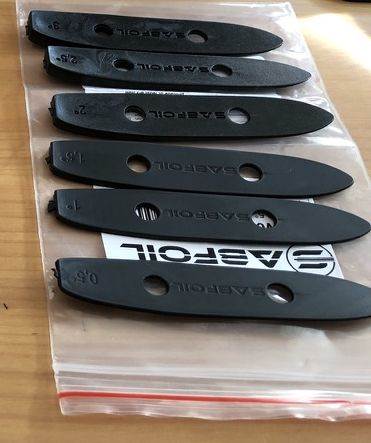 The square end is fat, the pin end is thin. With this they gain lift, right? I have two gray shims with my Moses 790 kit, they look similar and they gain lift too.
To reduce lift i use shims with thin square end and fat pin end.
Than i can calculate the angles easily: 900 fuse has -1.5 deg, i add a +1 deg shim so i get in result -0.5 deg total. Right?
If i would name reducing shims as negative, that would be confusing.
In the german forum i have read that the SAB race foils have + AND - shims in the kit. Very interesting.
At the exhibition in Silvaplana the boss of SAB told me to flip the negative shims 180 deg to depower my 790 foil. So thats why they do not sell depower shims for the freeride foils i think.
This was only for SAB shims. Other brands like Starboard may have other naming conventions. There is no general naming convention for foils so far.
For me as a long time RC model airplane builder/flyer is a positive angle of attack at a profile always looking up and a negative looking down.
Cheers Patrick
The thing that matters is the difference between front and rear wing orientation. And a difference is generally defined by subtraction.
ie. If the front wing is travelling at +2 degrees angle of attack on the fluid and the back wing at -2 degrees on that same fluid then you've got a 2-(-2) = 4 degree difference. If you want to shim it for more difference, (ie. more inclined to lift at low speed, and you want to stand further forward at high speed.) then shim the back by -2 to make it -4 . Then you've got 2-(-4) = 6 degrees. That'll get you going!
It makes sense that if the shim points the rear wing more downwards relative to the front wing we call it a negative (-) shim.
Of course you could always argue that differences should be found by addition.
Select to expand quoteIan K said..
The thing that matters is the difference between front and rear wing orientation. And a difference is generally defined by subtraction.
ie. If the front wing is travelling at +2 degrees angle of attack on the fluid and the back wing at -2 degrees on that same fluid then you've got a 2-(-2) = 4 degree difference. If you want to shim it for more difference, (ie. more inclined to lift at low speed, and you want to stand further forward at high speed.) then shim the back by -2 to make it -4 . Then you've got 2-(-4) = 6 degrees. That'll get you going!
It makes sense that if the shim points the rear wing more downwards relative to the front wing we call it a negative (-) shim.
Of course you could always argue that differences should be found by addition.
I totally agree.
That's why I started this thread, to get the discussion going so that we all come to an understanding about the naming convention for shims.
Like what is shown in the picture above I also have that set of SAB shims. They are labeled with numbers that do not have either positive or negative signs. That means they are positive degree numbers. I can prove this below.
At Boeing they say, "In God we trust, all others bring facts and data." Here below are some facts and data.
The first photo shows my -0.5 deg shim mounted under a 450 stab. I use this for my 950 wing.
The second photo shows, from left to right, a -0,5 deg, -1.0 deg, and the SAB-provided 1,5 deg. All were mounted such that up is the forward direction on the foil. The squared end is forward, the pointy end is aft. Note that the thickness is greater on the aft end for the negative shims, and that the thickness is greater on the forward end for the positive shim.
Now let's show some measurements, taken with a vernier caliper. Sorry, metric folks, these are in inches. I'm a yank. The third photo shows those measurements. The gray and white shims I got from Sailworks, and the black shim is from the SAB kit. Again the measurements show that the forward end is thinner than the aft end for the negative shims, and the reverse for the positive shim.
This proves that a negative shim REDUCES the down angle of the stab, This, therefore, REDUCES, the AOA of the front wing. This REDUCES the lift at a given speed. Examine the first photo again. If the aft end is thicker than front the down angle is reduced. In the photo this would rotate the stab 1/2 degree clockwise. Since the stab is on the bottom of the fuse, clockwise in the photo is a reduced down angle.
After two years of on-water experimentation with shims, I can testify that a negative shim REDUCES the lift and keeps the foil down during virulent gusts. Reducing the lift lets me use more back foot pressure to control the pitch of the foil.
QED


nice vid @ArtemN how much do you weigh if you don't mind my asking?
SAB lists the angle of incidence on their fuselages as -1.5 or -2.3 degrees depending on the fuse (negative b/c of pointing down?). All their shims are labeled w/ negative angles, so adding shims (or a negative to a negative) gives you a bigger difference relative to the fuselage.
Adrian Roper also explains his shimming naming convention: skip ahead to 26:50 as i can't embed timestamps w/ youtube. His rationale is difference in angles b/w the front wing and stabilizer are what matters, so positive shimming would be adding to this delta.
Select to expand quotesunsetsailboards said..
nice vid @ArtemN how much do you weigh if you don't mind my asking?
SAB lists the angle of incidence on their fuselages as -1.5 or -2.3 degrees depending on the fuse (negative b/c of pointing down?). All their shims are labeled w/ negative angles, so adding shims (or a negative to a negative) gives you a bigger difference relative to the fuselage.
Adrian Roper also explains his shimming naming convention: skip ahead to 26:50 as i can't embed timestamps w/ youtube. His rationale is difference in angles b/w the front wing and stabilizer are what matters, so positive shimming would be adding to this delta.
I'm 72-75kg, indeed Sab probably labeled as negative shim due to it's pointing down, whatever Adrian Roper is explaining makes total sense, we'll see how the industry settles with the naming convention.
Select to expand quotesegler said..
That's why I started this thread, to get the discussion going so that we all come to an understanding about the naming convention for shims.
Like what is shown in the picture above I also have that set of SAB shims. They are labeled with numbers that do not have either positive or negative signs. That means they are positive degree numbers. I can prove this below.
At Boeing they say, "In God we trust, all others bring facts and data." Here below are some facts and data.
The first photo shows my -0.5 deg shim mounted under a 450 stab. I use this for my 950 wing.
The second photo shows, from left to right, a -0,5 deg, -1.0 deg, and the SAB-provided 1,5 deg. All were mounted such that up is the forward direction on the foil. The squared end is forward, the pointy end is aft. Note that the thickness is greater on the aft end for the negative shims, and that the thickness is greater on the forward end for the positive shim.
Now let's show some measurements, taken with a vernier caliper. Sorry, metric folks, these are in inches. I'm a yank. The third photo shows those measurements. The gray and white shims I got from Sailworks, and the black shim is from the SAB kit. Again the measurements show that the forward end is thinner than the aft end for the negative shims, and the reverse for the positive shim.
This proves that a negative shim REDUCES the down angle of the stab, This, therefore, REDUCES, the AOA of the front wing. This REDUCES the lift at a given speed. Examine the first photo again. If the aft end is thicker than front the down angle is reduced. In the photo this would rotate the stab 1/2 degree clockwise. Since the stab is on the bottom of the fuse, clockwise in the photo is a reduced down angle.
After two years of on-water experimentation with shims, I can testify that a negative shim REDUCES the lift and keeps the foil down during virulent gusts. Reducing the lift lets me use more back foot pressure to control the pitch of the foil.
QED
I think the last shim in your photo must be an older one. SABFoil only supplies negative shims that increase the downforce that the stabiliser creates compared to the standard baked in angle on the fuselage. The measurements in the photo show that the top two sailworks shims would be positive angles and the last one negative according to the way the latest SABFoil shims are labelled. I have an identical shim to the last one that is now labelled -15. degrees.
I'm not surprised you need a +0.5 degree (labelled -0.5 by sailworks) shim with the 950/450 combination to reduce the stabiliser angle to -1.0 degrees. The 450 stabiliser creates lots of downforce relative to the amount of drag from the 950 front wing.
I agree with simonp65. S450 is the only stab where i need a shim (for W950/W999). And i use a 1dec to reduce the lift. Sadly SAB only offers shims to increase the lift.
Slingshot Hoverglide foiler here. I measured my stock stab AOA at -3.5. At higher speeds my i76 had too much lift so I placed a plastic tab from a bread bag under the front of the stab (it's on top of the fuse) then a piece of packing tape on the leading edge to cover the gap created. Can't exactly recall but I think it took the AOA to -2.5. Much better ride. I know of several foilers more skilled than I who do this. Very simple hack.
All stock foils start out shimless with some amount of designed-in stab down angle, anywhere from -0.5 to -4.0 degrees.
That's the starting point. No shim.
Now when you add a shim, the naming convention (for SAB and SB anyway) is that a positive shim number INCREASES the down angle to INCREASE the lift. A negative shim number DECREASES the stab down angle to DECREASE the lift. The positive or negative number describes the change in lift. Positive for increase, negative for decrease. Simple.
Obviously the thickness taper from front to back will differ depending on whether the stab is above or below the fuse. SAB and AFS put the stab below the fuse, same side as the front wing. LP and many others put the stab above the fuse. Therefore the thickness taper front to back will be opposite for SAB/AFS compared to LP and many others.
So, my SAB positive shims are thicker in front, negative shims are thinner in front. My LP shims are the opposite.
Select to expand quotesimonp65 said..
... I have an identical shim to the last one that is now labelled -15. degrees.
Sorry - ignore this. All my SABFoil shims are labelled without the minus sign even though they are sold as being negative shims
I have just completed a design project on a WinD and WinGfoil.....I really wanted to simplify the whole shim situation and avoid confusion so decided to break away from angle numbers and have a power rating. The angle preset on the fuselage is the shallowest angle you would ever set the stab up at ( least amount of down force) There are 4 shims and each has a power rating indicated by small holes in the shim..1 hole being the lowest power rating up to 4 holes being the highest power rating. The preset angle in the fuse is 0.7 degrees, shim no 1 is a 0 degree isolator ( isolating the carbon stab from the alloy fuse)shim 2 is 0.4 degrees, shim 3 is 0.8 degrees and shim 4 is 1.2 degrees.
So rather than having to remember angles and get confused with + and -. All you have to know is the more holes the more power, so much simpler....