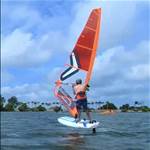
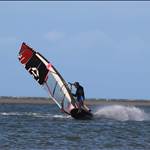
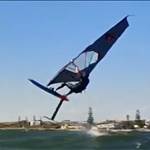
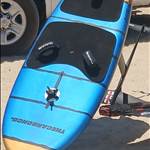
I hava a nice set (4,7 - 5,0 - 5,3 - 5,7) Severne Blade pro 2021 witch I use with a 90 ltr FSW board for medium to high wind freestyle wave bump and jump windsurfing. At low wind I go foiling with mij 105 ltr Horue board.
I can not carry a lot of shizzle in my car, so I always I hasitate what gear to take we me to the water. Mostly I take the 90 FSW and the foilboard with a lot of sails and masts.
Is my Severne Blade pro sail also good for light wind foilstyle foiling at my local freshwater lake?
I don't like the feel of regular (non pro) blades when foiling compared to freeks or others, but if I'm desperate and the wind drops and I have a blade I will rig it with some extra extension to move the center of effort higher and back off on the downhaul. They work but just not my favorite.
Ok so that reply makes me want to hijack the thread lol.
if higher COE is better, then is an S1 Pro better than Blade? Due to the upward lift pull rather than forward drive?
Select to expand quoteMark _australia said..
Ok so that reply makes me want to hijack the thread lol.
if higher COE is better, then is an S1 Pro better than Blade? Due to the upward lift pull rather than forward drive?
No mast pressure?
Select to expand quoteMark _australia said..
Ok so that reply makes me want to hijack the thread lol.
if higher COE is better, then is an S1 Pro better than Blade? Due to the upward lift pull rather than forward drive?
The short answer is yes.
Even despite the fact its less stable? Which really is not much less, and using the sail in less wind than wavesailing so its prob negligible. Right..?
Your Blade Pros will work fine for wind foiling.
Use them for a while and if you are still thinking you need a dedicated foil sail, buy 1 x foil freek in the size you use the most for wind foiling (my most used size is my 4.7m) and test it out.
Also Blade vs S1: The Severne website rates the Blade and the S1 the same at ++ for use on the Predator (whatever that means?).
www.severnesails.com/boards/predator/
I have had Blade Pros since 2015 and have used them for foiling since 2020. Short answer is yes it works extremely well for wind foiling.
To get the most out of the sail you have to rig it a little bit different. You can ad 5-10 cm more extension than what's listed on the sail to increase the lift the sail produces. Only downhaul until the leach is just about to go loose. Fun fact you can use the same trick to get a wave board planing a touch earlier but the lack of loose leach will be noticeable a lot earlier on a windsurf board.
Depending on what you define as light wind 4.7 might be too big as you smallest sail. I recently started using a 4.2 in 20knts. where I would normally use a 5.7 for windsurfing.
I really can't get why a higher CEO would be better for winDfoiling, espacially if you are foiling a small freeride/foilstyle board (sub 2m length, 100l or so, inner straps). I tend to go for the exact opposite, trying to minimize the sail effect as much as possible on the yaw (and pitch). Can anyone enlight me with any real physic explaination for this ?
As you go faster you must reduce the angle of attack of the foil to maintain the same lift (your total weight) . You do this by shifting your weight forwards, but the increased thrust from the sail (with increased wind, hence why your speed is increasing) also helps to push the nose of the board down too, reducing the foil angle of attack. It's the leverage of the thrust up high versus the drag from the foil down low which does this, hence the effect of centre of effort/pressure height.
How much this matters to your own setup will depend on the other factors affecting stability, such as the foil tail size and trim angle, and rig weight and how far forwards it is.
It's very apparent with a stable foil (SB Superflyer) and a big (8m2) rig in my case. Moving to a foil specific sail has changed the tail wing angle required by a degree or two, towards nose up, and made it more comfortable in gusts.
^^^^ that's why I asked about the S1Pro
it is not a high coe question is the fact the sail lifts up more than drives forwards. So I figure less mast foot pressure
Select to expand quote6u1d0 said..
I really can't get why a higher CEO would be better for winDfoiling, espacially if you are foiling a small freeride/foilstyle board (sub 2m length, 100l or so, inner straps). I tend to go for the exact opposite, trying to minimize the sail effect as much as possible on the yaw (and pitch). Can anyone enlight me with any real physic explaination for this ?
Interesting. I never tried lengthening the base because I date back to the eighties when it was all close the gap, but with a wave or fs sail you obviously never close any gap.
For windfoiling I always did the opposite: shorten the base by 2 cm so that the leech remains tighter (to just about going loose leach) while keeping the gap below between board and sail small.
But you actually recommend lengthening it.
I would assume the reason for a higher COE would be to have more leverage to get planing, but from other posts It seems to be more about control at speed to push the nose down.?
Select to expand quoteTomDW said..6u1d0 said..
I really can't get why a higher CEO would be better for winDfoiling, espacially if you are foiling a small freeride/foilstyle board (sub 2m length, 100l or so, inner straps). I tend to go for the exact opposite, trying to minimize the sail effect as much as possible on the yaw (and pitch). Can anyone enlight me with any real physic explaination for this ?
For windfoiling I always did the opposite: shorten the base by 2 cm so that the leech remains tighter (to just about going loose leach) while keeping the gap below between board and sail small.
But you actually recommend lengthening it.
At the risk of stating the obvious you add extension length but still pull less downhaul to have a tighter leach. You don't go block to block.
Ok, It seems I really need to clarify.
I was just asking for a reason to try to have the CEO high. It just puzzled me as IMHO, it makes balancing the all kit all the more difficult, but I really think that there are riders that have different thinking from mine, and I just try to get their reasoning. I don't say I have 'THE' way to tune a foiling rig. I know why I tune as I do, but I am also sure I still need to learn.
I tune my wave sails with loose leach : I really don't like the feeling of tight leach for my foiling. I usually rig on a shorter mast than recommended, but with a long extention (48cm) or mast extender. That's to get a softer mast. Being quite light, I figure that to get the sail into its desired shape with the little pressure we get when foiling, a softer mast is better.
As for trying to have the lowest CEO, I use Naish Chopper, ie sails that are just as if they had their top panel removed. I know it is not as efficient in terms of 'finesse' (low aspect). But what I found difficult to manage when foiling, is the gust (wind is quite nasty where I usually sail), and the changing downforce is hard to manage. for the same reason, I choose to have my UJ as aft as possible : its just about 10cm ahead of my front foot strap. My kit is thus quite twitchy, but less responsive to gust.
As for reducing AOA when going faster, it's automatic, no way to avoid it. But if you need more down force on the nose (either require to move your weight forward or on your sail), that means that your foil is designed with increasing tilt up tork. All foil do increase tilp up tork with speed, but the curb isn't the same for all, and there's a range of AOA where you can expect the tilt up tork to be rather constant. I don't chase top speed, and as long as I stay in my usual speed range (I guess somewhere between 15 to 22kt) the tilt up tork doesn't change much, so I don't feel the need for more down force (at least if I trimed correctly my stab, wich isn't always the case). But I can see why one would need this to get a very smooth and stable ride in light sea breeze. I sincerelly think that wave sails aren't the best at this game. I am more riding from gust to gust on lake and foil pumping.
A higher center of effort for a freestyle board allows for more "pop". On a wakeboard it will have a less planted feel and should get the board going a touch earlier. Similar story for getting foiling early.
BTW the 5-10cm extension and keeping the leach of the sail tight was a tip that came from Ben Severne in regards to rigging a Blade for foiling after I said it feels super planted. The measurements on the sail are a recommended middle ground. I have played around wit this on the waveboard in lower wind and a tighter leach with a touch more extension definitely gets the board going faster. Do will need to change the rigging once the wind picks up. On the foil setup though I find once I rig it in that way it doesn't make a massive difference as the wind picks up.
On a more theoretical level and in regards to chasing top speed you won't be able to get much out of playing around with the sail when using your stock standard free ride windfoils. The German Surf Magazin had a really good article about this a few years ago. They had the founder of Maui Ultra Fins who used to work in aeronautical engineering and has a background in Hydrodynamics explain about inherent max speed based on the front wing design.
You can tickle out extra speed by having a thinner and narrower mast as well as a more aerodynamic fuselage and ideally no trail wing but you'll only get maybe an extra 1 or 2 knots out of it if that. The really only makes a difference once we are talking higher speeds in excess of 35 knts.
The top speed apparently directly correlates to the minimum stall speed. In other words the idea high speed wing will have a very high stall speed. So the trick would be to get the board to at least that minimum stall speed. He also said the inherent stability will go down as the potential top speed of the wing increases. Probably why the americas cup hydrofoils have a computer assist.
Select to expand quotestehsegler said..
A higher center of effort for a freestyle board allows for more "pop". On a wakeboard it will have a less planted feel and should get the board going a touch earlier. Similar story for getting foiling early.
That's where I'd like to have some comprehensible definition of what is the 'pop' that you're mentioning. I've often heard about this, but can't really grasp what it is : I am definitely not skilled enough to experience it. I need to compensate for my lack of riding skill with a better understanding of the physic involved.
It already took me some reading and thinking to understand how having a higher boom on a slalom board makes it flying over the chop, and lowering it gives more control to prevent unwanted takeoff. Always trade off.
At first I would thought that CEO height would have the same kind of effect : having a higher CEO would be as having a lower boom, as the leverage (the ratio of CEO height over wishbone height) should increase, thus pushing the board down. But if I understand you correctly, it is some kind of total opposite with this 'pop' feeling.
The way I see it when people talk about "pop" they mean it's easier to get the nose of the board into the air. One of the reasons Freestyle sails have the centre of effort further up in the sail.
Can't remember where but I saw a diagram in a magazine not long ago that explained the directional force in a sail and how it shifts as the shape / coe / rigging of the sail changes. It's not exact science but I figure if the guy that designed the sail says "try the following to give you more lift there must be some truth to it".
Select to expand quotestehsegler said..
The way I see it when people talk about "pop" they mean it's easier to get the nose of the board into the air. One of the reasons Freestyle sails have the centre of effort further up in the sail.
I use freeks om foil with gorilla masts, if i rig with tight leech and outhsul to spec sail will have enough "pop" to lift me onto foil within a few short pumps in lighter wind than you would expect...
Select to expand quotestehsegler said..
A higher center of effort for a freestyle board allows for more "pop". On a wakeboard it will have a less planted feel and should get the board going a touch earlier. Similar story for getting foiling early.
BTW the 5-10cm extension and keeping the leach of the sail tight was a tip that came from Ben Severne in regards to rigging a Blade for foiling after I said it feels super planted. The measurements on the sail are a recommended middle ground. I have played around wit this on the waveboard in lower wind and a tighter leach with a touch more extension definitely gets the board going faster. Do will need to change the rigging once the wind picks up. On the foil setup though I find once I rig it in that way it doesn't make a massive difference as the wind picks up.
On a more theoretical level and in regards to chasing top speed you won't be able to get much out of playing around with the sail when using your stock standard free ride windfoils. The German Surf Magazin had a really good article about this a few years ago. They had the founder of Maui Ultra Fins who used to work in aeronautical engineering and has a background in Hydrodynamics explain about inherent max speed based on the front wing design.
You can tickle out extra speed by having a thinner and narrower mast as well as a more aerodynamic fuselage and ideally no trail wing but you'll only get maybe an extra 1 or 2 knots out of it if that. The really only makes a difference once we are talking higher speeds in excess of 35 knts.
The top speed apparently directly correlates to the minimum stall speed. In other words the idea high speed wing will have a very high stall speed. So the trick would be to get the board to at least that minimum stall speed. He also said the inherent stability will go down as the potential top speed of the wing increases. Probably why the americas cup hydrofoils have a computer assist.
I actually found that article in Surf Mag online and found it quite interesting indeed! Thx