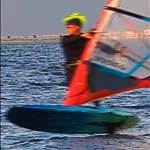
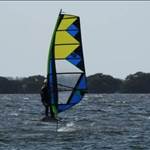
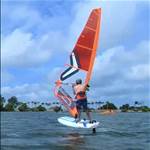
So in my pursuit of the lower boundary of foiling nirvana, trying to maximize my time on the water with the light winds where I live, I wrote a letter to Santa (I've been on the naughty list but pulled a few strings) and he delivered early: a Phantasm 930 foil with an 87 cm wide carbon mast and an 8.0 meter Severne Foil glide 2 sail.
There was no wind yesterday so I spent some time assembling the Phantasm foil, which I'm planning to use on my Starboard FoilX 145 board. More information: I weight just under 75 kg, am 60 years old, reasonably fit, but pumping onto the foil isn't getting easier, hence my quest to make it easy to foil in light air. I live on a river near Savannah, Georgia with afternoon seabreezes typically ranging from 6-12 mph, so the water is always flat and there are no waves or extreme maneuvers planned.
I've been using a Slingshot i99 Hoverglide for the last couple of years. Here's my question: with the Hoverglide, the winglets on the tail wing turn up, whereas on the Phantasm, the winglets on the tail turn down. Can anyone explain to me why this should be the case?
Also, since the FoilX doesn't have a track for the mast, I'm using the jack plate adapter which has a moderate amount of fore and aft adjustability. I'm hoping I have the foil far enough forward to eliminate the "back footed" feeling that I had with the i99 and the deep Tuttle box. I copy a few photos for those who are interested. I'm hoping to get on the water this afternoon if the wind picks up at all.


I do not know what the designer's reasoning is. I have tried them both ways and my preference has alway been for down turning tips because it gives you more usable ride height. With up turning tips I often vent the stab sailing downwind passing the harbor chop.
Do not know why stab tips are downward on one and upward on other. As for light wind foiling, I am 82 kg and fit, use an AFS W95 foil with F1080 cm2 wing for 8-12 knots, under 10 knots use a Aerotech non-cambered FreeSpeed 8.0 sail, over 10 knots and up to ~12 knots use a FreeSpeed 7.2, on a 80 cm wide Goya Bolt 135. The Foil X 145 is only 71 cm wide so that should make it easier to get up in light wind. Stance, pumping technique, and properly setup kit, make a huge difference in light wind, I learned that from Andy Brandt in one of his camps. By the way, see 2 AFS W85 foils for sail on Craigslist in Florida with I think the F1080 wing, but no pics so not 100% sure.
As for being back-footed, if I am back footed it means I am underpowered, because my kit is balanced when powered, so I put on either a bigger sail or bigger wing (easier).
You are on a huge wing in comparison (i99 2391 cm2, PFI 928 2343 cm2), so both have a lot more drag than my F1080 wing, and that will make it harder to get up, and once you are up will go slower and be more susceptible to foil outs with gusts than the F1080. My prediction is the PFI 928 is not going to help you much in your quest for light winds, but will certainly help for foiling gybes! (though similar to i99). I certainly would have bought a bigger wing from AFS if they sold one, when I was trying to get up in light winds, but now I realize why they do not make a bigger wing for light wind windfoiling, it is not needed! You just need good technique and that includes stance and pumping, as well as a properly setup kit, it only takes me a couple of well timed sail pumps to get up in 8-9 knot gusts. Still have time to ask Santa for a lesson with Andy! See some dates on his schedule for January in Titusville and St. Pete.
Appreciate the comments. Sandy, you are likely right that better technique would help. I actually took one of Andy Brandt's clinics last week and we worked on stance and pumping.
If there's any wind after the World Cup final, I'm going to give it a go.
Select to expand quoteFoulweatherjack said..
Appreciate the comments. Sandy, you are likely right that better technique would help. I actually took one of Andy Brandt's clinics last week and we worked on stance and pumping.
If there's any wind after the World Cup final, I'm going to give it a go.
Glad to help Jack, a key point for me from my lesson with Andy was leaning out over the water while sail pumping to get up, and that of course takes the right sized sail. Getting weight over the water, and off the board/foil, makes a huge difference, along with proper sail pumping. Now I will throw in a couple of foil pumps too, while sail pumping, once sail pumps get me moving forward, if on lower end of wind range for the sail/wing combination. There is certainly a balance I try to achieve with a sail/wing combo and pumping effort to get up, I prefer only needing a couple of sail pumps to get up when on 1/2-3/4 mile long runs.
Select to expand quoteFoulweatherjack said..
Where is the jack plate in this configuration? The taper on the back of the carbon wide confuses me. I have the jack plate 1 position back from the furthest forward it will go and push the mast side as far forward as I can and I think it looks further forward than that. Will try to get a picture in a bit
Here's where I've got mine. But also it's the ptm 926 not that wing so there may be some differences.


Aero:
The jack plate on my board is in the same location as yours. The taper on the Phantasm mast makes it difficult to appreciate the actual location of the mast. I think I'm just going to try it the way it is for now. It's kind of cold so I have to put on wet suit, but it looks like the wind may be building so I'm gonna give it a try.


Appreciate the comments. Sandy, you are likely right that better technique would help. I actually took one of Andy Brandt's clinics last week and we worked on stance and pumping.
If there's any wind after the World Cup final, I'm going to give it a go.
Appreciate the comments. Sandy, you are likely right that better technique would help. I actually took one of Andy Brandt's clinics last week and we worked on stance and pumping.
If there's any wind after the World Cup final, I'm going to give it a go.
Yeah looks like you can still push the mast forward without moving the jack plate. Worth adjusting if it's still backfooted to you.
So with the jack plate in position as above, it still felt a little back footed, so I came in and moved the jack plate one notch forward. Sadly, the wind died afterwards, so I wasn't able to try out the new balance.


Not trying to rain on your festive parade but that foil looks way to far back for a foil like the PFI928.
if there is anyway Santa could do you a solid with a used wizard or levitator with twin tracks it would open up a whole other world for you. When I tested the i99 on the wizard 130 it was much further forward than your board.
you will enjoy that phantasm mast and solid feel over the hoverglide etc many riders under estimate the importance of the mast in light winds and the 87W is going to be way stiffer than the aluminum mast.
With regards to the wing tips, it must be less drag because it's a much quicker foil and I do not feel as if you give up any stability!, it's a win-win

Thanks, Core: I appreciate the benefit of your experience. I can still move the foil forward an inch or two; I think I'll try that on the jack plate before moving to another board: I may have used up all my favors with the elves at the North Pole.
Select to expand quoteFoulweatherjack said..
Thanks, Core: I appreciate the benefit of your experience. I can still move the foil forward an inch or two; I think I'll try that on the jack plate before moving to another board: I may have used up all my favors with the elves at the North Pole.
ok glad you can still move the foil forward couple more inches, if it still feels back leggy maybe move the sail/rig mast base back towards you but only 1cm at a time, it will help with early lift however if you move it too much it will pop up quick, but it will feel really foil sensitive and all other place in gusts etc.
Back to your question Jack, Phantom foils has a stab. with subtle downward tips, while ZFINS foils has the stab. almost flat with no tips. Anything that is not in the slip stream of the front wing could increase drag, so that may explain in part why most of the top guys at the last PWA event were on ZFINS foils. So stab. tips up or down are going to increase drag, but may also increase stability. That would explain why ZFINS foil has a little vertical fin just in front of the flat stab.
And remember, if you are under powered for the wind (in your case because of too small of a sail) you will be back footed when up on the foil, but shiming the stab. can solve that problem too, I needed to use 1AFS stab. shim on my foil to not need so much back foot pressure to get up and stay up. Of course as pointed out by others, Adjusting foil and sail mast position may also solve the problem.
Select to expand quoteSandman1221 said..
Back to your question Jack, Phantom foils has a stab. with subtle downward tips, while ZFINS foils has the stab. almost flat with no tips. Anything that is not in the slip stream of the front wing could increase drag, so that may explain in part why most of the top guys at the last PWA event were on ZFINS foils. So stab. tips up or down are going to increase drag, but may also increase stability. That would explain why ZFINS foil has a little vertical fin just in front of the flat stab.
Winglets REDUCE drag
Select to expand quoteaeroegnr said..Sandman1221 said..
Back to your question Jack, Phantom foils has a stab. with subtle downward tips, while ZFINS foils has the stab. almost flat with no tips. Anything that is not in the slip stream of the front wing could increase drag, so that may explain in part why most of the top guys at the last PWA event were on ZFINS foils. So stab. tips up or down are going to increase drag, but may also increase stability. That would explain why ZFINS foil has a little vertical fin just in front of the flat stab.
Winglets REDUCE drag
Really, so why were all the top finishers at the last PWA on a foil that did not have stab. winglets? Do you know what you are talking about?, sometimes you do get confused when responding to comments I make aero. Note that the Phantom and ZFINS foil front wings do not have winglets, so maybe you should let them know about your discovery!
Now Boeing has pronounced winglets on the front wing of their planes that fly in air, but here we are talking about stabilizer winglets on a foil that "flies" in water.
The Boeing front wing winglets were designed after large birds that when "soaring" use their wing tip feathers to make "winglets" to reduce drag, but those same birds do not use their tail feathers to make winglets, and when they are diving they do not use their wing tip feathers to make winglets, probably because they create drag at high speeds!
All lifting surfaces have a flow component that goes from root to tip. This is more pronounced in air than in water, and it is more pronounced at low speeds and high attack angles (such as during takeoffs and landings). The idea of winglets is to reduce the tip vortex from this spanwise flow. Tip vortex creates drag. At low speed and high attack angles, the tip vortex causes the wing to stall more easily. Winglets have been a huge improvement in flight safety.
The airplane industry has studied this for many years. Tips up, tips down, tips both (earlier Airbus), tips big, tips small, on and on. Alaskan bush planes have massive down-turned tips. The advantage of the airplane industry is that they have had wind tunnels to study all this.
OK, back to water. A few people, such as the well funded AC and such, have also made similiar flow devices to study lift and drag in underwater foils. Their body of knowledge is getting bigger and better all the time. We all benefit.
Yes, I think winglets on foils is less important than for air. As mentioned, all sorts of foils out there are performing just fine without winglets.
There is another quite important unrelated benefit of winglets. They do indeed provide the benefit of less tendency to cut your leg when you (inevitably) kick your foil. In July on a fluke fall I kicked the wing of my SAB race foil (no winglets) bad enough to keep me off the water for 4 months. (You can always recognize a foiler (or formula sailor) by all the nicks on their legs.)
Select to expand quotesegler said..
All lifting surfaces have a flow component that goes from root to tip. This is more pronounced in air than in water, and it is more pronounced at low speeds and high attack angles (such as during takeoffs and landings). The idea of winglets is to reduce the tip vortex from this spanwise flow. Tip vortex creates drag. At low speed and high attack angles, the tip vortex causes the wing to stall more easily. Winglets have been a huge improvement in flight safety.
The airplane industry has studied this for many years. Tips up, tips down, tips both (earlier Airbus), tips big, tips small, on and on. Alaskan bush planes have massive down-turned tips. The advantage of the airplane industry is that they have had wind tunnels to study all this.
OK, back to water. A few people, such as the well funded AC and such, have also made similiar flow devices to study lift and drag in underwater foils. Their body of knowledge is getting bigger and better all the time. We all benefit.
Yes, I think winglets on foils is less important than for air. As mentioned, all sorts of foils out there are performing just fine without winglets.
There is another quite important unrelated benefit of winglets. They do indeed provide the benefit of less tendency to cut your leg when you (inevitably) kick your foil. In July on a fluke fall I kicked the wing of my SAB race foil (no winglets) bad enough to keep me off the water for 4 months. (You can always recognize a foiler (or formula sailor) by all the nicks on their legs.)
Yes I think it comes down to design tradeoffs and design speeds. High aspect thinning tips without winglets are efficient but that leads to a sharp edge and may start to have structural, vibration, durability or manufacturing issues at a certain point. Mid aspect are going to benefit more from winglets when they are shorter and may have more sweep for other reasons, and they won't stab you as easily as in your case. That sounds like it really sucked.
Select to expand quoteaeroegnr said..Sandman1221 said..
Back to your question Jack, Phantom foils has a stab. with subtle downward tips, while ZFINS foils has the stab. almost flat with no tips. Anything that is not in the slip stream of the front wing could increase drag, so that may explain in part why most of the top guys at the last PWA event were on ZFINS foils. So stab. tips up or down are going to increase drag, but may also increase stability. That would explain why ZFINS foil has a little vertical fin just in front of the flat stab.
Winglets REDUCE drag
On wings yes, on stabs no. Likely at the Renolds numbers and wing loading we are operating at they make little difference to efficiency but a significant difference to "feel".
Select to expand quoteGrantmac said..
On wings yes, on stabs no. Likely at the Renolds numbers and wing loading we are operating at they make little difference to efficiency but a significant difference to "feel".
winglets on the stab contribute to the directional stability of the foil. Winglets on the wings do, too, but not as much. The Zfin foil compensates for the flatness of their wing/stab by using a small vertical fin. Otherwise, you get a foil that can occasionally feel like it wants to yaw at times - having ridden a foil with flat wings/stab myself.
Select to expand quoteGrantmac said..aeroegnr said..Sandman1221 said..
Back to your question Jack, Phantom foils has a stab. with subtle downward tips, while ZFINS foils has the stab. almost flat with no tips. Anything that is not in the slip stream of the front wing could increase drag, so that may explain in part why most of the top guys at the last PWA event were on ZFINS foils. So stab. tips up or down are going to increase drag, but may also increase stability. That would explain why ZFINS foil has a little vertical fin just in front of the flat stab.
Winglets REDUCE drag
On wings yes, on stabs no. Likely at the Renolds numbers and wing loading we are operating at they make little difference to efficiency but a significant difference to "feel".
I could be wrong, wouldn't be the first time and probably not the last, and yeah they to Paducah's point they do something with lateral stability. Seems like at low speed if you chopped off the winglets on something like the phantasm rear they'd probably be a little more draggy and less stable, at higher speeds it would be a different story.
I appreciate all of the erudite comments. Just wondering, does Santa's sleigh have winglets too? How do the reindeer achieve avoid too much yaw while pulling the fat guy in the back? And what's the Reynolds number on the sleigh? Maybe there's some carryover knowledge that we can apply to wind foiling.
I appreciate all of the erudite comments. Just wondering, does Santa's sleigh have winglets too? How do the reindeer avoid too much yaw while pulling the fat guy in the back? And what's the Reynolds number on the sleigh? Maybe there's some carryover knowledge that we can apply to wind foiling.
Select to expand quoteFoulweatherjack said..
I appreciate all of the erudite comments. Just wondering, does Santa's sleigh have winglets too? How do the reindeer achieve avoid too much yaw while pulling the fat guy in the back? And what's the Reynolds number on the sleigh? Maybe there's some carryover knowledge that we can apply to wind foiling.
I'm no expert but I think it's the sleigh's Rudolph number not the Reynolds number > 1 or his delivery will be late. Speaking of which, I bet he's a fantastic ice boarder
Stability definitely falls under that nebulous category of "feel".
The overall dihedral profile of the wing and stab are also a major factor.
I quite like a fairly flat wing, downturn tips are too stable in the wider sizes. Anhedral flattening to the tips or even coming up into a little dihedral seems to create a very unsettled and challenging wing, especially coupled with a flat stab.
Select to expand quoteGrantmac said..
Stability definitely falls under that nebulous category of "feel".
The overall dihedral profile of the wing and stab are also a major factor.
I quite like a fairly flat wing, downturn tips are too stable in the wider sizes. Anhedral flattening to the tips or even coming up into a little dihedral seems to create a very unsettled and challenging wing, especially coupled with a flat stab.
The PTM 926 has an interesting anhedral to it that flattens some at the tips. Kind of curious what it would feel like with a flatter stab. It felt more lively than the i76 and i99 for sure, haven't ridden the lower aspect phantasms like foulweatherjack has.
This discussion, and others like it, are great in that they show the maturity of the sport. In 2016-7, all we wanted was to get up off the water and stay there. Period. A single on-wing reach all the way across the Columbia River was a major accomplishment.
Now we talk about foil dynamics, shapes, aspect ratios, speeds, structures, sizes, the full gamit. Throw in boards and sails, too.
This all happened in regular windsurfing, too, over the years. Kiting and winging, too. You see the improvements every year. It also helps that the riders have all gotten better as well.
It will just keep getting better, and we all will benefit.
The turned down tips on the phantasm stabilizers do almost nothing to reduce drag by mitigating the tip vortices. I can tell you that as an engineer and also as a rider that sanded off the tips from one of my phantasm stabilizers. What they do do is slightly improve the yaw stability of the foil with very little impact on the pitch stability.