I imagine those with a bit of expertise can negotiate familiar sandbars in relative safety by holding good height. Can you sense the ground effect starting to kick in?
If so how would mounting the rear wing 2 or 3 inches lower go? An inverted T tail. It should get into ground effect sooner, suck itself lower, pitch you back up. Terrain following without the radar. en.wikipedia.org/wiki/T-tail
Select to expand quoteIan K said..
I imagine those with a bit of expertise can negotiate familiar sandbars in relative safety by holding good height. Can you sense the ground effect starting to kick in?
If so how would mounting the rear wing 2 or 3 inches lower go? An inverted T tail. It should get into ground effect sooner, suck itself lower, pitch you back up. Terrain following without the radar. en.wikipedia.org/wiki/T-tail
I never win negotiating with sandbars. I always get into an argument and end of with a sore wallet. Best to leave them alone!
But then again I have very little expertise
Tried that negotiation ONCE, cost me some good bruising and a boom head.
Pick a fight you can win
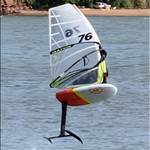
At least in onshore conditions, waves tend to ramp up and get steeper over sandbars. Foils like the Infinity 76 and 84 tend to get pushed up and down quite a bit waves; in steep chop waves, going up or down 50 cm in a second is quite normal. After mapping out the local shallows by hitting them a few times when slogging, the solution is simple: walk an extra 100 m. Two extra incentives are that these shallows are often rocks and shells rather than sand, and that there's lots of sea weed growing on the bottom that sticks really well to foils.
The one sand bar we have close to the launch that's soft sand has produced some funny crashes when foilers came in high, but not quite high enough.
I am familiar with ground effect from flying gliders and I can confidently state I have never once felt anything close to it on a hydrofoil.
Select to expand quoteWindbot said..
I am familiar with ground effect from flying gliders and I can confidently state I have never once felt anything close to it on a hydrofoil.
I agree. Ground effect occurs when air off the wing is displaced downward and forms a high pressure area under the wing, increasing lift and extending glide. I don't think that would occur in a liquid as it can't be compressed.
I'd be pretty sure it's there. Just questioning whether it kicks in far enough off the bottom to be felt or taken advantage of. ( before crashing). The WSSRC considers it exists.... for planing hulls at least.
www.sailing.org/news/3762.php
"There is much anecdotal evidence about the positive effects on speed by the shallow water effect and certain published study including the effect on fast ferries when entering shallow water and using the effect to "unstick"
seaplanes. However in order to obtain some hard data, the Council commissioned the Wolfson Unit of Southampton to prepare a paper on the specific subject.
Their conclusion of this detailed study was that the drag of a planing board is reduced when the water depth is less than the beam of the board, with a possible reduction of 50% in very shallow water of less than half the beam of the board. A water depth of 50cm would be deep enough to avoid shallow water effects."
Sandbars are a fact of life on the inshore waters of Florida. So, to avoid them I get really picky about where I windfoil. Yes, you can find spots that remain deep enough, even at low tide. I have three such spots in the Tampa/St Pete area of the Gulf coast. Most freshwater lakes are plenty deep, but they also sometimes harbor gators, at least in the shoreline weeds. Check with the locals. Stay out in the open.
Ground effect is a feature of lift in a compressible medium like air. Since water is not compressible at our speeds, ground effect is negligible.
Surf foilers spend most of their time in shallow water and there was a highly technical discussion on the Progression Project podcast (podcasts.apple.com/us/podcast/the-progression-project/id1206097336 ) where they claim that there was a ground effect when the wing gets near the bottom.
Some of the posts above say that because water is difficult to compress this wouldn't allow ground effect. But wouldn't that actually increase ground effect instead? When the water gets squeezed between the wing and the bottom I would expect the pressure on the underside of the wing to increase even more because water is not very compressible.
The surf foilers on the podcast also talk about a sort of ground effect from being close to the water surface. the theory being that the water has more difficulty swirling off the wing tips and back onto the top surface of the wing.