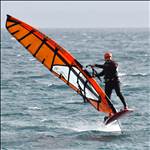
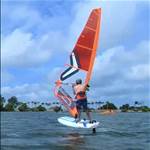
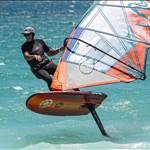
Hello from Mallorca! Sorry of my english.
I just upgrade my Starboard GTR+ to Starboard evolution with IQ foil mast, 95 evolution fuselage, 725-650-575 front wing, and 255 -2 thin estab. I make slalom foil all the time, looking for a max speed cross the wind and down wind. I sail always with the wind from the open sea, with choppy in open bay. After a long winter season doing freefoil with 5-4-3 m2 sail, now I'm readapting to my new foil. Now I can sail with higher wind, but for the moment I'm not faster than the last year with the GTR foil. I usually have two problems:
1) One problem I feel is always the same; in downwind with I push to the limit, the movement of the choppy it force me to make continuous rectifications with every chop to keep the foil in the water. This continuous rectifications make very difficult increase speed. In fact sometimes I'm faster across the wind because the choppy don't affect less. I order a 105 fuselage looking for more stable feeling.
2) Another problem, is when the wind is higher the pression in the rear foot increases a lot because the sail is pushing harder on the nose. I try to move to pope the mast track, and pull a litlle more the downhaul to decrease the downforce of the sail. But at the end, my rear leg is working to much. I don't know if my problem is the drag of the foil, or I need more power on the stab. Or I need to train to have more power on my legs.
Thanks in advance for your help!
Select to expand quotemr love said..
Mast track back..straps back if you can..it will help.
yeah, second moving mast base back, if it is a regular slalom board move mast base all the way back in the mast track, and use a single bolt mast base, two bolt base will not let you go as far back.
The OP wrote: "downwind with I push to the limit, the movement of the choppy it force me to make continuous rectifications with every chop to keep the foil in the water. This continuous rectifications make very difficult increase speed."
This exactly why Bruce Peterson recommends you balance and tune for more back foot pressure if you want higher speed. Moving the sail mast base backward will actually make the situation worse. Keep it forward. Also keep your footstraps forward. For speed you want the whole foil further behind you.
Also if your sail mast base pressure lightens with every chop, the pitch will come up, requiring a correction. Try to keep the down pressure constant with the boom and/or harness. Use a long foil mast to keep the bottom of board up above the waves.
Another thing to experiment with is negative shims on the stab to decrease the stab down angle. This helps increase back foot pressure, and is usually faster. But don't overdo it. The stab needs to do its job.
Since most foilers don't care a lot about speed, they tune and balance for front foot pressure and enjoy life that way (easier to jibe, too). But if you want speed, you have to increase back foot pressure.
www.seabreeze.com.au/forums/Windsurfing/Foiling/Back-foot-pressure-and--counter-heel-?page=1#4
check out this post from an earlier date. I doubt I need to introduce who Nico is, but many would regard him as one of, if not the best race wind foiler in the world, certainly one of the fastest. This topic, I think relates directly to what you're asking.
I'd say the longer fuse will also help to a degree by slowing down the pitch movement and making it easier to stay on top of what's going on
You can clearly see that Nico is using a front footed setup on speed runs:
For me the need for back foot pressure to keep the board/foil in the air means the sail mast base is too far forward,and/ or foil mast base is too far back.
When my AFS W95 foil tries to breach/come out of the water often, that tells me the front wing is too large for the conditions, so I use a smaller front wing and go faster without breaching. My AFS F1080 cm2 wing is good to 12 knots, then I switch to the F770 cm2 wing for 12-18 knots, from 18-30 knots I use the S670 cm2 wing with no breaching in the gusts, while going really fast!
Select to expand quotesegler said..
The OP wrote: "downwind with I push to the limit, the movement of the choppy it force me to make continuous rectifications with every chop to keep the foil in the water. This continuous rectifications make very difficult increase speed."
This exactly why Bruce Peterson recommends you balance and tune for more back foot pressure if you want higher speed. Moving the sail mast base backward will actually make the situation worse. Keep it forward. Also keep your footstraps forward. For speed you want the whole foil further behind you.
Also if your sail mast base pressure lightens with every chop, the pitch will come up, requiring a correction. Try to keep the down pressure constant with the boom and/or harness. Use a long foil mast to keep the bottom of board up above the waves.
Another thing to experiment with is negative shims on the stab to decrease the stab down angle. This helps increase back foot pressure, and is usually faster. But don't overdo it. The stab needs to do its job.
Since most foilers don't care a lot about speed, they tune and balance for front foot pressure and enjoy life that way (easier to jibe, too). But if you want speed, you have to increase back foot pressure.
OP also said, 2) Another problem, is when the wind is higher the pression in the rear foot increases a lot because the sail is pushing harder on the nose.
he is using back foot pressure to keep the board up on the foil, and that means sail mast base is too far forward!
Thanks a lot for your comments!!
I sail with a Patrik Foil ride 145, very happy with it. Of course I'm following Nico Goyard, and I have seen he sail with a lot of front foot pressure. I have a friend with Phantom, and he sail with the same way. In this moment I'm progressing with 575 evo, and I increase my top speed average the last week, and the feeling is I must be very smooth with my foot pressure to keep the control in the choppy; but with trainning I thing is possible to go faster.
In the other hand the next week I will receive the 105 EVO fuselage, with 460 SLR and 560 SLR front wings and 210 tail. Anyway, I will test the next weeks, and I share the results, but I will need to find the correct settings
Best regards!
Segler.....If you read his point 2 Xavier says he has too much back foot pressure. That indicates to me that his balance is too forward biased so he needs to move everything back.
You move the mast foot and straps forward if you have too much pressure on your front foot.
The 255(-2) is recommended to have the +1 shim with the 95+ fuse I believe. You can use the 0 or +0.5 shim with the 105+ or evo fuse, as the stab has more leverage with more length behind the mast.
The 105+ is a lot easier to ride than the 95+ with the smaller (725 and below) wings, but my experience with those is still minimal.
Grant wrote: "Nobody going properly fast is doing it off the back foot." Except Bruce Peterson, who, with his team, is the fastest foiler in the Gorge. He is back foot.
Hey everybody, remember, foiling wings are lifting surfaces. The faster the speed the more the lift. If you tune and balance for back foot at slow speed, it will move forward to more balanced, then even to forward foot as you speed up. We all know this instinctively already. When we go faster we have to keep the foil from breaching.
So tune for what you want. If you want moderate speeds on waves and lots of turniness and easier jibing, go for front foot. Be prepared burn out your front leg. If you jibe a lot, your leg can get a rest when it becomes the back leg.
If you want straight line speed, go for back foot.
Since I'm an old geezer, leg burnout is a bad thing. I tune for balance at 20 mph board speed. That translates to back foot at 14 mph board speed when I first start the run. And, no, my jibes are not flying. I don't need them to be. Coming down off the wing and completing a regular windsurfing planing jibe is plenty good enough.
Bruce isn't anywhere near fast enough to be who we're talking about here, I've sailed with him a time or two on foil.
14mph, 20mph. These numbers are irrelevant to the discussion which is about pushing 30 Kts. You're like a Laser sailor telling Moth sailors how to rig their boats.
Select to expand quotesegler said..
Grant wrote: "Nobody going properly fast is doing it off the back foot." Except Bruce Peterson, who, with his team, is the fastest foiler in the Gorge. He is back foot.
Hey everybody, remember, foiling wings are lifting surfaces. The faster the speed the more the lift. If you tune and balance for back foot at slow speed, it will move forward to more balanced, then even to forward foot as you speed up. We all know this instinctively already. When we go faster we have to keep the foil from breaching.
So tune for what you want. If you want moderate speeds on waves and lots of turniness and easier jibing, go for front foot. Be prepared burn out your front leg. If you jibe a lot, your leg can get a rest when it becomes the back leg.
If you want straight line speed, go for back foot.
Since I'm an old geezer, leg burnout is a bad thing. I tune for balance at 20 mph board speed. That translates to back foot at 14 mph board speed when I first start the run. And, no, my jibes are not flying. I don't need them to be. Coming down off the wing and completing a regular windsurfing planing jibe is plenty good enough.
I often agree with you but not your last statement - it's crazy, learn how to foil gybe, you're probably almost there.
It's easier to foil gybe than plane gybe and is a big part of the fun of foiling 
One of our locals learnt to windfoil at 70 and rips fast foiling gybes in ocean swells 
Select to expand quoteGrantmac said..
Bruce isn't anywhere near fast enough to be who we're talking about here, I've sailed with him a time or two on foil.
14mph, 20mph. These numbers are irrelevant to the discussion which is about pushing 30 Kts. You're like a Laser sailor telling Moth sailors how to rig their boats.
I have sailed with Bruce several times. Actually, he uses me as a buoy. He goes very fast, even with big Moses foils (similar to the 800 starboard). I asked a guy who is always training on his slalom gear, and they go neck to neck at certain angles (maybe upwind). Again, he uses a big wing for slalom drag racing standards.
As to how he sets his gear, have no idea. I have one of his boards and I set it pretty balanced but when sailing at over 20 knots I am leaning forward. I guess that makes the set up front footed? I don't really need to push with my back foot when foiling fast.
Bruce Peterson wrote me an email about this. I quote verbatim:
"My setups are all slightly forward biased to CL of the foil, such that if I back off (or panic) and weight my front foot, the foil immediately comes down. I have to purposely weight my back foot to get the foil up and stay trimmed level. This gives me an aft raked stance and is where 40 years of windsurfing muscle memory kick in. You cannot foil fast without a predisposition to down-trim, otherwise you're forever chasing the lift, trying to lean forward while holding the sail back.
On the 107-800 foil, that I use now, I am running -0.7? shim under the 400 stabilizer (and I have moved my stance 1" forward from the 105-900).
Negative shim reduces (flattens) the stab angle for less downforce and less drag. It will move your balance point aft slightly."
I think there is some confusion about what makes a back-footed versus front-footed foiler. I agree with others that I use back foot pressure to get up, especially in waves, but once up and just powered I am neutral weight wise but as my speed increases, like when heading upwind and sheeting-in while at the same time leaning out and pulling the sail over, then I am using front foot pressure and the more I sheet-in with my back hand the more front foot pressure (they go hand in foot!). So I guess that makes me front footed. Also using the harness-line as my front hand when heading upwind while powered up.
Was doing that the other day, powered up, in 1-2' waves heading upwind, then leaned the board over to go faster and was really flying, but in waves you need to keep an eye on the waves, cause then I caught the windward rail on a taller wave, kinda like catching the front edge of a snowboard on some chunky snow, trips you up and down I went, gripped the boom with both hands and drove the mast into the water, actually a very safe crash since I was over the water, so mast hit water not board and I hit the water not the board or mast.
An easy way to trim the balance between front and back foot pressure is to change the mast(foil mast) rake with a shim in the box. I hated my f4 slalom foil because it needed way too much back foot pressure. Then I saw an interview with Jordy and he said between 3 to 3,8 degrees rake on the mast. Tried it and it changed everything. Now I have a top speed above 29 knots and I am hoping to even faster with more training
Select to expand quotesegler said..
Bruce Peterson wrote me an email about this. I quote verbatim:
"My setups are all slightly forward biased to CL of the foil, such that if I back off (or panic) and weight my front foot, the foil immediately comes down. I have to purposely weight my back foot to get the foil up and stay trimmed level. This gives me an aft raked stance and is where 40 years of windsurfing muscle memory kick in. You cannot foil fast without a predisposition to down-trim, otherwise you're forever chasing the lift, trying to lean forward while holding the sail back.
On the 107-800 foil, that I use now, I am running -0.7? shim under the 400 stabilizer (and I have moved my stance 1" forward from the 105-900).
Negative shim reduces (flattens) the stab angle for less downforce and less drag. It will move your balance point aft slightly."
400 stabilizer... seems huge? what units are we talking about here?
Select to expand quotebel29 said..segler said..
Bruce Peterson wrote me an email about this. I quote verbatim:
"My setups are all slightly forward biased to CL of the foil, such that if I back off (or panic) and weight my front foot, the foil immediately comes down. I have to purposely weight my back foot to get the foil up and stay trimmed level. This gives me an aft raked stance and is where 40 years of windsurfing muscle memory kick in. You cannot foil fast without a predisposition to down-trim, otherwise you're forever chasing the lift, trying to lean forward while holding the sail back.
On the 107-800 foil, that I use now, I am running -0.7? shim under the 400 stabilizer (and I have moved my stance 1" forward from the 105-900).
Negative shim reduces (flattens) the stab angle for less downforce and less drag. It will move your balance point aft slightly."
400 stabilizer... seems huge? what units are we talking about here?
The 399 or 400 stab is normal for that setup. 399 or 400mm wide with around 207cm2 surface area (399).
Select to expand quoteKasper79 said..
An easy way to trim the balance between front and back foot pressure is to change the mast(foil mast) rake with a shim in the box. I hated my f4 slalom foil because it needed way too much back foot pressure. Then I saw an interview with Jordy and he said between 3 to 3,8 degrees rake on the mast. Tried it and it changed everything. Now I have a top speed above 29 knots and I am hoping to even faster with more training
Sweet. What symptoms do you suffer when there is too much back foot pressure?
For me its not making gybes, higher take off speed/effort, and worse angles upwind when over powered (
Another interesting thing is using a dedicated foil slalom sail vs a fin slalom sail. Foil sails are higher aspect, shorter booms so much lighter on the back hand. Slalom sails are designed so you have some back hand pressure and that pressure gets transfered down onto your back foot. This is so you can keep the fin loaded without having to physically push too hard. However on a foil that back foot biased stance that a slalom sail naturally sets up means the foil gets too lifty at speed so you then have to really concentrate on keeping the pressure on the front foot. A dedicated hi aspect foil sail sets up a more neutral stance so easier to go fast with.
Just another factor of the whole equation.
Select to expand quotethedoor said..Kasper79 said..
An easy way to trim the balance between front and back foot pressure is to change the mast(foil mast) rake with a shim in the box. I hated my f4 slalom foil because it needed way too much back foot pressure. Then I saw an interview with Jordy and he said between 3 to 3,8 degrees rake on the mast. Tried it and it changed everything. Now I have a top speed above 29 knots and I am hoping to even faster with more training
Sweet. What symptoms do you suffer when there is too much back foot pressure?
For me its not making gybes, higher take off speed/effort, and worse angles upwind when over powered (
You can add in much worse breaching when setup back footed.
Select to expand quoteZeroVix said..
The 399 or 400 stab is normal for that setup. 399 or 400mm wide with around 207cm2 surface area (399).
thanks for clarifying that 400 is span not surface area...!
Hi! I just receive my new Starboard SLR wings (560-460 cm2) with 210 stab. The Evo wings are faster than the original Starboard, but the SLR are very different. Obviously is a high aspect wings with thin tips. But the concept of this wing is to make a smaller wing(the 560 is the bigger size) but with a lot of lift. I make the first test with 10-11 knots, and compared with friends with F4(720 wing) and Phantom(720 wing) I have more lift and I can go with less wind than my friends (all with 8.0 sails). When the wind arrives to 12-13 knots, I need to put the schim of -1 to feel more confortable because it have to much lift. In terms of speed, I was a little bit faster than F4, and same speed of Phantom( his top speed 24.7, mine 25.5), but cross the wind same speed. The first feeling is this new wings are more front foot pressure, look like faster. I will wait for better wind conditions to look for the top speed of this foil. Here's a few pictures of the wings, and speed results of the day. I hope I can go faster, and break the 30 knots some day. Saludos!!