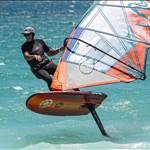
Somebody asked on the Progression Podcast forum (forum.progressionproject.com/);
What are the benefits of a foil setup that locks in the turns (has a lot of resistance in the roll axis once the turn is started) vs one that is more pivoty (lets you adjust easily mid-turn).
The foils that lock in may have other benefits (like lower drag and glide), but I'm wondering specifically if there's a benefit to that style of turning itself.
Is is like a carving snowboard where you can push more momentum into carving turns and the speed is redirected out more efficiently?
And what conditions favor carving foils vs pivoty foils?
I've been trying to optimise for locked-in carving for ages - stability at speed (18-22 knots) so that I need a lot of bodyweight and dipping the rig to carve hard.
So foil to the rear of the tracks (especially if waves or big windswells) and sail mast base quite far forward (certainly compared to Simon's).
Current Simmer 920cm2 (88cm) front and 400 Slingshot rear (no shims) is giving me the best speed/carve combo.
I've tried 3 smaller front wings (around 700cm2) and 2 smaller rears. Also -ve and +ve shimming. Didn't go faster and introduced roll instability so lessened the ability to power into carves.
From what I've seen wingers pivot carve. Prone foilers seem to do both.
Thoughts?
Maybe I misunderstand you but I think I agree. My jibing is much better on a board where the mast to mast distance is "large". When I switch down to boards like thedoor uses and the masts are super close I keep breaching during the turn. Everything else the same. Coincidence? I think not.
Not sure I fully get the difference but I recently tried this smaller stab
sabfoil.com/en/products/stabilizer-430
than my typical
sabfoil.com/en/products/stabilizer-450-mm
Which is thicker and has bigger wingtips.
Certainly the biggest issue was not getting lift forwards enough with the 430, but I did feel like carves were less predictable with the 430. Wonder if that related to the instability you were mentioning?
PS: I tend to avoid front wings with wing tips
Select to expand quotePS: I tend to avoid front wings with wing tips
They go on forever?
Select to expand quoteazymuth said..
Somebody asked on the Progression Podcast forum (forum.progressionproject.com/);
What are the benefits of a foil setup that locks in the turns (has a lot of resistance in the roll axis once the turn is started) vs one that is more pivoty (lets you adjust easily mid-turn).
The foils that lock in may have other benefits (like lower drag and glide), but I'm wondering specifically if there's a benefit to that style of turning itself.
Is is like a carving snowboard where you can push more momentum into carving turns and the speed is redirected out more efficiently?
And what conditions favor carving foils vs pivoty foils?
I've been trying to optimise for locked-in carving for ages - stability at speed (18-22 knots) so that I need a lot of bodyweight and dipping the rig to carve hard.
So foil to the rear of the tracks (especially if waves or big windswells) and sail mast base quite far forward (certainly compared to Simon's).
Current Simmer 920cm2 (88cm) front and 400 Slingshot rear (no shims) is giving me the best speed/carve combo.
I've tried 3 smaller front wings (around 700cm2) and 2 smaller rears. Also -ve and +ve shimming. Didn't go faster and introduced roll instability so lessened the ability to power into carves.
From what I've seen wingers pivot carve. Prone foilers seem to do both.
Thoughts?
Based on your video's, I think you would know better than most ??.
I've admired your high speed carving abilities in chunky conditions. I would "think" the HA, narrow cord would be more reistant to roll and carry more speed ??. Didn't you cut down a 926 to ~826 ?. Was the to decrease lift and gain speed ?. I do know that at 21 knots on my 730PFI I'm ready to soil myself 
Have you thought about trying an ~800 race foil on a shorter fuselage? They seem to really lock in.
Select to expand quoteGrantmac said..
Have you thought about trying an ~800 race foil on a shorter fuselage? They seem to really lock in.
Was going to suggest something like that. A lot of what JJ is describing is what a higher aspect foil delivers. The trade off is that i don't think it'll be great for the mad high wind carving he likes doing in general. Especially when the power kicks in in 25+knots
Select to expand quoteBullroarerTook said..PS: I tend to avoid front wings with wing tips
They go on forever?
took me a bit but I got it...
meant downturned wing tips
Select to expand quotethedoor said..BullroarerTook said..PS: I tend to avoid front wings with wing tips
They go on forever?
took me a bit but I got it...
meant downturned wing tips
That is funny
Select to expand quoteGrantmac said..
Have you thought about trying an ~800 race foil on a shorter fuselage? They seem to really lock in.
Cheers Grantmac (and Luke).
After today's session in onshore winter conditions, I've figured out that mid-aspect works better for me when the ocean bumps are super-energetic.
The high-aspect Simmer 920 flies down/upwind but the tradeoff is I have to keep the speed up.
Epic fun but there are times when the more relaxed lift/control from the mid-aspect wing is better;
Gybing down a swell it's often an advantage to be able to accelerate slower to whip the board around.
Riding waves DTL - sometimes helpful to slow down a little to not outrun the wave.
And the MA wing reacts quicker to lift up over waves when flying upwind.
It's amazing how different ocean foiling in powerful confused swells is to flatter river foiling.
Always have to add the additional lift from the ocean moving and acceleration from gravity drops into the equation - no surprise that optimized kit for each is going to be different.
HA Simmer Blackbird Race 920cm2, 880mm
MA 1050cm2, 926mm cut to 830


Select to expand quoteBullroarerTook said..PS: I tend to avoid front wings with wing tips
They go on forever?
Well, it's either this
or (my preference) this
back to the topic for which most of this stuff is over my head - on holiday, rented an RRD board and foil for freeriding in pretty stiff conditions with a 4.2 sail. It was a "lightwind day" at this spot - seriously. The foil wing was a racey 800cm2 affair and it took me a good bit to get used to the lower roll stability than my normal high wind freeride wing which is a bit bigger but more mid-aspect. The downside for me to the 800 was it took being on the gas the whole time as where with a slightly bigger wing I can depower and play more. I do like the feel of a slightly longer wheelbase when doing hard carving jibes as azymuth refers to. I've heard reference to the idea that wingers pivot more while we tend to carve but don't have enough experience on the other side of the coin to offer constructive input.
I think wingers CAN pivot but don't necessarily have to, I certainly don't prefer to when winging. I prefer sheeting the wing to accelerate onto the swell then either flagging if the swell has power or keeping a bit of power in the wing if it doesn't. Wingers on HA foils are carving with a lot of power, if you've only seen wingers on large LA foils then you aren't seeing what is possible.
I'm on a fast MA 1650 but I'll be stepping down to a HA 950 of the same width on the days with +15kts. I personally think going much beyond a 1m span starts to reduce the carving potential a lot although brands are fighting hard to develop wide foils that can.
My 2 cents worth from what I experienced in Maui last spring.
Both Wingers and Windfoilers can Pivot and Carve. Generally the Wingers do not use the Wing initiating the carve while Windfoilers do.
Having the sail attached to the board allows the Windfoiler to transfer more power into the carve (heelside or toeside) than a Wing. When sheeting-in to initiate the carve.
The Wingers ability to depower quickly and pivot without changing stance allows for both easier pivoting tacks and jibes.
Most intermediate to advanced wingers continue to ride bigger and bigger reef waves with HA foils much less than 1000cm2 and carve up the face of the waves at high speed. With the wing flagged.
IMHO the two disciplines are more the same than different and folks have lots of fun doing both. Focusing on wave/swell riding here are my thoughts on the 3 different types of wave/swell riding I have tried.
Downwind with the sail or wing flagged ahead. Both Wingers and Windfoilers have to switch hands to travel in the other direction but I think the wing is less cumbersome than the sail in this application.
Downwind with power in the sail/wing traveling up and down the swell in one direction. I enjoy being able to use the power in the sail to accelerate into the carves while I have not seen a winger doing the same.
Riding a reef wave/swell 90 degrees to the wind is preferred winging condition for most wingers - probably because Maui is awesome for this. Wingers jibe (usually a pivot) on the incoming swell and flag the wing for that pure surfing feel. I carve onto a coming swell and love the acceleration the swell gives to the turn. I started out riding the swells only in the upwind direction carving up and down the face. The last couple trips I have begun to carve 180 degrees downwind followed by 180 degree carve upwind on the swell both using the sail to help power through the turn. I have found using a MA "wave" foil with freestyle sails has improved the fun factor for me.
I used to think my slingshot infinity 76 was the bees knees until I got on the sabfoil 799, slightly shorter fuse at 880mm and longer mast 111cm. I noticed a big difference in ability to carve tightly heel side without losing speed and generally just feels more playful to the locked in i76 which has lots of control carving toe side down wind like gripping the rail on a roller coaster. This is probably due to the down turned winglets.
I think pivoting carves were more frowned upon but at the end of the day it's whatever works for your skill level and kit that gives you that high thrill level. I think the ability to carve tightly on a wave while going as fast as possible is what we are all trying to achieve. When you see the skilled prone foilers do it, I think why not us?
Noticed one of the Maui kids posted this that he thinks the Powered Turns are the future for Wingfoiling Waves. I have to agree with him as it is what I try to do on a swell windfoiling. Of course he is a LITTLE better at it than I. However I believe having the sail attached to the board allows more power to be delivered into the turn and definitely gives me something to hang on to so I don't fall in