In laymans terms please.There are a couple of hydrofoil moth dinghys that scream ( float) past when im sailing.Cripes they are impressive especially downwind! I was subplaning & it was flying! I even thought if I ever got into dinghys Id get one but apparently they are for experienced only + prob cost heaps..
Hi SBC,
Andrew Mcdougall of KA sails is the man.
this page has the details
www.kasail.com/sailing/index.html
and the Mach2http://mach2boats.com/index.php?option=com_content&view=category&layout=blog&id=38&Itemid=57
andrew also created the software that a lot of windsurfing companies use to design their sails on.
personally i think Andrew is one of the best designers on the planet and the results of his sails and moths speak volumes for just how good KA is
Yep AMAC is the foiling Moth guru for sure.
I,ll have a go in Laymans terms.
The Foils are effectively wings. They generate lift and allow the hull to fly above the water. Due to the low wetted surface area for the amount of lift they generate they are very low drag and allow really fast speeds in low wind .
The T foils on the moth are trimmed by flaps on the trailing edge of the main foils ( at the end of the centreboard) These are connected to a rod at the bow that trails in the water. As the hull lifts higher from the water the angle of the rod changes and it adjusts the flaps. This ensures that the hull does not lift too high and allow the foils to reach the surface. The pitch of the hull is adjusted by the foils on the rudder. You can change the angle to prevent the bow lifting too much or visa versa preventing a nose dive .
The reason they get going in such light winds is a combination of the foil shape creating alot of lift at low hull speeds and the fact that the total weight of the hull and rig is really low.
Andrew really is a leader in this type of yacht design. Boats designed by him dominated the last World Moth championships and also his sails for that matter.
He himself had close to a clean sweep at the Moth Australian Championships , not bad for a 54 year old (or is it 55). I am really enjoying working with him on the KA windsurfing sails, I have learned so much.
Anyway, I hope I succeeded in explaining the basics of how the foiling moths work.
robert miller did the winged keel  lol, Ben (robert miller) Lexcen was certainly another great aussie designer.
i'm not sure if there are similarities or not with the winged keel and the moth foils. the moth has foils front and back though. but i really don't know too much about them.
i think if you look at amac's body of work he certainly deserves the same recognition that ben lexcen received if not more.
i found this video on youtube...... looks like fun!!!
Nothing like the 12 meter winged keel, these are hydrofoils.
AMAC did not invent them he's certainly not claimimg that. The T foil system that the moths use I beleive was created by somebody in Perth.
AMAC has just taken them to another level of performance.
If you have ever seen a foiling Moth doing 20 knots in what seems like no wind it is certainly impressive.
Thanks for the video.The guy I saw looked more spectacular because it was flat water & he was screaming downwind in a straight line. It amazes me how they can end up with it tilted to windward at times & not fall in.


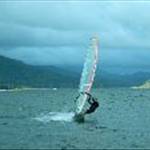
Heres some photos but the first time I saw him it was flat water & he was blasting much faster than this.
i might be one of the guys on the moth you noticed. though that isnt me in the photo. where? im racing out of stgeorge sc most weeks. came 2nd behind andrew mcdougall at the last nationals.
they really are pretty quick. in moderate stuff i think we are faster than forumla boards around the course, over about 20k i think the formula would be quicker downwind but we'd still beat them up hill. we race on the same course as couple of guys on forumla gear most weeks, don't know if they are the top of the game though.
Mr Love explaned
"The Foils are effectively wings. They generate lift and allow the hull to fly above the water. Due to the low wetted surface area for the amount of lift they generate they are very low drag "
I think what makes them good is submerging them so that surface tension no longer slows them down?
A submerged swimmer is faster than one on the surface. Hence racing rules about not staying under.
However, I take your point that the effect is not the important one.