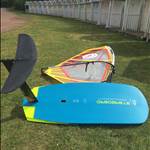
Today I received the IQFoil Junior. This foil kit is the same as the adult one, that is, 900 wing, 255 stab, and 115 plus and 95 plus fuses, but it has an alu mast instead of a carbon one (which makes it $ 1300 US Dollars cheaper). Instead of getting the kit with the 900 wing, I went with the 1000 wing (the store did not charge me anything for the swap).
I will use the foil with my Starboard Formula Experience (formula board with tufskin, designed for young people; it is stronger than the regular formula board but it is heavier). As soon as I received the foil, I installed it on the board. I have been reading a lot about properly setting a mast without flanges, which are a pain compared to the masts with flanges or tracks (I have a slingshot foil which has a flange).
So I installed the fuselage to the mast, pushed the mast down and rocked it as much as possible, then I put the screws and tightened them just a little bit, rocked the mast again, tightened the screws again, and so forth probably a total of four times until the mast was not sinking in the box anymore (I had my finger touching the edge of the mast head and box so I could feel how I was pulling the mast in.
I was satisfied with how much the mast head sunk on the board because I tried to move the mast back and forth and it did not budge at all.
I noticed two things:
1) the mast head is not sitting parallel to the bottom of the board: the front of the mast head is roughly 4 mm below the bottom of the board and the back of the mast head is roughly 2 mm below (see pictures attached I used the caliper to measure the depth and then place it outside so you can used it as a reference to how much the mast head is in). Is this common? Do you think this can be a problem?
2) I checked the angle of the mast in relation to the bottom of the board (the bottom is flat, no rocker) and it is leaning forward (see picture). Is this also common? any problem with this?
I can imagine that a perfect fit is almost impossible when you have a 15 year old board, but I wonder if anybody has noticed the same things. Any comments not related to the lawn? :)


Hello, I'm not a specialist of the Starboard foil, but I'm in the same situation with my Moses foil mast. Setting the foil in a way you can repeat from session to session looks more difficult thant with mys AFS, that has "stop" at the front of the foil.
The angle that has to be checked, is between the fuselage and the bottom of the board. It can be expected at 2? to 3?. Impact, measurement process and some values are given in marseille.glissattitude.com/blog/reglages-windfoil-le-rake.html
(sorry, in French, but maybe can still help).
With my Moses, as I had a concern bolting the mast all the way down like that, I designed and 3D printed some shims as illustrated at the end of the above link. The foil, at front screw level, sits on the shim and blocks the down movement.
Maybe seat it to the deep T box with a rubber mallet and then tighten the 2 screws?
Thanks. I checked the French link and it makes sense. What I would like to know now is what Should be the angle of the fuselage in relation to the board for starboard foils. That way, I have "factory setting" and than I can play from there.
Only thing you should achieve is proper snug fit of the tuttle head into the board's tuttle box.
Nothing else matters until that is achieved.
Select to expand quoteWillyWind said..
Today I received the IQFoil Junior. This foil kit is the same as the adult one, that is, 900 wing, 255 stab, and 115 plus and 95 plus fuses, but it has an alu mast instead of a carbon one (which makes it $ 1300 US Dollars cheaper). Instead of getting the kit with the 900 wing, I went with the 1000 wing (the store did not charge me anything for the swap).
I will use the foil with my Starboard Formula Experience (formula board with tufskin, designed for young people; it is stronger than the regular formula board but it is heavier). As soon as I received the foil, I installed it on the board. I have been reading a lot about properly setting a mast without flanges, which are a pain compared to the masts with flanges or tracks (I have a slingshot foil which has a flange).
So I installed the fuselage to the mast, pushed the mast down and rocked it as much as possible, then I put the screws and tightened them just a little bit, rocked the mast again, tightened the screws again, and so forth probably a total of four times until the mast was not sinking in the box anymore (I had my finger touching the edge of the mast head and box so I could feel how I was pulling the mast in.
I was satisfied with how much the mast head sunk on the board because I tried to move the mast back and forth and it did not budge at all.
I noticed two things:
1) the mast head is not sitting parallel to the bottom of the board: the front of the mast head is roughly 4 mm below the bottom of the board and the back of the mast head is roughly 2 mm below (see pictures attached I used the caliper to measure the depth and then place it outside so you can used it as a reference to how much the mast head is in). Is this common? Do you think this can be a problem?
2) I checked the angle of the mast in relation to the bottom of the board (the bottom is flat, no rocker) and it is leaning forward (see picture). Is this also common? any problem with this?
I can imagine that a perfect fit is almost impossible when you have a 15 year old board, but I wonder if anybody has noticed the same things. Any comments not related to the lawn? :)
Hi WillyWind,
No comments that are not related to your lawn. The lawn looks good!
BTW, when you are on the foil, the mm difference in relationship of board to foil mast does not seem to matter.
2.5 to 3 degrees is the usual prescription for freeride/slalom. The upwind/downwind guys do a bit less. Yes, the foil to board angle matters. Not enough angle and the nose hits harder on touchdowns and lift off is delayed as it's more difficult to get enough AOA on the foil wings.
Phantom even bothered to make a video. 
www.facebook.com/Phantomwindsurfing/videos/1041530199626965/
This should be the best link for you: iqfoil.star-board.com/guides/
There is a video dedicated to the rake tuning :-)
We had a similar issue trying to place a deep tuttle foil into a Go Starboard board. We found that the older deep tuttle designs seemed a bit more sloppy with angles and such just like you. Shim it, or sail it. at this point, just get out and give it a shot!
If your board doesn't have a reinforced tuttle box, get a strap to go between a footstrap mounting hole and one of the mast bolts.
We had a similar issue trying to place a deep tuttle foil into a Go Starboard board. We found that the older deep tuttle designs seemed a bit more sloppy with angles and such just like you. Shim it, or sail it. at this point, just get out and give it a shot!
If your board doesn't have a reinforced tuttle box, get a strap to go between a footstrap mounting hole and one of the mast bolts.
Select to expand quotejmf1 said..
This should be the best link for you: iqfoil.star-board.com/guides/
There is a video dedicated to the rake tuning :-)
Saving everyone a click
Gonzalo also explains why it matters - does a better job than me and covers too much angle which I neglected to do.
Awesome! I wish it was easier to find info on the starboard site. I even signed up to the IQFoil newsletter and never got much info (heck, I just suscribed to the channel that posted those videos called IQfoil and I was, and still are, the first subscriber!).
I am making a spacer/shim so assembly is easier (I made a wooden spacer to see how it works and it works great). I also reinforced the top of the finbox (6 layers of glass). There is no wind for few days so the only think I can do is to play with the set up. I could take care of my lawn too, but it ain't gonna happen...
I have had similar issues with the old JP pink one, and have a youth iqfoil on order for my daughter and expect same problems again (currently slingshot and i love the flange). The most important issue is that the top of the tuttle head at the front must make contact with the "ceiling" of the tuttle box, otherwise the up force on the vertical front of the box can be too great. To achieve this on my very old board i bought a slab of hard rubber that was the correct width to insert into the front of the box before the foil and cut it down by trial and error until it was right. The key problem is how to stick it in place. I havent solved that yet
i also used a cheap geometry right angle made of plastic to make sure the mast to board relationship was always square.
I contacted Starboard and I received two answers: one was to buy a new foilboard (good try, Starboard). The other one was that if you measure the angle of the fuselage right behind the front wing, the reading should be between 1.5 and 2 degrees in relation to the board (between 1 and 2.5 is just ok). I was also told that I should build a support no only for the front bolt but for the back one as well so the support spreads the load better (I call it support because it is too long to call it a shim. the finbox is 12 cm deep so the support is around 5 cm tall). I am currently working on it. It takes a lot of time because it is based on trial and error. I will post the results when I am done.
Select to expand quotejmf1 said..
This should be the best link for you: iqfoil.star-board.com/guides/
There is a video dedicated to the rake tuning :-)
Well Starboard should get there act together then: there's a video on YT where Remi Villa explains it's no more necessary to adjust the rake .
Sorry, this forum does not allow new users to post links here but search for "Palestra de IQfoil - Classe Olimpica em Paris 2024 ".
It starts from 16:00
Who then are we to believe?
The early Starboard foil masts had a tapered fit to the top of the foil head. This was so that they could be fitted into a standard Tuttle box as no one had a dedicated foil board.

The newer blue foil mast from the supercruiser, has a removable taper, so that it can fitted into an older or non foil board with a Tuttle head.
The older orange foil head from a 95 race, shares the foil loads onto to front and rear taper, and the small flat area around the front bolt... rather than using an external collar to load up the bottom skin of the board.
The newer foil head spreads the load across to top of the head and so relies less on the tapers... although it's obviously quite important to get them to fit.
If the Tuttle box is deep enough in your old Starboard it's useful to make a shim so that the foil doesn't move around, and also to perhaps, tune the foil mast to the angle you described earlier. Which is the way I measured mine.. just behind the front wing on the fuselage.
I made my shim by measuring the removable section on the blue mast and cutting an old Tuttle box fin head roughly to the same dimensions.
i then glued thin epoxy sail battens to fine tune the angle for my foil board.
I made 2 shims, one for the Starboard foil boards and a slightly thinner one for my JP's as the box depth and rocker are slightly different


To be honest it's a bit of faffing around, but once done, the positives are:
the foil doesn't rock forward or backwards - which seems to be a cause of foil box failure;
The foil bolts bolts are always tight and you don't need to retighten them;
you don't need a rubber mallet to hammer take your foil in or out;
you can carefully tune your foil mast angle to the rocker of your board to help stop catapulting on post breech touchdown.
so not mixed messages from Starboard, just an evolution of design
hope that helps
My ancient board has been being used for foiling for 3 yrs now with no reinforcement and no problems (yet...). A big void above the back tuttle bolt has been no problem (but i shim the front when i havent got a flange and, to be fair, the flange has been used for about 2 of those 3 years). However i use a truly enormous washer on the back bolt to spread the force over a very large area - easy on this old board as its flat at back and bolts heads are not sunk below deck level.
Select to expand quoteRuddeBos said..
The early Starboard foil masts had a tapered fit to the top of the foil head. This was so that they could be fitted into a standard Tuttle box as no one had a dedicated foil board.
The newer blue foil mast from the supercruiser, has a removable taper, so that it can fitted into an older or non foil board with a Tuttle head.
The older orange foil head from a 95 race, shares the foil loads onto to front and rear taper, and the small flat area around the front bolt... rather than using an external collar to load up the bottom skin of the board.
The newer foil head spreads the load across to top of the head and so relies less on the tapers... although it's obviously quite important to get them to fit.
If the Tuttle box is deep enough in your old Starboard it's useful to make a shim so that the foil doesn't move around, and also to perhaps, tune the foil mast to the angle you described earlier. Which is the way I measured mine.. just behind the front wing on the fuselage.
I made my shim by measuring the removable section on the blue mast and cutting an old Tuttle box fin head roughly to the same dimensions.
i then glued thin epoxy sail battens to fine tune the angle for my foil board.
I made 2 shims, one for the Starboard foil boards and a slightly thinner one for my JP's as the box depth and rocker are slightly different
To be honest it's a bit of faffing around, but once done, the positives are:
the foil doesn't rock forward or backwards - which seems to be a cause of foil box failure;
The foil bolts bolts are always tight and you don't need to retighten them;
you don't need a rubber mallet to hammer take your foil in or out;
you can carefully tune your foil mast angle to the rocker of your board to help stop catapulting on post breech touchdown.
so not mixed messages from Starboard, just an evolution of design
hope that helps
Thanks, that was helpful
I have a Goya Bolt 135 and AFS Wind95 foil, I used a dial caliper to measure the depth of the foil box front/back (71 mm,71 mm), and height of the mast head from the flange front/back (68 mm, 51 mm). So I need to make a shim that goes from 1mm to 17mm. You would think someone would make this adapter.
Select to expand quoteSandman1221 said..
I have a Goya Bolt 135 and AFS Wind95 foil, I used a dial caliper to measure the depth of the foil box front/back (71 mm,71 mm), and height of the mast head from the flange front/back (68 mm, 51 mm). So I need to make a shim that goes from 1mm to 17mm. You would think someone would make this adapter.
Actually, Starboard obviously does make a shim (see above), so contacted my local dealer to see if I can get one, will probably contact cement it to the mast head.
when I tighten both mast head screws the foil angles back 0.8 degrees more (used a level app on my phone), that makes a difference in light winds for me because I move my front foot forward to keep the board level (two stab shims and a relatively narrow/thin tail allow the tail to sink).
So I finally finished the spacer. To reach the recommended setting, the spacer is 50 mm on the back bolt and 52 mm on the front one. Even with this spacer, the front taper is still sitting fully. The back side of the spacer is not tapered because that side of the finbox is not tapered (at least where the spacer fits).

FYI, in the US SB is now shipping foils with a foil box mast head, with a line on it where to cut it for a DT box.
So here is a spacer I made for my AFS Wind95, made from starboard (polypropylene), the angle between the box and fuselage is now zero with both screws tight!