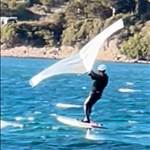
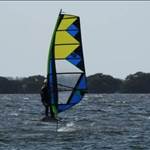
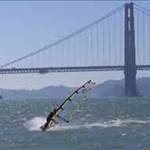
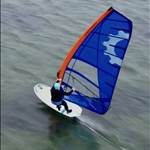
I am noticing the new windfoil sails are becoming significantly taller than the regular windsurf sails also referred as high aspect. A high aspect sails apparently have the potential to generate higher speed flow of air with less turbulence. I would appreciate your comments on this new evolution and sharing your experience if you have tested similar size sails for its performance on foiling particularly for a race foil set-up. For example, do you have the same power for plaining/foiling on same size sail low aspect vs high aspect? I guess once you are up foiling, HA sail perform much better but do you loose initial power to get up in foiling?
You could also contact Bruno Andre, he designed the HA Maui Hot Sails for foiling, he also works at AFS. I think those Maui Hot sails are on the next size up mast compared to a regular sail of the same size. And from what I remember, the stiffer mast is supposed to make the HA sail better for pumping, in addition to what you mentioned.
I doubt that performance is the reason to go to higher aspect sails for foiling. Otherwise, slalom sails should have gone this way already. With sails, the performance gains are not as clear-cut as with wings or fins, since the front edge cannot be shaped. Instead, the mast introduces additional turbulence, so the longer mast negates some or all of the gains from a higher aspect ratio.
The higher aspect ratio and tighter leech of foil sails both move the center of lift up, which in turn increases the mast foot pressure. That's also true for gusts, and exactly what's needed to counteract the higher lift the foil generates at higher speeds.
Interestingly, freestyle sail design went the same direction, towards higher aspect ratios and tighter leeches. The reasons were different, though: to allow the smallest possible sail size for highly skilled sailors, and neutral behavior when ducking the sail (whereas wind range is much less important for competitive freestyle). But the similar design explains why many freestyle sails work great for foiling.
For slalom sails, the higher center of lift from higher aspect sails and tighter leeches would not work nearly as well as for foiling. The higher leverage that the sail has over the sailor moves load forward, from the feet towards the mast foot, when the wind increases. That's great to reduce the angle of attack of the foil, and allow it to stay under control when going faster. But on a slalom board, it would increase the wetter area, slowing down the board. Perhaps this only comes into play at very high skill levels, but that's what slalom sails are designed for. But freestyle and foil-specific sails definitely make a differences even for intermediate foilers.
My experience has been that they're two different kettles of fish. They each excel at their respective disciplines, but neither work well for the other discipline.
the higher aspect sails are excellent for pumping up onto the foil, the tighter leech gives you the feeling that each pump will get you onto the foil. And once foiling the tighter leech and more upright cut sail (as boardsurfer says) provides a more stable powered sail and gives some forward weight to hold the nose down and counter the lift from the foil (which makes for a more stable ride so far as pitch goes). Try using a low aspect slalom sail for foil racing and you'll find yourself tilting it forwards. None of this is good for traditional slalom, you want quite the opposite.
the loose leech low aspect sails on the other hand provide a more stable ride when your board maintains connection with the water. The loose leech, lower cut foot and lower centre of effort lets the nose of the board fly higher, and stops the rider getting carted over the front by gusts and wave hits.
its a case of foiling allowing the use of the more efficient higher aspect sails, because you dont have to deal with the instability that water interaction causes. Everything is smooth when youre foiling, so you can use a higher aspect sail.
The comment above: "The higher aspect ratio and tighter leech of foil sails both move the center of lift up, which in turn increases the mast foot pressure. That's also true for gusts, and exactly what's needed to counteract the higher lift the foil generates at higher speeds" is spot-on.
My old slalom sails were actually bad for foiling. In gusts, they pushed forward and not down, and I had a hard time keeping the foil from breaching. The early solution was to foil with the Sailworks Hucker, which has the center of lift up high.
Of course, time on foil will cure most ills, but the newer foil sails make this all easier.
Naish has a radially high aspect Freerace foil design now:
www.naishsails.com/product/lift-rn/
Would love to know if anyone has tried these.
I am on the original Ezzy Hydra sail for foil free ride, which is essentially low aspect on the bottom and high aspect on top. I find I get excellent speeds and overall it is easier to control than other foil dedicated free ride designs.
I see sailworks has the flyer-fr high aspect sail now. And they have it in a 3.4 size, which I will probably get. I have the standard flyer in 4.5 and 5.2 which I really like.
www.sailworks.com/flyer-fr.html
I think the question should be: why are slalom sails lower aspect than they were 15-20 yrs ago? If you look at sails from that era, they often have similar measurements to modern foil sails. 7.5s rigging on 490s was common and much shorter boom lengths than today once you account for the inset outhaul eyelets on most sails. If you look back at catalogues from the late 90s to even up to 2010, you might be surprised how lower aspect fin sails have become since that time.
My understanding is that notwithstanding the increased aero efficiency of higher aspect sails, havinng the flow stay attached in rough sea surfaces and acceleration out of jibes started to favor race designs with longer booms.
Shorter booms, despite a lower batten count, keep the sail pressure more even and reduce the yoyo effect. That was the big revelation as people moved from using their slalom sails to foil-specific sails 3-4 yrs ago.
North 2005 catalog issuu.com/northwindsurf/docs/05_ns_product_special_us_single
North 2005 Daytona (freerace sail) 7.8 521x215 North Type R (freeride) 7.5 493x213 compared to my GA Air Ride 7.7 493x210
North 2009 Warp 8.0 508x225 compared to my HGO 8.0 at 522x222 (they say 220 but it rigs 222)
btw, I personally have found having a short boom on a small sail (say around 4.0) to be a bit twitchy. ymmv
It is also about the sails ergonomic.
Slalom sails became lower aspect with the introduction of shorter wider boards and carbon fins. It is about getting the board to fly off the fin. With the longer boom the sail becomes a little bit back hand biased. When you pull a little harder on the back hand that load gets transferred down to your back foot which in turn helps you keep pressure on the fin. The fin flexes under this pressure and helps lift the board up and reduce the wetted surface...more speed.
On a foil you only want this back foot loading when you are initiating flight and as soon as you are up to speed and accelerating you start transferring weight forward to flatten the AOA of the foil. The shorter boom doesn't load up your back hand as much and results in a neutral stance, so its more natural to pressure the front foot with this stance.
I have been using camless sails mainly for foiling, wave sails for when its windier. I have noticed that the foil gets a bit pitchy with the wave sails as the power is more on off and the draft moves back in the gusts. The draft moving back is exactly what you don't want on the foil as it makes you pull on your back hand and load the back leg in a gust which is when you are accelerating and need to get the weight forward. I used a small cammed sail in stronger winds and it was a revelation...just need a dedicated foil sail now!!
One reason slalom sails are lower aspect than they used to be is mastfoot position, at least that's my take on it. A modern slalom board has the aftmost mastfoot position as much as 25cm further back than on a good board from the early noughts. (Remember clearing the sail for a water start by dragging the boom across the tail of the board? Can't do that on a modern design). This allows the board to fly off the fin much more directly and immediately. On a 2002 slalom board rail shape had a lot to do with pointing ability but on a modern board it's all about the fin, so having the mast back is most efficient. However, that limits aspect ratio because with the mastfoot further back, you can't rake the high-aspect sail back as much because the center of effort would move behind the center of lateral resistance.
Since the foilboard's center of lateral resistance (once it's flying) doesn't move around like the CLR of a finned board, you don't need to rake the sail back as much as you pick up speed, so you can have a fuller foot (as with the Sailworks Flyer FR) and a higher aspect sail. My avatar shows a Flyer FR 8.5 and the slot is closed with the bottom of the mast still nearly vertical.
I use a Aerotech Phantom 4.5 crossover wave sail on a 400 mast (pretty stiff setup) with a 160 cm boom (160-220 at min. setting), still learning how to get the most out of the Phantom, but in 20-30 max knots with an AFS S670 cm2 wing it handles so easily, very easy to turn on/off so gusts are not a problem and the S670 wing makes it very easy to navigate 2-3 foot waves, especially when I have to drop into the trough of 3' plus waves. No feeling of the foil wanting to breach at all. I think some of the breaching issues foilers talk about could be due to using too large of a wing for the conditions, the S670 is so easy to control with fairly light front foot pressure, versus the F1080 wing in the same conditions where it wants to breach a lot, though that was with an Aerotech Freespeed 5.8. And the Phantom 4.5 really pumps good too, since the mast is relatively stiff. Honestly, for my intermediate level I have no need for a foil specific sail, especially one with cambers.
Select to expand quotemr love said..
It is also about the sails ergonomic.
Slalom sails became lower aspect with the introduction of shorter wider boards and carbon fins. It is about getting the board to fly off the fin. With the longer boom the sail becomes a little bit back hand biased.
Thank you for that clarification. I do remember an accomplished foiler telling me a few years back that the great thing about foil specific (in this case large race) sails is the relative lack of back hand pressure and, as you mention, the increased steadiness in flight.
Select to expand quotemr love said..
. I have noticed that the foil gets a bit pitchy with the wave sails as the power is more on off and the draft moves back in the gusts. The draft moving back is exactly what you don't want on the foil as it makes you pull on your back hand and load the back leg in a gust which is when you are accelerating and need to get the weight forward. I used a small cammed sail in stronger winds and it was a revelation...just need a dedicated foil sail now!!
Mirrors my experience as well. Cammed sails are so stable is crazy puffy winds. I'm fine with camless sails when they are less than 4.0 in size, but that also means the winds are typically higher, keeping the sail inflated better without the draft moving all over the place.
Nah, it's just makes for easier duck jibes
www.instagram.com/p/ChrZeCxIX59/?igshid=YmMyMTA2M2Y=
Select to expand quoteWsurfAustin said..mr love said..
. I have noticed that the foil gets a bit pitchy with the wave sails as the power is more on off and the draft moves back in the gusts. The draft moving back is exactly what you don't want on the foil as it makes you pull on your back hand and load the back leg in a gust which is when you are accelerating and need to get the weight forward. I used a small cammed sail in stronger winds and it was a revelation...just need a dedicated foil sail now!!
Mirrors my experience as well. Cammed sails are so stable is crazy puffy winds. I'm fine with camless sails when they are less than 4.0 in size, but that also means the winds are typically higher, keeping the sail inflated better without the draft moving all over the place.
I think you guys must be on wings that are too big for the conditions. With 4.5 Phantom sail, yes it is very on/off and that makes it easy to let a gust go by without affecting flight, and never felt I needed to load the back leg. The Phantom requires a lot more outhaul tension then a Freespeed sail, and that helps to lock in the draft! It sounds like some of you guys are trying to sell foil specific sails to people who do not know better! Andy Brandt told me to use wave sails for foiling, because they are so on/off, and he was right!
Select to expand quoteSandman1221 said..
I think you guys must be on wings that are too big for the conditions...
Speed is not always the answer. Some of us want to go slow in big conditions so we can play on the swell. The same wing that gives you fits in 25 kts, I find wonderfully playful and controllable.
fwiw, anything below 6 is fine with me being camless. I'm not afraid to pull on some downhaul, though. imho, most properly tuned small sails are fairly draft stable given that their primary design was for finned riding in higher winds. Just make sure your harness lines are setup for full power and not too far forward.
Select to expand quotePaducah said..Sandman1221 said..
I think you guys must be on wings that are too big for the conditions...
Speed is not always the answer. Some of us want to go slow in big conditions so we can play on the swell. The same wing that gives you fits in 25 kts, I find wonderfully playful and controllable.
fwiw, anything below 6 is fine with me being camless. I'm not afraid to pull on some downhaul, though. imho, most properly tuned small sails are fairly draft stable given that their primary design was for finned riding in higher winds. Just make sure your harness lines are setup for full power and not too far forward.
Oh sorry, okay big wing and you want to play in the waves, let me see, how about a wave sail?, that is what they are made for!
Select to expand quoteSandman1221 said..WsurfAustin said..mr love said..
. I have noticed that the foil gets a bit pitchy with the wave sails as the power is more on off and the draft moves back in the gusts. The draft moving back is exactly what you don't want on the foil as it makes you pull on your back hand and load the back leg in a gust which is when you are accelerating and need to get the weight forward. I used a small cammed sail in stronger winds and it was a revelation...just need a dedicated foil sail now!!
Mirrors my experience as well. Cammed sails are so stable is crazy puffy winds. I'm fine with camless sails when they are less than 4.0 in size, but that also means the winds are typically higher, keeping the sail inflated better without the draft moving all over the place.
I think you guys must be on wings that are too big for the conditions. With 4.5 Phantom sail, yes it is very on/off and that makes it easy to let a gust go by without affecting flight, and never felt I needed to load the back leg. The Phantom requires a lot more outhaul tension then a Freespeed sail, and that helps to lock in the draft! It sounds like some of you guys are trying to sell foil specific sails to people who do not know better! Andy Brandt told me to use wave sails for foiling, because they are so on/off, and he was right!
Everyone's different.
My goal is TOW with conditions from 10-30 knots and a single wing. PFI730 is great for dynamic range. The higher the wind, the smaller the sail, and the more fun IMO. BTW, not trying to sell anything, just sharing info. Modulating power in a linear fashion works better for me than On-Off. JMO.
Select to expand quoteWsurfAustin said..Sandman1221 said..WsurfAustin said..mr love said..
. I have noticed that the foil gets a bit pitchy with the wave sails as the power is more on off and the draft moves back in the gusts. The draft moving back is exactly what you don't want on the foil as it makes you pull on your back hand and load the back leg in a gust which is when you are accelerating and need to get the weight forward. I used a small cammed sail in stronger winds and it was a revelation...just need a dedicated foil sail now!!
Mirrors my experience as well. Cammed sails are so stable is crazy puffy winds. I'm fine with camless sails when they are less than 4.0 in size, but that also means the winds are typically higher, keeping the sail inflated better without the draft moving all over the place.
I think you guys must be on wings that are too big for the conditions. With 4.5 Phantom sail, yes it is very on/off and that makes it easy to let a gust go by without affecting flight, and never felt I needed to load the back leg. The Phantom requires a lot more outhaul tension then a Freespeed sail, and that helps to lock in the draft! It sounds like some of you guys are trying to sell foil specific sails to people who do not know better! Andy Brandt told me to use wave sails for foiling, because they are so on/off, and he was right!
Everyone's different.
My goal is TOW with conditions from 10-30 knots and a single wing. PFI730 is great for dynamic range. The higher the wind, the smaller the sail, and the more fun IMO. BTW, not trying to sell anything, just sharing info. Modulating power in a linear fashion works better for me than On-Off. JMO.
Hey, sorry WsurfAustin, okay see what you mean, I guess if the gusts are not too rangy that would work. However, the gusts I have to deal with are really rangy and so it is easier for me to just sheet out a little on a wave/Phantom sail and let the excess blow by so the gust does not affect my flight/course. The bigger the wing, the more so, for my conditions. Gotta remember my conditions are just that, and not necessarily anyones else's!