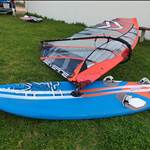
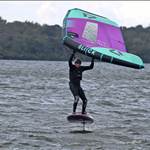
I'm currently learning wind and wing foiling Fanatic wind skysup 142L and axis foils. Same board for both.
Q. The axis people are now saying the short fuselage 706mm is now the standard and recommended for learning on wing. Why has this changed from the old standard 760mm for wing?
but there is a windsurf fuselage about 800mm.
Why does wind foiling need the longer fuse compared to wing.
If I use a larger stabiliser on a shorter fuselage does this have the same effect as a longer fuse. Stability?
Will the short black axis fuselage work for windfoiling or do I really need to buy another longer one at least standard length 760mm or windfoil 800mm.
Sounds like your talking about the red fuselage, longer fuse for windsurf to compensate for the weight of the sail mast etc helps with pitch stability you could wing foil with the windsurf fuse or buy the standard and deal with the instability while learning windsurf foil.Bigger stabilizer might just add more lift.
Longer fuses lead to more stability along the long axis of the board due to leverage. Larger stabilizers can have the same effect, but they can increase drag more than a longer fuse.
In winging, you have 2 points that pressure the board from above - your feet. In windfoiling, you have 3: your feet and the mast foot. With a sail, every time you sheet in or out, or the wind changes, or you put more or less weight in the harness, the pressure on the mast foot changes. Since the mast foot is relatively far forward, it has the more leverage over the foil than your feet, so even small changes make the foil go up and down. With longer fuses, this effect is reduced, and fight height is more stable. That's one reason racers now use 115 cm fuselages.
With a sail, boards are larger, and rails and underwater shape are meant for planing. So it's relatively easy to pick up enough speed for the foil to "kick in". But wing boards are usually smaller, shorter, narrower, and often have rounded (non-planing) rails. That means they don't pick up speed nearly as well, so you have to use the foil to get the board out of the water. That requires a rocking motion that can be much larger than in windfoiling. The shorter fuses that give the winger more leverage over the foil enable that. The standard fuselage length for winging with Armstrong foils is 60 cm (but note that differences in who the wings are mounted mean you cannot compare fuselage lengths directly between different brands).
If your skills are good enough, you can wing with an 80 cm fuse, and windfoil with a 60 cm fuse. You'd probably have more fun the other way around, though. You can definitely try windfoiling with your current fuselage. Keep in mind that most beginners need 10 sessions to reach stable flight (although I have seen a range from 1 to 50+ sessions). As a beginner, increased drag from a larger stabilizer may actually be a plus, since many beginners are more comfortable with slower speeds in their first sessions. If you find that controlling flight height is difficult after several sessions, then it may be time to consider the longer fuse.
Another aspect of the longer windsurf fuses is that they tend to increase the distance between the mast and the front wing. For boards that use a tuttle mount far at the back of the board, that is necessary to get a balanced setup. If your windfoil board has only a tuttle mount, you may need to buy the windfoil fuse. But if you have a track mount, you can just move the mast forward instead. That may have some drawbacks, for example lower possible upwind angles, but those matter little at the beginning.
Select to expand quoteboardsurfr said..
Longer fuses lead to more stability along the long axis of the board due to leverage. Larger stabilizers can have the same effect, but they can increase drag more than a longer fuse.
In winging, you have 2 points that pressure the board from above - your feet. In windfoiling, you have 3: your feet and the mast foot. With a sail, every time you sheet in or out, or the wind changes, or you put more or less weight in the harness, the pressure on the mast foot changes. Since the mast foot is relatively far forward, it has the more leverage over the foil than your feet, so even small changes make the foil go up and down. With longer fuses, this effect is reduced, and fight height is more stable. That's one reason racers now use 115 cm fuselages.
With a sail, boards are larger, and rails and underwater shape are meant for planing. So it's relatively easy to pick up enough speed for the foil to "kick in". But wing boards are usually smaller, shorter, narrower, and often have rounded (non-planing) rails. That means they don't pick up speed nearly as well, so you have to use the foil to get the board out of the water. That requires a rocking motion that can be much larger than in windfoiling. The shorter fuses that give the winger more leverage over the foil enable that. The standard fuselage length for winging with Armstrong foils is 60 cm (but note that differences in who the wings are mounted mean you cannot compare fuselage lengths directly between different brands).
If your skills are good enough, you can wing with an 80 cm fuse, and windfoil with a 60 cm fuse. You'd probably have more fun the other way around, though. You can definitely try windfoiling with your current fuselage. Keep in mind that most beginners need 10 sessions to reach stable flight (although I have seen a range from 1 to 50+ sessions). As a beginner, increased drag from a larger stabilizer may actually be a plus, since many beginners are more comfortable with slower speeds in their first sessions. If you find that controlling flight height is difficult after several sessions, then it may be time to consider the longer fuse.
Another aspect of the longer windsurf fuses is that they tend to increase the distance between the mast and the front wing. For boards that use a tuttle mount far at the back of the board, that is necessary to get a balanced setup. If your windfoil board has only a tuttle mount, you may need to buy the windfoil fuse. But if you have a track mount, you can just move the mast forward instead. That may have some drawbacks, for example lower possible upwind angles, but those matter little at the beginning.
Great info and esp that third paragraph about why wingers prefer short fuse. I did my winging on a big board and long fuse and it was easy af. But shorter fuse setups made things harder. I always wondered why more beg/int med wingers did not use longer fuses.
to OP I tried a few sessions on short fuse and large stabilizer a few years ago and it was near impossible to gybe. It did pump better but that is not such a big priority in windfoil.
Select to expand quotethedoor said..boardsurfr said..
Longer fuses lead to more stability along the long axis of the board due to leverage. Larger stabilizers can have the same effect, but they can increase drag more than a longer fuse.
In winging, you have 2 points that pressure the board from above - your feet. In windfoiling, you have 3: your feet and the mast foot. With a sail, every time you sheet in or out, or the wind changes, or you put more or less weight in the harness, the pressure on the mast foot changes. Since the mast foot is relatively far forward, it has the more leverage over the foil than your feet, so even small changes make the foil go up and down. With longer fuses, this effect is reduced, and fight height is more stable. That's one reason racers now use 115 cm fuselages.
With a sail, boards are larger, and rails and underwater shape are meant for planing. So it's relatively easy to pick up enough speed for the foil to "kick in". But wing boards are usually smaller, shorter, narrower, and often have rounded (non-planing) rails. That means they don't pick up speed nearly as well, so you have to use the foil to get the board out of the water. That requires a rocking motion that can be much larger than in windfoiling. The shorter fuses that give the winger more leverage over the foil enable that. The standard fuselage length for winging with Armstrong foils is 60 cm (but note that differences in who the wings are mounted mean you cannot compare fuselage lengths directly between different brands).
If your skills are good enough, you can wing with an 80 cm fuse, and windfoil with a 60 cm fuse. You'd probably have more fun the other way around, though. You can definitely try windfoiling with your current fuselage. Keep in mind that most beginners need 10 sessions to reach stable flight (although I have seen a range from 1 to 50+ sessions). As a beginner, increased drag from a larger stabilizer may actually be a plus, since many beginners are more comfortable with slower speeds in their first sessions. If you find that controlling flight height is difficult after several sessions, then it may be time to consider the longer fuse.
Another aspect of the longer windsurf fuses is that they tend to increase the distance between the mast and the front wing. For boards that use a tuttle mount far at the back of the board, that is necessary to get a balanced setup. If your windfoil board has only a tuttle mount, you may need to buy the windfoil fuse. But if you have a track mount, you can just move the mast forward instead. That may have some drawbacks, for example lower possible upwind angles, but those matter little at the beginning.
Great info and esp that third paragraph about why wingers prefer short fuse. I did my winging on a big board and long fuse and it was easy af. But shorter fuse setups made things harder. I always wondered why more beg/int med wingers did not use longer fuses.
to OP I tried a few sessions on short fuse and large stabilizer a few years ago and it was near impossible to gybe. It did pump better but that is not such a big priority in windfoil.
I agree, I see a lot of beginner wingers trying really short fuses because it looks cool or someone advises them that are experienced wingers but in reality they are struggling with pitch control and the learning curve is longer.
I learned to wing on the same SS foil set up as for wind foil and only when my skills improved did I change down to a short fuse.
Thanks guys for the input especially boardsurfr for such a detailed explanation.
It all makes sense once explained. I actually didn't really think about the 2 points of contact for winging vs 3 for windfoiling as well as weight of the rig. I'll probably have to bite the bullet and buy the axis black windfoil fuselage.
Hi Dale
I think the windfoil Axis fuselage is more for wind foil boards that have the fin boxes further back on the board. Your fin boxes in the Fanatic 142 Lt board does not have the fin boxes at the back of the board.
I did ask Adrian (from Axis) about this in Merimbula in 2019.
At the time, I had a new Axis foil set up, that I had not yet used. I had just purchases the Naish Hover crossover 120lt board, for SUP foil and Wind foil. I asked Adrian if my Axis set-up would be ok in the Naish board. There was a Naish board in Merimbula that Adrian looked at (on the Naish display stand in Merimbula that year). Adrain said yep, will work fine. This was because the fin boxes were not right at the back of the board. My Axis set-up at the time (back in 2019) was 68cm mast, standard fuse, 820 Surf front wing, and 440 rear foil. This set-up did work well for wind foiling. Later on I got the 910PNG front wing. The 910PNG was just so much better than the older 820 foil. The 910 was better in every way. It was faster, more controllable and no kind of "bucking" that the old 820 could develop. The 910 was great (this was before the newer BSC and HPS foils existed -- which I never used the BSC or HPS foils, so I can't really comment on those for wind foiling)
One of my friends had the Fanatic 142 Lt board for wind foil. He had the 1010PNG foil, 75cm mast, 420 rear foil, standard fuse. Also a very nice foil for wind foiling.
Ive since moved onto just Sup and Wing foiling. Now I have the ART 999 and 1099 foils.
We have gone down to the short and now ultra short fuse.
The Axis short fuse is fine for wind foiling on the boards that have the fin boxes further up the board.
A local who still does quite a lot of wind foiling here, has my old Naish Hover crossover 120lt board. He has the 1010PNG wing, 75cm mast, short fuse and 420 rear foil. He goes very well wind foiling.
Im not much help with the HPS or BSC foils, as I jumped from the 910PNG foil to the ART foils, so I skipped the HPS and BSC foils for wind foiling.
Boardsurfr,
Thanks.....best explanation I have read. Please continue to contribute.
Marc
Hi
My small experience about this. I bought a glide surf large foil (1600 cm2) with large stab and surf fuselage because I wanted to use small wave sails in light winds even I'm light (70 kg), after hearing a big front wing and stab could compensate the small fuse.
However until I switch to the long fuse (81 cm instead of 71 cm) my flights were not stable enough. The effect of this 10 cm increase was huge.
On the other hand, I have a friend of my size which is learning quite well with a 2100 cm2 gong surf foil and small fuse. I think his stab is bigger than mine.
Maybe he is more skilled than me, but the conclusion could be to get the same stability a windfoil fuselage gives from a large front wing with small fuse you need to increase a lot the size of the wing.