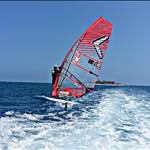
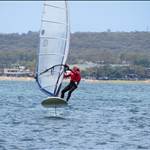
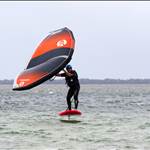
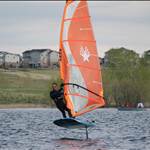
I have a Starboard Team set and a Starboard Formula board 161. Whilst I was improving my space block from wood to a hard plastic (made from a chopping board) I have noticed that the fuselage is not parallel to the bottom of the board. I took some measurement (pictures attached) should I turn the spacer to make the fuselage parallel? 
The mast is not 90 degrees, I have slightly set the tuttle in a very small amount more at the front but should I take a little more off the front of the spacer to bring the fuselage parallel?
How are dedicated foil boards setup?
I have not been completely happy with the liftoff in light winds.
Board to back of front wing fuelage 96.5cm, Back of board 90 degrees to fuslage 95cm


I have a sb formula 162 but have a NP aluminum foil so measurement may differ.
I noticed what looks like a small chip at the front edge of your deep tuttle box?
If so mine did the same thing how many times have you used the foil?
Made a space blocks as well but am reluctant to use it, me being paranoid it might hert instead of help.
Fuselage May or May not be parallel to board.
depends on designer so maybe check with supplier first.
fuselage is definitely not the same width everywhere.
as long as you' re flush at the box, you're good
Select to expand quoteCAN17 said..
I have a sb formula 162 but have a NP aluminum foil so measurement may differ.
I noticed what looks like a small chip at the front edge of your deep tuttle box?
If so mine did the same thing how many times have you used the foil?
Made a space blocks as well but am reluctant to use it, me being paranoid it might hert instead of help.
I had the NP alu before I got the Starboard, the foil pushes up into the front of the box, mine has some cracks now use a block and have no problem.
Why do the foil makers not make this clearer that you must feel that gap? Starboard does loads of fancy videos but no info on how to make these blocks.
Select to expand quoteStevespurs said..CAN17 said..
I have a sb formula 162 but have a NP aluminum foil so measurement may differ.
I noticed what looks like a small chip at the front edge of your deep tuttle box?
If so mine did the same thing how many times have you used the foil?
Made a space blocks as well but am reluctant to use it, me being paranoid it might hert instead of help.
I had the NP alu before I got the Starboard, the foil pushes up into the front of the box, mine has some cracks now use a block and have no problem.
Why do the foil makers not make this clearer that you must feel that gap? Starboard does loads of fancy videos but no info on how to make these blocks.
Maybe thay want your box to brake so you buy there foil board ?
?
I have made a couple blocks first one was a bit too small length wise.
But are they supposed to be wedged in the box with the spacer's force on the front and back walls of the box or the top of the box?
It's hard to get the block to be a perfect fit, but can't see the top roof part of the tuttle being strong enough for the foil. I don't make theses boxes nor install them, but I can imagine the foil with the spacer poping threw the deck
I do not understand why are the manufacturers so reluctant to add flanges on the top models? It would solve so many problems and the drag involved at getting to fly would really be very minimal?
Select to expand quotetibi said..
I do not understand why are the manufacturers so reluctant to add flanges on the top models? It would solve so many problems and the drag involved at getting to fly would really be very minimal?
Probably because they want to sell you a foil ready board. My LP foil has a flange on and i have an aluminium plate on the deck so in my case i dont think i need a spacer. But if things are too strong it may fail elsewhere.

This is my mates board after hitting a bank at about 15kn.
Notionally the fuselage should be level with the deck of the board. That's the more or less flat surface you're standing on. The ideal is to have the foil neutral in position. That's how it's designed to work.
The bottom of the board will have rocker and probably some tail lift. If the fuse is level with the bottom towards the tail then the foil is likely to be nose down. That creates lots of drag and makes you slow and difficult to get up foiling.
As you ride along a nose down foil will pull you down into the water. You need to get it level to get speed then pitch it slightly nose up to lift off. It's a bugger to have to try and change the angle of the board just to get the foil on the right angle.
Any radical variations on this just makes life difficult. You will have to compensate the board angle to get the foil on the right angle. Riding nose up sucks, and nose down is almost impossible. If you're a beginner then a foil coming up to soon is just going to stall and drop you in the water,
Select to expand quotetibi said..
I do not understand why are the manufacturers so reluctant to add flanges on the top models? It would solve so many problems and the drag involved at getting to fly would really be very minimal?

Swindy......I think you mate had his mast bolted into the tuttle head backwards. Looks to have the trailing edge forwards.
Select to expand quoteTe Hau said..
Swindy......I think you mate had his mast bolted into the tuttle head backwards. Looks to have the trailing edge forwards.
You are right, the mast looks back to front. I wasnt there. I will let him know. Only his second time out on it.
Select to expand quoteGorgo said..
Notionally the fuselage should be level with the deck of the board. That's the more or less flat surface you're standing on. The ideal is to have the foil neutral in position. That's how it's designed to work.
The bottom of the board will have rocker and probably some tail lift. If the fuse is level with the bottom towards the tail then the foil is likely to be nose down. That creates lots of drag and makes you slow and difficult to get up foiling.
As you ride along a nose down foil will pull you down into the water. You need to get it level to get speed then pitch it slightly nose up to lift off. It's a bugger to have to try and change the angle of the board just to get the foil on the right angle.
Any radical variations on this just makes life difficult. You will have to compensate the board angle to get the foil on the right angle. Riding nose up sucks, and nose down is almost impossible. If you're a beginner then a foil coming up to soon is just going to stall and drop you in the water,
Did you read the Glissattitude article? My experience concurs with it. Your board has a slight positive inclination at sub planing and planing. It's easy to tell because the bottom of the tail will be under water. The positive inclination aligns the foil with the water flow and lets it to gently take off.
Select to expand quoteSwindy said..Te Hau said..
Swindy......I think you mate had his mast bolted into the tuttle head backwards. Looks to have the trailing edge forwards.
You are right, the mast looks back to front. I wasnt there. I will let him know. Only his second time out on it.
Regardless, hitting a bank is no fun. Ouch, that looked painful.
Select to expand quoteGorgo said..
Notionally the fuselage should be level with the deck of the board. That's the more or less flat surface you're standing on. The ideal is to have the foil neutral in position. That's how it's designed to work.
The bottom of the board will have rocker and probably some tail lift. If the fuse is level with the bottom towards the tail then the foil is likely to be nose down. That creates lots of drag and makes you slow and difficult to get up foiling.
As you ride along a nose down foil will pull you down into the water. You need to get it level to get speed then pitch it slightly nose up to lift off. It's a bugger to have to try and change the angle of the board just to get the foil on the right angle.
Any radical variations on this just makes life difficult. You will have to compensate the board angle to get the foil on the right angle. Riding nose up sucks, and nose down is almost impossible. If you're a beginner then a foil coming up to soon is just going to stall and drop you in the water,
With the spacer block in, my foil was slightly pictched back 0.5 cm from 90 degrees. So the front was slightly higher then the back. My measurements were: With block- front of mast to top edge of fuseledge 81.5cm.
Back of mast to front edge of fuseledge 81cm.
Without block:
Front and back measurements were both 81cm so the fuseledge was 90 degrees in the back part of the board. As said that makes takeoffs difficult. So with the block in my board rides more nose up slightly. Can post a pic, but could the foil move at all with the block in , it should be good and tight with the block hopefully.
How did the op make out with his foil anyways? I would imagine most foils are 90? to the bottom of your board?