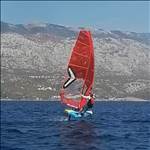
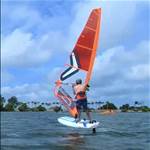
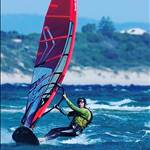
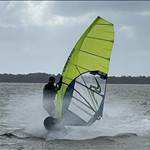
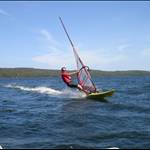
Speaking of wide (course) race boards, what are your thoughts about having the front footstraps as far forward as possible? Has anyone experimented with footstraps positioning or does mostly everyone run them all the way forward by default?
I'm mostly interested in recreational upwind-downwind riding (not racing), speed and reaching are a secondary priority. On my old FW board, I added extra strap inserts to allow super forward strap positioning, and I liked the feeling, as well as the wider stance, being on the tall side.
What would be the downsides of having front footstraps too far forward and how would that manifest during foiling? Has anyone measured different course race 1 m wide boards (or IQ foil) and compared the numbers?
I know a few IQFoilers have pushed straps backwards with +1 shim to increase upwind/downwind angles for racing.
For forward straps, I have not personally tried but it may help for some people. It would probably also help fully powered reaches, or higher speed closer to the reach but kill upwind/downwind ability. I definitely wouldn't want it for light wind myself.
With recommended settings on straps my upwind is definitely improved with mast base further back, and is very noticeable in light wind.
With a short fuselage and smaller wing than the 900 (like 650 or 725) with the 105+ fuselage, I notice it is very backfooted when not powered up and is uncomfortable unless I push the mast track backward some.
Maybe best for al responders to this thread to also quote their respective weight ?
For the sake of argument, let the numbers be:
- 95-100 cm wide board (IQ or course race)
- 9-10 m2 foil race sail
- 115 fuselage (SB plus or equal)
- 900-1000 race wings
- Wind averages 7-15 kt (gusts are stronger)
- 85-90 kg rider, geared up
- Flat water/medium chop & upwind/downwind foiling
I noticed on some race photos (eg. Silvaplana Formula Foil) that some pros indeed put the front strap backwards, and then rake their body quite far forward, with the front leg bent at the knee. What is the advantage of such setup, compared to having the straps more forward and less pronounced knee bending? Is it not easier to control gusts or apply more front foot/front wing pressure if the straps are further forward?
Or do they prioritize max. lift, hence the setup more to the back, which the heavy guys can mitigate with the extra weight and more forward body leaning. Speaking of that, even former RSX gold medallists are adopting "foil body type" :) www.instagram.com/p/CZbvdgPLFgu/
I used to run my straps maximum width (front all forward and back all back). Underpowered I wouldnt even really be in the strap anyway, only my big toe in the front strap (further out, and maybe a tad further back) and my back foot pretty much all the way out on the side of the board with the heel angled forward, sometimes standing on my toes to be able to rake out more. Contrary to what might seem intuitive, being farther outboard & stretching your body to the max increases upwind power in light winds. In high winds having a wide stance increases control.
In my experience having a bent front leg kills the power. Driving the board with a straight front leg got me way higher speeds & upwind angles. Was training with some of the best riders out there those days and competative at least regarding angles and speed. (Luuc van Opzeeland, Kiran Badloe, Huig-Jan Tak)
The lighter the winds, the more the back foot has to be forward to maintain an "optimal" 7 stance with straight front leg. In higher winds the sail is more loaded and thus mast foot pressure increases, meaning the back foot moves back. I accomplished this mostly by angling the back foot heel forward or heel back, and not necessarily moving out of the strap completely.
Kit:
Patrik Formula V3 with tail extenders maximum width (96cm under backfoot)
Lokefoil Race M & L (inbetween 115+ and ++)
Phantom RF 9 & 10m sails.
Me:
95Kgs
194cm tall
Wind 5-30+ knots
Have to say I stopped racing when IQ came, so maybe people are aiming for something different now. A lot of development happens in the racing field especially with a sport as young as ours! This is my 2c, but maybe a current IQ racer has a different perspective. It could for example be (just speculation/example) that a narrower stance allows better pumping upwind, which pretty much nobody really did in races when I was competing.
Thanks. I was hoping for your insight. Still have those light wind pumping & jibing videos saved as studying material :)
Have things changed radically in the last couple of years when it comes to stance and footstrap positioning? Here's an older thread I was looking at and the reply suggests that having straps more towards the back of the board would be beneficial: www.seabreeze.com.au/forums/Windsurfing/Foiling/strap-positionning?page=1#9
On the other hand, on newer course race boards the stance isn't getting wider nor are some riders running straps all the way forward. For example, Nico Goyard had the front straps running 3-4 holes back on Silvaplana Formula Foil.
So, I'm exploring the options, because my experience confirms what you've mentioned, that a wider stance increases control and I also don't feel the lack of power in light winds. As you've said, in this case, I merely move the weight more towards the back.
Last but not least, a lack of local riders with race gear makes it difficult to comparatively test which settings result in better VMG. Maybe I should test with port side straps forward and starboard side straps backward to see if there's a difference. I can only experiment regarding control, which does seem to be great with a wide and "front footstrap far front" setting.
Select to expand quoteFormuIa said..
Thanks. I was hoping for your insight. Still have those light wind pumping & jibing videos saved as studying material :)
Have things changed radically in the last couple of years when it comes to stance and footstrap positioning? Here's an older thread I was looking at and the reply suggests that having straps more towards the back of the board would be beneficial: www.seabreeze.com.au/forums/Windsurfing/Foiling/strap-positionning?page=1#9
On the other hand, on newer course race boards the stance isn't getting wider nor are some riders running straps all the way forward. For example, Nico Goyard had the front straps running 3-4 holes back on Silvaplana Formula Foil.
So, I'm exploring the options, because my experience confirms what you've mentioned, that a wider stance increases control and I also don't feel the lack of power in light winds. As you've said, in this case, I merely move the weight more towards the back.
Last but not least, a lack of local riders with race gear makes it difficult to comparatively test which settings result in better VMG. Maybe I should test with port side straps forward and starboard side straps backward to see if there's a difference. I can only experiment regarding control, which does seem to be great with a wide and "front footstrap far front" setting.
That post is really old! Hahah. Have to say that in that time most people were riding slalom boards with a windfoil and the windfoils had significantly less front foot pressure. Have come back from the idea that a bent front leg is a good thing since then, but on my formula foil kit I could easily keep flying with my back foot tucked all the way against the front strap, so "front foot power" plenty!
The degree to which the front leg is bent depends strongly on the load in the sail and thus downward pressure through the mast base. A very "front footed" setup can be sailed with perfectly straight legs if there's enough weight in the sail.
I do believe having front foot power is good, but the pressure in the sail must match the power from the foil. In light winds the foil is 'overpowering' the load in the sail, thus requiring a more forward bodyweight to maintain straight legs.
Whether or not straight legs are the ideal is a different point of discussion, I think with straight legs you can extend your body further, which instantly translates in more power upwind. With a bent front leg its also harder to realy drive the board through the front foot in my experience.
I use a JP 100 wide course board, with either full foil Neil Pryde Evo Flight Sails or the Severne HGO 9m sail and the IQ Foil setup. I weigh 75 kgs.
I used to have the front footstraps all the way forward, but kept hitting the water all the time when i had the sail sheeted on hard in gusts and downwind. It frustrated me so much coz i tried shifting my mast base all over the place to try to reduce it. I changed my downhaul, my boom height etc, but no fix to the problem. It was only after one of my mates (who is one of the best foilers in the country) looked at my set up and said my footstraps were too far forward did i get any results. I moved them back two holes and the stability has increased along with my speed. :)
I'm 82-88kg when I've been running iqfoil.
I checked and I have the 2nd hole from front as recommended on the board but my rear strap is one further back than this recommended position.

I know a fast iqfoil rider of 105kg. He has the front strap in the most rearward position, no back strap, & mast base as far back as possible. His best vmg is footing to windward rather than pinching.
Select to expand quoteFormuIa said..
For the sake of argument, let the numbers be:
- 95-100 cm wide board (IQ or course race)
- 9-10 m2 foil race sail
- 115 fuselage (SB plus or equal)
- 900-1000 race wings
- Wind averages 7-15 kt (gusts are stronger)
- 85-90 kg rider, geared up
- Flat water/medium chop & upwind/downwind foiling
I noticed on some race photos (eg. Silvaplana Formula Foil) that some pros indeed put the front strap backwards, and then rake their body quite far forward, with the front leg bent at the knee. What is the advantage of such setup, compared to having the straps more forward and less pronounced knee bending? Is it not easier to control gusts or apply more front foot/front wing pressure if the straps are further forward?
Or do they prioritize max. lift, hence the setup more to the back, which the heavy guys can mitigate with the extra weight and more forward body leaning. Speaking of that, even former RSX gold medallists are adopting "foil body type" :) www.instagram.com/p/CZbvdgPLFgu/
I've shifted my front straps all the way forward. since getting on an iq set i've realized how little i load my front foot upwind tilted over, and how uncomfortable it is downwind standing forward of my front foot, still hooked into the strap.
Based on the responses, it doesn't seem that weight is not the deciding factor when it comes to strap position, otherwise heavyweight guys would run different settings compared to the featherweight division, but that's not the case. Even Goyard being on the lighter spectrum has straps pretty far back on course race setup.
@Maddlad, quite interesting discovery, thanks for sharing!
Select to expand quoteFormuIa said..
Based on the responses, it doesn't seem that weight is not the deciding factor when it comes to strap position, otherwise heavyweight guys would run different settings compared to the featherweight division, but that's not the case. Even Goyard being on the lighter spectrum has straps pretty far back on course race setup.
@Maddlad, quite interesting discovery, thanks for sharing!
No worries at all mate. Happy foiling! :D
Select to expand quoteSubsonic said..FormuIa said..
For the sake of argument, let the numbers be:
- 95-100 cm wide board (IQ or course race)
- 9-10 m2 foil race sail
- 115 fuselage (SB plus or equal)
- 900-1000 race wings
- Wind averages 7-15 kt (gusts are stronger)
- 85-90 kg rider, geared up
- Flat water/medium chop & upwind/downwind foiling
I noticed on some race photos (eg. Silvaplana Formula Foil) that some pros indeed put the front strap backwards, and then rake their body quite far forward, with the front leg bent at the knee. What is the advantage of such setup, compared to having the straps more forward and less pronounced knee bending? Is it not easier to control gusts or apply more front foot/front wing pressure if the straps are further forward?
Or do they prioritize max. lift, hence the setup more to the back, which the heavy guys can mitigate with the extra weight and more forward body leaning. Speaking of that, even former RSX gold medallists are adopting "foil body type" :) www.instagram.com/p/CZbvdgPLFgu/
I've shifted my front straps all the way forward. since getting on an iq set i've realized how little i load my front foot upwind tilted over, and how uncomfortable it is downwind standing forward of my front foot, still hooked into the strap.
How far is your mast base from your front foil screw? Wondering how everyone is jibing with straps so far forward especially in light air without the board nose diving.
Select to expand quotePaducah said..Subsonic said..FormuIa said..
For the sake of argument, let the numbers be:
- 95-100 cm wide board (IQ or course race)
- 9-10 m2 foil race sail
- 115 fuselage (SB plus or equal)
- 900-1000 race wings
- Wind averages 7-15 kt (gusts are stronger)
- 85-90 kg rider, geared up
- Flat water/medium chop & upwind/downwind foiling
I noticed on some race photos (eg. Silvaplana Formula Foil) that some pros indeed put the front strap backwards, and then rake their body quite far forward, with the front leg bent at the knee. What is the advantage of such setup, compared to having the straps more forward and less pronounced knee bending? Is it not easier to control gusts or apply more front foot/front wing pressure if the straps are further forward?
Or do they prioritize max. lift, hence the setup more to the back, which the heavy guys can mitigate with the extra weight and more forward body leaning. Speaking of that, even former RSX gold medallists are adopting "foil body type" :) www.instagram.com/p/CZbvdgPLFgu/
I've shifted my front straps all the way forward. since getting on an iq set i've realized how little i load my front foot upwind tilted over, and how uncomfortable it is downwind standing forward of my front foot, still hooked into the strap.
How far is your mast base from your front foil screw? Wondering how everyone is jibing with straps so far forward especially in light air without the board nose diving.
I'll have to check the measurement and get back to you, its mid point of track with the 9.5m hgo, and 1cm forward of that with the 8m.
but i don't find it nose dives at all gybing, unless I consciously make it happen.
had them forward for about a month now. Light winds it does cause some issues with hobby horsing upwind, but getting better at controlling that by staying more upright. Once the winds up, it definitely makes things feel better off breeze (to me at least). But if the pros are all moving everything back, then im no one to argue.
Select to expand quoteMaddlad said..
I use a JP 100 wide course board, with either full foil Neil Pryde Evo Flight Sails or the Severne HGO 9m sail and the IQ Foil setup. I weigh 75 kgs.
I used to have the front footstraps all the way forward, but kept hitting the water all the time when i had the sail sheeted on hard in gusts and downwind. It frustrated me so much coz i tried shifting my mast base all over the place to try to reduce it. I changed my downhaul, my boom height etc, but no fix to the problem. It was only after one of my mates (who is one of the best foilers in the country) looked at my set up and said my footstraps were too far forward did i get any results. I moved them back two holes and the stability has increased along with my speed. :)
I've been running with my footstraps forward and inboard with my JP135 and GTR+. The was working ok with the 330 TW, but You've convinced me to try outboard strap position and one hole back now I'm using a 255 -2 TW. 25.9kt PB so far, I'm hoping this will help me get past 26.
Select to expand quotePaducah said..
How far is your mast base from your front foil screw? Wondering how everyone is jibing with straps so far forward especially in light air without the board nose diving.
I'll have to measure, on old FW board it's like this (pic below). The mast base is a few mm behind the "recommended" position for fin. For the foil, it should probably be even further back, as the setup does feel a little rear-foot biased (though I'm used to this from FW days).
After comparing it to newer 100 cm course race boards, those have longer mast tracks (and placed further back).
Regarding light wind jibing, this is mostly a question of technique (for me at least :)). On a good day, I can do it with 10 m2 sail and 1000 wing in light conditions without touching the water. I haven't noticed any pronounced nose-diving, but I do need to adapt body position when jibing in marginal winds (below 10 kt) with weight more towards the back.

I think it is important to remmeber that you can control foil lift by raking the board to windward with leverage... and that should work with the strap forward or aft. Downforce comes from the harness, arms and mast pressure more effecxtively than front foot pressure when fully loaded.
Select to expand quoteFormuIa said..Paducah said..
How far is your mast base from your front foil screw? Wondering how everyone is jibing with straps so far forward especially in light air without the board nose diving.
I'll have to measure, on old FW board it's like this (pic below). The mast base is a few mm behind the "recommended" position for fin. For the foil, it should probably be even further back, as the setup does feel a little rear-foot biased (though I'm used to this from FW days).
After comparing it to newer 100 cm course race boards, those have longer mast tracks (and placed further back).
Regarding light wind jibing, this is mostly a question of technique (for me at least :)). On a good day, I can do it with 10 m2 sail and 1000 wing in light conditions without touching the water. I haven't noticed any pronounced nose-diving, but I do need to adapt body position when jibing in marginal winds (below 10 kt) with weight more towards the back.
I'm good on the technique and with the IQ 900, the board balances well where my straps are (non-IQ freerace 91cm). But I'm light, around 63 kg and wondering how heavier riders are keeping the nose up when the back foot comes up and across in lighter wind when there's less lift pressure from the foil.
Half off topic - is it just me or does the 1000 require more backfoot pressure than the 900 all other things equal? Tempted to throw in a half a degree on the stab for the 1000 because it feels more nose heavy than the 900.
Interesting. As mentioned, I haven't noticed nose-diving in jibes as a result of straps placement. It was noticeable if I changed two things: mast foot forward or too little stab angle (eg. SB -3 or -4? total, e.g. -2 wing with -1/-2 spacer). Then the whole setup had less lift and was more back-foot heavy.
I haven't used 1000 enough to be able to compare it with 900 in direct comparison. One reason I might think of is: have you tried them back-to-back with the same setup and in the same session? Or could it be that 1000 was used in lighter winds and 900 when you were powered up?
Select to expand quoteSubsonic said..Paducah said..Subsonic said..FormuIa said..
For the sake of argument, let the numbers be:
- 95-100 cm wide board (IQ or course race)
- 9-10 m2 foil race sail
- 115 fuselage (SB plus or equal)
- 900-1000 race wings
- Wind averages 7-15 kt (gusts are stronger)
- 85-90 kg rider, geared up
- Flat water/medium chop & upwind/downwind foiling
I noticed on some race photos (eg. Silvaplana Formula Foil) that some pros indeed put the front strap backwards, and then rake their body quite far forward, with the front leg bent at the knee. What is the advantage of such setup, compared to having the straps more forward and less pronounced knee bending? Is it not easier to control gusts or apply more front foot/front wing pressure if the straps are further forward?
Or do they prioritize max. lift, hence the setup more to the back, which the heavy guys can mitigate with the extra weight and more forward body leaning. Speaking of that, even former RSX gold medallists are adopting "foil body type" :) www.instagram.com/p/CZbvdgPLFgu/
I've shifted my front straps all the way forward. since getting on an iq set i've realized how little i load my front foot upwind tilted over, and how uncomfortable it is downwind standing forward of my front foot, still hooked into the strap.
How far is your mast base from your front foil screw? Wondering how everyone is jibing with straps so far forward especially in light air without the board nose diving.
I'll have to check the measurement and get back to you, its mid point of track with the 9.5m hgo, and 1cm forward of that with the 8m.
but i don't find it nose dives at all gybing, unless I consciously make it happen.
had them forward for about a month now. Light winds it does cause some issues with hobby horsing upwind, but getting better at controlling that by staying more upright. Once the winds up, it definitely makes things feel better off breeze (to me at least). But if the pros are all moving everything back, then im no one to argue.
Measured today, 110cm from the front foil bolt centre (which is the middle of the mast track) for the 9.5m HGO, and 111cm for the 8m HGO It's a jp 175L board.
110 cm is very common. I set mine to 108 and leave it there for all sail sizes. It works fine.
What is different is the geometry between freeride foils and race foils. Race foils locate the front wing much further forward of the mast compared to freeride foils. See the photo below.
You notice that freeride foil boards place the front fin screw at about the midpoint between the back footstrap screws. This balances the front wing to about the midpoint between front and back footstraps. Typical for freeride geometry. If you mount a race foil on this board, the wing is too far forward and you can't keep the board down unless you stand in front of the front footstraps. I know this from experience.
In the finning days, the front fin screw was completely behind the back footstraps. You can mount a race foil into this and have it balance out pretty well. A friend of mine runs an old iSonic 127 with a SB race foil, and it is nicely balanced. He rips with it.
I have a custom foil board with the fin box completely behind the back footstraps. I mound my Moses 105-900 race foil into it, put the sail at 108 cm, and it is all nicely balanced. I won't ever try a freeride foil in it because it will never lift since the freeride wing is too far aft.
You can tweak the balance point a little bit with stab shimming. However, this has a much smaller effect than where you place the front wing.

Select to expand quoteStretchy said..Maddlad said..
I use a JP 100 wide course board, with either full foil Neil Pryde Evo Flight Sails or the Severne HGO 9m sail and the IQ Foil setup. I weigh 75 kgs.
I used to have the front footstraps all the way forward, but kept hitting the water all the time when i had the sail sheeted on hard in gusts and downwind. It frustrated me so much coz i tried shifting my mast base all over the place to try to reduce it. I changed my downhaul, my boom height etc, but no fix to the problem. It was only after one of my mates (who is one of the best foilers in the country) looked at my set up and said my footstraps were too far forward did i get any results. I moved them back two holes and the stability has increased along with my speed. :)
I've been running with my footstraps forward and inboard with my JP135 and GTR+. The was working ok with the 330 TW, but You've convinced me to try outboard strap position and one hole back now I'm using a 255 -2 TW. 25.9kt PB so far, I'm hoping this will help me get past 26.
Awesome, i hope it works out for you. Just remember you need to find the right balance for your set up by moving your mast base around. You want to have it so that when you sheet in hard it keeps the board as level as possible so you have the confidence to keep the power on when it blows. Im sure you'll crack the 26 knot barrier soon. :)
Select to expand quoteSubsonic said..
Measured today, 110cm from the front foil bolt centre (which is the middle of the mast track) for the 9.5m HGO, and 111cm for the 8m HGO It's a jp 175L board.
Thanks for taking the time. Interesting as I'm 105 on an HGO 8 and iq foil. 107-108 just make it feel heavy for me. High level IQFoilers I've talked to said they run things "at the back".
We've reached the summer doldrums and it may be a while before I can revisit this. 
Select to expand quotePaducah said..Subsonic said..
Measured today, 110cm from the front foil bolt centre (which is the middle of the mast track) for the 9.5m HGO, and 111cm for the 8m HGO It's a jp 175L board.
Thanks for taking the time. Interesting as I'm 105 on an HGO 8 and iq foil. 107-108 just make it feel heavy for me. High level IQFoilers I've talked to said they run things "at the back".
We've reached the summer doldrums and it may be a while before I can revisit this.
I run my mast base right at the back of the track with all my sails (HGO 9m, Neil Pryde Flight Evo 8 & 7) if that helps.
Select to expand quoteMaddlad said..Paducah said..Subsonic said..
Measured today, 110cm from the front foil bolt centre (which is the middle of the mast track) for the 9.5m HGO, and 111cm for the 8m HGO It's a jp 175L board.
Thanks for taking the time. Interesting as I'm 105 on an HGO 8 and iq foil. 107-108 just make it feel heavy for me. High level IQFoilers I've talked to said they run things "at the back".
We've reached the summer doldrums and it may be a while before I can revisit this.
I run my mast base right at the back of the track with all my sails (HGO 9m, Neil Pryde Flight Evo 8 & 7) if that helps.
Thanks. Appreciate that. So, how far back is the back of the track from the screw if you know offhand? I'm on a custom and the nearest IQFoil board is 5 hrs by car.  .
.
Talked to a local cat foiler this past weekend and need to up my speed game a bit and represent. 
@Maddlad, what mast rake are you normally running on your gear?
I've been experimenting a bit with trim (mast base and mast rake), and it seems that the more I increase mast rake or put the mast base rearward, the harder is it to pump in marginal winds (averages 8 kt or below). If I set mast rake around 1-1.2? and mast base forward to 112-113 cm, then it gets easier to pump (100 cm wide course race board), but going with "recommended" 2? rake and 110 cm gets me nowhere ... maybe it's a matter of (poor) technique?
Select to expand quoteFormuIa said..
@Maddlad, what mast rake are you normally running on your gear?
I've been experimenting a bit with trim (mast base and mast rake), and it seems that the more I increase mast rake or put the mast base rearward, the harder is it to pump in marginal winds (averages 8 kt or below). If I set mast rake around 1-1.2? and mast base forward to 112-113 cm, then it gets easier to pump (100 cm wide course race board), but going with "recommended" 2? rake and 110 cm gets me nowhere ... maybe it's a matter of (poor) technique?
The rake settings are also strongly dependent on tail kick. If you have 1 degree more tailkick than an IQ board, 1 degree of rake becomes 2 degrees compared to the IQ. I would use what works for you in this case, not what the leaflets say.
Thanks. It seems I'll indeed need to steer more into "what works for me" and probably more control/less power, rather than what the recommended settings for pros say :) Same goes with the footstraps, somehow I prefer having them radically forward and less bent front knee, even at the expense of VMG.
Select to expand quoteFormuIa said..
@Maddlad, what mast rake are you normally running on your gear?
I've been experimenting a bit with trim (mast base and mast rake), and it seems that the more I increase mast rake or put the mast base rearward, the harder is it to pump in marginal winds (averages 8 kt or below). If I set mast rake around 1-1.2? and mast base forward to 112-113 cm, then it gets easier to pump (100 cm wide course race board), but going with "recommended" 2? rake and 110 cm gets me nowhere ... maybe it's a matter of (poor) technique?
Hi mate,
I run a 2 degree shim in the foil box of my JP 100cm wide, 230 litre course racing board (2021) if that helps. I run the mast base at the very back of the track which is apparently 106.5 cm from the front screw hole to the centre of the mast pin. I dont have much trouble getting going in 8 knots but i am only 75 kgs and i pump reasonably well due to course racing. Hope that helps. :)