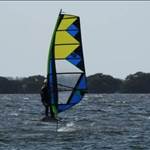
I have been foiling for 2 -3 years but don't get a ton of time on the water ( been 4 -5 times in the past 3 months). Definitely need to go more but also think some advice could help get over the plateau. I can foil in good control for a bit(25-50 meters??) but tend to either get nervous about foiling out and hence set it down or run out of speed and touch down naturally. I tend to rig a bit on the small side I guess. Today was 16-22 mph or so and I used a 5.5, a Moses 790, and a 140 fanatic stingray. I weigh about 210 lbs.
long story short I read a fair amount of conflicting advice. Some say straighten your legs to make the platform Rigid and weight the harness to get more control Then some say bend knees more to weight the harness for control.
Some say don't put your back foot in the strap but then every instructional video seems to have both feet in the straps.
mostly think I need time and to man up so to speak, but seems I am foiling with a bit of anxiety all the time trying not to foil out (even though this never seems To happen) and maintain balance where on a normal board given enough wind I can just lock in and blast along.
Any thoughts to help get in the zone? Feel I have been at about the same level for a awhile now. I love the sensation when going but seems I end up schlogging two thirds of the time and then just getting a few good rides on the foil here and there.
Your sail size sounds about right. Until you can fly steady, a sail size that almost allows you to plane on a proper sized windsurf board should be fine (one size smaller with larger front wings, or if you feel overpowered).
If you "run out of speed", the trim might not be right. The best thing to do would be to have a more experienced foiler use your gear to check the trim. The most likely issue is that the front wing is too far back if you use the tuttle box.
Now to the legs. Sam Ross is pretty clear about this: you start with very straight legs; especially the back leg is straight. Later, after you achieve stable flight (regularly for several hundred meters), you start bending the knees to work on getting more weight in the harness. But that only comes when you want to go faster, and when you want to maximize upwind angles - definitely not when you are still getting nervous enough to set the board down.
Most windsurfers who sail in choppy conditions use the knees extensively to deal with the chop. But if you try to do the same thing on the foil, you'll get dolphin rides - up, down, up, down, with crashes from overfoiling and full stops from coming down too hard. When you are foiling, any small weight shifts forward or back will cause the foil to go down respectively up. Bending the knees independently from each other, which works great for windsurfing and is deeply ingrained in the muscle memory of many windsurfers, causes relatively large weight shifts, which send the foil skyward or down to the water way too quickly. Keeping the legs, and especially the back leg, as straight as possible is the easiest way to override the muscle memory. In foiling, you have to be much more "immobile" than in windsurfing. Locked knees help. The two types of windsurfers I have seen who picked up foiling the fastest were those who are used to sailing with locked knees and a more upright stance: freestylers and long board racers.
As for the back foot strap, forget (or, better, remove) it until your flights are steady. Even the front foot strap is optional - some beginners like it, others prefer to go without. I did not use foot straps at all for my first 100 or 200 foil sessions, and still sometimes go without when on freeride foils. On faster foils (e.g. 800 cm front wings), the front straps are somewhere between beneficial and necessary, but I still never saw a reason to use use back straps from recreational foiling.
Just rig the next size bigger sail, I learned with rear foot straps but only use the front now. Move the universal forward to control breaching. Keep mast base pressure and try to sail faster
Select to expand quotedrnebe said..
I have been foiling for 2 -3 years but don't get a ton of time on the water ( been 4 -5 times in the past 3 months). Definitely need to go more
I think thats your main problem, not enough time on the water. I started last September and that month and October I got out a fair few times. Over the UK winter I didnt have too many decent sessions as the wind was gusty and it was cold. So my improvements slowed down.
Once Spring came and I had more decent sessions my rate of improvement increased. I've had 30 decent sessions now, and feel a lot more in control than last October. There are a couple of other windsurfers who started foiling last year and I'm now ahead of them purely because I have had more ToW.
Boardsurfr has covered all the other aspects of learning I can think of. Particularly straight legs and stand over the board to start, then as you progress use weight in the harness more.
Running out of speed could be not reading the lulls and adjusting trim on the board. It takes time to read the gusts and lulls and allow for them as you run into them so you keep on the foil. Once you have some muscle memory for steady flight, it frees your brain up to look ahead for changes in the wind and anticipate them.
In 1990 when I started windsurfing, I went from complete beginner to first planing gybe on a short board in 3 months. Now I'm 60, it takes a little longer to pick things up. Trying to forget all the instinctive things you do on a fin board was the hardest part.
Thank you for the tips and clarifying the stiff legs and no back strap issue. As far as setup , no one foils here so can't get some one to try. I have a Tuttle and the sail mast base is about 43 inches (109 cm) from the front Tuttle screw. The mast base is about 134 cm from tail. I have a 1 degree shim in. Sometimes when I foil and am not fully going the nose seems to ride high but eventually seems to level out.
definitely need more time in water but if you have any comments on the settings fire away.
Your 43 inches is about right. At 200 lb I also use the Fanatic Stingray 140 with the SAB 790 (and 940, 950, and 720) with 4.2 to 7.0 sails.
Yup, more TOF (time on foil) will be your goal, but you have good equipment.
Select to expand quotedrnebe said..
Sometimes when I foil and am not fully going the nose seems to ride high but eventually seems to level out.
definitely need more time in water but if you have any comments on the settings fire away.
"Nose high" is a very typical beginner problem. Sometimes, beginners even ride this way on purpose, because flattening out means picking up speed, which can be scary.
Try to get the board to flatten out, rather than just waiting for it to happen. Sheeting in sometimes does the trick, since it puts extra pressure on the mast foot. You can even pump a couple of times while already on the foil to pick up a bit more speed. The other thing to do is to shift your weight forward a little bit.
Nose high means you need more speed to get stable. That will also get you through lulls. Is your board tuttle or track?
If it was my gear I'd bring the mast base back at least 2" and the boom down compared to finning. That will make changes in sail pressure upset the balance far less.
Select to expand quotesegler said..
Your 43 inches is about right. At 200 lb I also use the Fanatic Stingray 140 with the SAB 790 (and 940, 950, and 720) with 4.2 to 7.0 sails.
Yup, more TOF (time on foil) will be your goal, but you have good equipment.
I am 210 lbs and I was pretty comfortable with Slingshot 99 or Armstrong foil of similar size but when switched Starboard IQfoil 95/800 wing I was puzzled why I could not ride as good when I was using 85 cm Starboard foil board. I regressed and experienced dolphin motion. Then I decided to get 91 cm foil slalom board. There was an immediate comfort in my ride and found my balance. Buddy of mine 50 lbs lighter experienced the same but he was on Goya bolt regular board with foil box and he was going up and down. He got my 85 cm wide board and he also right away started riding in balance. Therefore I think for your weight wider board may provide more steady ride. If there is an opportunity to rent or borrow wider board, you could test this possibility. I found out riding back foot without straps is more controllable and less likely for foot injury if you fall from foiling.
The problem with going with different boards is that you have to determine where the balance point is. Unless you actually do that, you are flying in the dark. It's no wonder people struggle with different foils and boards. With tuttle you cannot move the foil, but you can move the footstraps and sail mast base. With dual track you can move the foil itself. Get the front wing somewhere near the mid point between front and back footstraps (or feet).
Good advice already given. Just want to stress one point already made.....For me getting into the harness and committing to it was the big game changer. Its very scary to do because you lose that instant sheet in/sheet out control you think you have. With foiling the sheet in and out thing is big trouble. It leads to pitchy up and down motions and either foil outs or burying the nose into a wave. Try the harness if you are not already. Use your hips to shift weight fore and aft to control ride height. The Sam Ross videos are excellent if you haven't seen them. Good luck and keep at it . It will be worth the trouble.
Select to expand quoteH2Ophbc said..
....For me getting into the harness and committing to it was the big game changer. Its very scary to do because you lose that instant sheet in/sheet out control you think you have. With foiling the sheet in and out thing is big trouble. It leads to pitchy up and down motions and either foil outs or burying the nose into a wave. Try the harness if you are not already. Use your hips to shift weight fore and aft to control ride height. The Sam Ross videos are excellent if you haven't seen them. Good luck and keep at it . It will be worth the trouble.
How much the harness helps depends a lot on gear setup and personal things like sailing style and harness skills. Sam Ross tends to be on relatively fast gear with a cambered sail that's pretty stable, and his videos are filmed in pretty flat water. With that kind of setup, the harness can definitely make life easier.
But many beginners learn on larger foils with smaller and lighter sails. These combos can fly with very little sail pressure, and sheeting in or out a bit does not have a large effect. The only thing a harness does is increase the fear factor. Chop that pushed the large foils up and down a lot only makes being hooked in worse for a beginner, especially those that are somewhat fearful.
Select to expand quoteboardsurfr said..H2Ophbc said..
....For me getting into the harness and committing to it was the big game changer. Its very scary to do because you lose that instant sheet in/sheet out control you think you have. With foiling the sheet in and out thing is big trouble. It leads to pitchy up and down motions and either foil outs or burying the nose into a wave. Try the harness if you are not already. Use your hips to shift weight fore and aft to control ride height. The Sam Ross videos are excellent if you haven't seen them. Good luck and keep at it . It will be worth the trouble.
How much the harness helps depends a lot on gear setup and personal things like sailing style and harness skills. Sam Ross tends to be on relatively fast gear with a cambered sail that's pretty stable, and his videos are filmed in pretty flat water. With that kind of setup, the harness can definitely make life easier.
But many beginners learn on larger foils with smaller and lighter sails. These combos can fly with very little sail pressure, and sheeting in or out a bit does not have a large effect. The only thing a harness does is increase the fear factor. Chop that pushed the large foils up and down a lot only makes being hooked in worse for a beginner, especially those that are somewhat fearful.
The scariest part for me was always harnessed in going downwind. I can do it now after trying several foils in different conditions and lots of TOW but race gear is definitely more steady downwind than freeride gear when it gets to overpowered time. Smaller uncammed sails are so much twitchier.
Hey drnebe!
It took me a couple of years to get relaxed and I was sailing a lot more than you are, shooting for 2 times per week year round at that point. Everyone learns at their own pace so be patient with yourself and try to sail more regurlarly.
Use efoiling, wake foiling or a wake cable park to get flight time when it's flat. For wake foiling you can use your windfoil set up.
Wake foiling really accelerated my learning to windfoil.
Your equipment choices and sizes are reasonable for the wind and your size.
Straps are not a necessity so do what feels right for you.
Really work to overcome that fear of the foil out because it keeps you from learning to sail fast. Personally, I don't feel I am pushing myself hard enough unless I foil out a once in a while.
A lesson from a good teacher who is watching you can do wonders!, sure worked for me with Andy Brandt.
Thank you for all the great pointers and encouragement. Definitely need to get on the water!
Don't be too hard on yourself, time on the water especially a few days in a row will make a big difference. To me it sounds like your Sail size is about right for the 790. Which I think is a great first foil. I used it with more of a up right stance more over the centre of the board. However I do rig my "windsurfing" sails as deep as possible beyond the recommended settings.
As stated by some already; I advanced much more quickly once I removed all the foot straps. I was more relaxed and figured out quickly were to stand (there also have been some threads on foot placement aids). You can advance to foot straps later but it worked for me especially when learning to jibe.
Otherwise getting an experience foiler to try your set up on the day, can confirm its balanced. Especially if using foot straps, without straps I find I just move around to find the balance point.