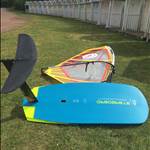
Have an AFS Wind95 foil with F800 wing. It has a lip going 3/4s around the mast head that meets up with the bottom of the board/box (Goya Bolt 135 Pro). What I noticed is that the rear screw can always overpower the front screw tilting the foil slightly back. An issue with light winds, so I barely snug up the rear screw in order to not pull the foil back, otherwise if I tighten the rear screw a gap will open up (the thickness of my thumb nail or more) where the front of the mast head lip meets the board/box. Any ideas on how to fully tighten the rear screw without tilting the foil back?
Thanks
The WillyWind post addresses the same issue with a different foil that has no lip/flange, could make a shim for the rear screw I guess.
when I tighten both mast head screws the foil angles back 0.8 degrees more (used a level app on my phone), that makes a difference in light winds for me because I move my front foot forward to keep the board level (two stab shims and a relatively narrow/thin tail allow the tail to sink). Starboard makes a shim to adapt their DT heads to a foil box, contacted my local dealer to see if I can get one, will contact cement it to the mast head.
here is a spacer I made for my AFS Wind95, made from starboard (polypropylene), the angle between the box and fuselage is now zero with both screws tight!

OK, I will say it one more time, then I will give up trying to convince everybody.
The ONLY thing that matters is a very tight seating of both the front and back rounded tapers between the foil and the box.
If your foil will not fit in there without rocking back and forth, it HAS TO MEAN that the foil is bottoming out (topping out) inside the box, with the result that the front and back rounded tapers are not fully seated. This is bad news. This will break the box, break the screws, and generally make things difficult.
If you are shimming or adding bulk to the top of your foil with the intent to get it to bottom out inside the box, you are just asking for trouble.
You actually WANT a gap between the top of the foil and inside top of the box. Only with such a gap can you be assured that the front and back rounded tapers are fully seated. Those tapers are what carry the entire rocking cantilevering loads of the foil.
If you have a foil with flanges, just insert and tighten the screws until the flanges are tight against the bottom of the board. If you are lucky, you will still have a gap on the inside, but the flange helps to carry the loads.
This business of doing all this stuff to get a contact between the top of the foil and the inside top of the box is ridiculous. You are barking up the wrong tree. Concentrate on the tapers (or flange). That's where the load carrying physics is located. BY DESIGN. Look up the tuttle design document. There is nothing there that implies any sort of top contact. Everything there implies taper contact.
Sorry. OK, off the soapbox. I'm just trying to help everybody avoid problems with their tuttle interfaces.
So actually, the best solution going forward is stop using tuttle altogether. The industry is beginning to do exactly that by migrating over to dual track. Good move. I just purchased a Fanatic Stingray with both tuttle and dual track. Slingshot for 2021 is all dual track.
But come on, peeps, stop trying to fill up the space inside the tuttle finbox. That's the wrong thing to do. The right thing is to seat the front and back rounded tapers.
Select to expand quotesegler said..
OK, I will say it one more time, then I will give up trying to convince everybody.
The ONLY thing that matters is a very tight seating of both the front and back rounded tapers between the foil and the box.
If your foil will not fit in there without rocking back and forth, it HAS TO MEAN that the foil is bottoming out (topping out) inside the box, with the result that the front and back rounded tapers are not fully seated. This is bad news. This will break the box, break the screws, and generally make things difficult.
If you are shimming or adding bulk to the top of your foil with the intent to get it to bottom out inside the box, you are just asking for trouble.
You actually WANT a gap between the top of the foil and inside top of the box. Only with such a gap can you be assured that the front and back rounded tapers are fully seated. Those tapers are what carry the entire rocking cantilevering loads of the foil.
If you have a foil with flanges, just insert and tighten the screws until the flanges are tight against the bottom of the board. If you are lucky, you will still have a gap on the inside, but the flange helps to carry the loads.
This business of doing all this stuff to get a contact between the top of the foil and the inside top of the box is ridiculous. You are barking up the wrong tree. Concentrate on the tapers (or flange). That's where the load carrying physics is located. BY DESIGN. Look up the tuttle design document. There is nothing there that implies any sort of top contact. Everything there implies taper contact.
Sorry. OK, off the soapbox. I'm just trying to help everybody avoid problems with their tuttle interfaces.
So actually, the best solution going forward is stop using tuttle altogether. The industry is beginning to do exactly that by migrating over to dual track. Good move. I just purchased a Fanatic Stingray with both tuttle and dual track. Slingshot for 2021 is all dual track.
But come on, peeps, stop trying to fill up the space inside the tuttle finbox. That's the wrong thing to do. The right thing is to seat the front and back rounded tapers.
Thank you for responing, I think what is happening is this: I tighten the front screw and the mast head flange touches the board bottom, then when I tighten the rear screw the mast pivots slightly on the front screw/barrel nut because of the play in the coarse threaded screw and barrel nut and because the rear screw barrel nut is lower in the mast head and so has more leverage. As a result the fuselage/board bottom angle goes from 0.0 degrees to 0.8 degrees towards the back of the board, and makes the wing drag when the board is level on the water. The shim makes the fuselage/board angle go 0.8 degrees forward when the front screw is tight so that when the rear screw is tightened and takes up the play in the front screw/barrel nut the angle goes to 0.0 degrees.
Now I agree with you that with the shim some of the pressure on the foil box goes from the side walls to the top of the box. But on a rail foil attachment all of the force is applied to the board bottom because there is no box, and that is not a problem for upward forces. I am more concerned if I hit something with the foil, that impact will try to pull the foil out of the box, so in that case a shim is not an issue. And Starboard now makes foils (in US) with a squared off head to fit the depth of the foil box in the back, and that is what I have done with the shim essentially.
The other option is to wrap plastic/monofilm around the rear of the mast head to make the sidewall connection tighter so that the rear screw can not pull the mast head so deep, but it is tricky to get the right thickness of film and will then make it difficult to get the foil out of the box.
I think with a flange you will always be tilting the foil backwards sightly if you fully tighten both screws. The flange was made I think for boards that did not have a DT box designed for foils, and puts pressure on the board bottom instead of the side walls. But I think it is really not needed for foil used in a DT box designed for foils. Maybe that is why Moses stoped making foils with a flange, because it caused the tilting issue I have described.
The other thing I suspect is that even in a DT foil box the sidewalls have some flex, so that the mast head is making contact with the foil box even before the screws are fully tightened. So just because the shim stops the head from going in as far, does not mean that the mast head is not making full contact with the box.
Segler, not trying to get in an argument, but based on what you said you should be very opposed to the use of a flange on a foil, since it would prevent the mast head from fully seating in the box if the foil box was ridgid with no flex, because it would be nearly impossible to have the mast head flange touch the board bottom while at the same time have the mast head seat fully in the foil box.
Select to expand quotesegler said..
OK, I will say it one more time, then I will give up trying to convince everybody.
........
But come on, peeps, stop trying to fill up the space inside the tuttle finbox. That's the wrong thing to do. The right thing is to seat the front and back rounded tapers.
This all sounds very logical but goes against what all PWA racers do : shimming the foil mast to adjust the rake angle according to the conditions and/or type of race (up-down or slalom).
I can't post direct links here (since I'm new) but on the site of Phantom foils this is even explained in their official foil manual . Would they really publish this If they risk claims for destroyed foil-boxes ?
Then there's the other topic on this forum (How Do I Properly Sit a Starboard Foil Mast? ) with the YT clip where Gonzalo Costa explains how to adjust the trim by using shims...
Your explanation would imply they are all wrong then ?
Interesting, was checking out the Phantom manual, they recomend a 3 degree angle or greater between the fuselage and board, two other knowledgable foilers told me it should be 0.0 degrees, maybe racing is different or it is specific to the Phantom foils.
I wonder how you would create a shim in my 13 cm formula board box? One hellava shim. Listen to Segler. He is right.
Select to expand quotesegler said..
OK, I will say it one more time, then I will give up trying to convince everybody.
The ONLY thing that matters is a very tight seating of both the front and back rounded tapers between the foil and the box.
If your foil will not fit in there without rocking back and forth, it HAS TO MEAN that the foil is bottoming out (topping out) inside the box, with the result that the front and back rounded tapers are not fully seated. This is bad news. This will break the box, break the screws, and generally make things difficult.
If you are shimming or adding bulk to the top of your foil with the intent to get it to bottom out inside the box, you are just asking for trouble.
You actually WANT a gap between the top of the foil and inside top of the box. Only with such a gap can you be assured that the front and back rounded tapers are fully seated. Those tapers are what carry the entire rocking cantilevering loads of the foil.
If you have a foil with flanges, just insert and tighten the screws until the flanges are tight against the bottom of the board. If you are lucky, you will still have a gap on the inside, but the flange helps to carry the loads.
This business of doing all this stuff to get a contact between the top of the foil and the inside top of the box is ridiculous. You are barking up the wrong tree. Concentrate on the tapers (or flange). That's where the load carrying physics is located. BY DESIGN. Look up the tuttle design document. There is nothing there that implies any sort of top contact. Everything there implies taper contact.
Sorry. OK, off the soapbox. I'm just trying to help everybody avoid problems with their tuttle interfaces.
So actually, the best solution going forward is stop using tuttle altogether. The industry is beginning to do exactly that by migrating over to dual track. Good move. I just purchased a Fanatic Stingray with both tuttle and dual track. Slingshot for 2021 is all dual track.
But come on, peeps, stop trying to fill up the space inside the tuttle finbox. That's the wrong thing to do. The right thing is to seat the front and back rounded tapers.
Having a foil sitting on a external flange loading up the bottom skin of the board is well dodgy.
how thick is that board skin compared to the top and sides of the Tuttle box?
From the Starboard 2021 foil website
" Make sure that the top of the foil's mast makes full contact with the bottom of the board's foil box. This full-contact gives maximum support to the foil and sets the mast firmly at the recommended angle. "
RuddeBos,
the AFS flange is very narrow and only contacts the foil box edge without a shim, with the shim I made it is slightly off the box.
And thanks for the info from SB, that makes me feel better about the shim I made.
Select to expand quotesegler said..
OK, I will say it one more time, then I will give up trying to convince everybody.
The ONLY thing that matters is a very tight seating of both the front and back rounded tapers between the foil and the box.
If your foil will not fit in there without rocking back and forth, it HAS TO MEAN that the foil is bottoming out (topping out) inside the box, with the result that the front and back rounded tapers are not fully seated. This is bad news. This will break the box, break the screws, and generally make things difficult.
If you are shimming or adding bulk to the top of your foil with the intent to get it to bottom out inside the box, you are just asking for trouble.
You actually WANT a gap between the top of the foil and inside top of the box. Only with such a gap can you be assured that the front and back rounded tapers are fully seated. Those tapers are what carry the entire rocking cantilevering loads of the foil.
If you have a foil with flanges, just insert and tighten the screws until the flanges are tight against the bottom of the board. If you are lucky, you will still have a gap on the inside, but the flange helps to carry the loads.
This business of doing all this stuff to get a contact between the top of the foil and the inside top of the box is ridiculous. You are barking up the wrong tree. Concentrate on the tapers (or flange). That's where the load carrying physics is located. BY DESIGN. Look up the tuttle design document. There is nothing there that implies any sort of top contact. Everything there implies taper contact.
Sorry. OK, off the soapbox. I'm just trying to help everybody avoid problems with their tuttle interfaces.
So actually, the best solution going forward is stop using tuttle altogether. The industry is beginning to do exactly that by migrating over to dual track. Good move. I just purchased a Fanatic Stingray with both tuttle and dual track. Slingshot for 2021 is all dual track.
But come on, peeps, stop trying to fill up the space inside the tuttle finbox. That's the wrong thing to do. The right thing is to seat the front and back rounded tapers.
Now starboard tells you the top of the Mmast head must touch the box anda even their ads are very explicit about it.
windsurf.star-board.com/products/foil-slalom/?preview=true

Select to expand quoteZeroVix said..
I wonder how you would create a shim in my 13 cm formula board box? One hellava shim. Listen to Segler. He is right.

Select to expand quoteWillyWind said..segler said..
OK, I will say it one more time, then I will give up trying to convince everybody.
The ONLY thing that matters is a very tight seating of both the front and back rounded tapers between the foil and the box.
If your foil will not fit in there without rocking back and forth, it HAS TO MEAN that the foil is bottoming out (topping out) inside the box, with the result that the front and back rounded tapers are not fully seated. This is bad news. This will break the box, break the screws, and generally make things difficult.
If you are shimming or adding bulk to the top of your foil with the intent to get it to bottom out inside the box, you are just asking for trouble.
You actually WANT a gap between the top of the foil and inside top of the box. Only with such a gap can you be assured that the front and back rounded tapers are fully seated. Those tapers are what carry the entire rocking cantilevering loads of the foil.
If you have a foil with flanges, just insert and tighten the screws until the flanges are tight against the bottom of the board. If you are lucky, you will still have a gap on the inside, but the flange helps to carry the loads.
This business of doing all this stuff to get a contact between the top of the foil and the inside top of the box is ridiculous. You are barking up the wrong tree. Concentrate on the tapers (or flange). That's where the load carrying physics is located. BY DESIGN. Look up the tuttle design document. There is nothing there that implies any sort of top contact. Everything there implies taper contact.
Sorry. OK, off the soapbox. I'm just trying to help everybody avoid problems with their tuttle interfaces.
So actually, the best solution going forward is stop using tuttle altogether. The industry is beginning to do exactly that by migrating over to dual track. Good move. I just purchased a Fanatic Stingray with both tuttle and dual track. Slingshot for 2021 is all dual track.
But come on, peeps, stop trying to fill up the space inside the tuttle finbox. That's the wrong thing to do. The right thing is to seat the front and back rounded tapers.
Now starboard tells you the top of the Mmast head must touch the box anda even their ads are very explicit about it.
windsurf.star-board.com/products/foil-slalom/?preview=true
I think that disclaimer will be removed or modified. It might apply to their specific boards. It would be impossible for a true formula board that has 12-13cm deep box. Not going to happen. Manufactures make mistakes and provide wrong information. I have seen ads that disclose a deep tuttle box, but they are not deep tuttle. I am not saying that it is wrong on their specific boards, just not going to happen on many other boards.
Select to expand quoteWillyWind said..ZeroVix said..
I wonder how you would create a shim in my 13 cm formula board box? One hellava shim. Listen to Segler. He is right.
I have seen that on NW. Why does a Formula board have a 12-13cm deep box for a 70cm fin? Do you pull the deep tuttle fin all the way up? Why are the race foils with deep tuttle and not track?
Show me one with track:
www.phantom-windsurfing.com/foils
Do you really think that they are behind in R&D?
Here is a nice video on how to set up.
www.phantom-windsurfing.com/settings
*warning - they have a Cobra 69 box and not deep tuttle* at least that is what it looks to me.
We had a guy break his box and the deck of his formula board the other week shimming the box. The Starboard advice cited is for Tuttle boxes for foil boards, I would imagine. Another guy did damage to his mast around the screws because the head tilted and put undue pressure on that part of the foil. Starboard would not replace it because it was not a foil box but a formula Tuttle box. Not all Tuttles are equal segler is giving good advice.
Select to expand quoteCaptFathom said..
We had a guy break his box and the deck of his formula board the other week shimming the box. The Starboard advice cited is for Tuttle boxes for foil boards, I would imagine. Another guy did damage to his mast around the screws because the head tilted and put undue pressure on that part of the foil. Starboard would not replace it because it was not a foil box but a formula Tuttle box. Not all Tuttles are equal segler is giving good advice.
I received an email from one of the people who was involved in the development of the IQFoil and he told me to put a spacer/shim in my formula board. This is one of the reasons I am doing it. plus, There are countless designs out there In the world that deal with cantilever forces and do not use tapers.i think the idea of the tapers was to sit the fin tight but make it easy to remove. I guess the foil designers are using the tapers mainly to center the foil (and carry the side to side loads), but let the top of the box carry all the cantilever forces. I don't see any problem with it, as long as you have a very beefy foilbox top. I added glass to the top of my foilbox and now it is 5 mm thick. I might be wrong and I will break my board; in that case, I will install a new foilbox and move on. I will use a leash for the foil though.
so I would say if you don't have a foil ready board, do your research, contact the board manufacturer, and pick what you want to do (to shim or not to shim). You might have years of trouble free foiling or your board might explode as soon as it touches the water, which it will give you the perfect excuse to buy a brand new board!
BTW, I don't have any engineering background but I am an tinkerer by nature and I love to argue :)
Select to expand quoteWillyWind said..ZeroVix said..
I wonder how you would create a shim in my 13 cm formula board box? One hellava shim. Listen to Segler. He is right.
I can't even imagine what the box looks like if that actually fits 
Something is not right here!
Select to expand quoteAUS 808 said..WillyWind said..ZeroVix said..
I wonder how you would create a shim in my 13 cm formula board box? One hellava shim. Listen to Segler. He is right.
I can't even imagine what the box looks like if that actually fits
Something is not right here!
I know it looks weird! the parts highlighted in red are fully seating. The angle marked with blue is 90 degrees (I guess it doesn't look like a 90 degree angle because I'm not holding the mast perpendicular to the camera.

Fill the void with q cell resin mix.
Fully install the foil to what ever angle you prefer. With lots of grease on it and plastic straws over your bolts. Drill two holes in the deck above the void and use a syringe to inject resin mix. Simples. 
You then have a super strong box fully supported on all sides.
I also put some layers of weted out carbon down the tapers of the box then inserted the foil and tightened it up and then filled it.
Be careful not to glue it in permanently
Select to expand quoteZeroVix said..WillyWind said..segler said..
OK, I will say it one more time, then I will give up trying to convince everybody.
The ONLY thing that matters is a very tight seating of both the front and back rounded tapers between the foil and the box.
If your foil will not fit in there without rocking back and forth, it HAS TO MEAN that the foil is bottoming out (topping out) inside the box, with the result that the front and back rounded tapers are not fully seated. This is bad news. This will break the box, break the screws, and generally make things difficult.
If you are shimming or adding bulk to the top of your foil with the intent to get it to bottom out inside the box, you are just asking for trouble.
You actually WANT a gap between the top of the foil and inside top of the box. Only with such a gap can you be assured that the front and back rounded tapers are fully seated. Those tapers are what carry the entire rocking cantilevering loads of the foil.
If you have a foil with flanges, just insert and tighten the screws until the flanges are tight against the bottom of the board. If you are lucky, you will still have a gap on the inside, but the flange helps to carry the loads.
This business of doing all this stuff to get a contact between the top of the foil and the inside top of the box is ridiculous. You are barking up the wrong tree. Concentrate on the tapers (or flange). That's where the load carrying physics is located. BY DESIGN. Look up the tuttle design document. There is nothing there that implies any sort of top contact. Everything there implies taper contact.
Sorry. OK, off the soapbox. I'm just trying to help everybody avoid problems with their tuttle interfaces.
So actually, the best solution going forward is stop using tuttle altogether. The industry is beginning to do exactly that by migrating over to dual track. Good move. I just purchased a Fanatic Stingray with both tuttle and dual track. Slingshot for 2021 is all dual track.
But come on, peeps, stop trying to fill up the space inside the tuttle finbox. That's the wrong thing to do. The right thing is to seat the front and back rounded tapers.
Now starboard tells you the top of the Mmast head must touch the box anda even their ads are very explicit about it.
windsurf.star-board.com/products/foil-slalom/?preview=true
I think that disclaimer will be removed or modified. It might apply to their specific boards. It would be impossible for a true formula board that has 12-13cm deep box. Not going to happen. Manufactures make mistakes and provide wrong information. I have seen ads that disclose a deep tuttle box, but they are not deep tuttle. I am not saying that it is wrong on their specific boards, just not going to happen on many other boards.
that disclaimer is fine; note that it refers to a fit in a Foilbox and not a finbox in a Formula board.
if you want to foil with a board that has a deep tuttle finbox then get a foil that has a flange on the mast. If you want to use a race-type foil without a flange then get a board with a Foilbox or install a Foilbox.
i destroyed finboxes in 2 formula boards, replacing both with foilboxes.
i filled one of my finboxes with q-cells. that worked fine for a while then eventually let go and the the resulting "spacer" put the load on the deck and delaminated the deck. I have seen others who built spacers to fill the void and in one case delaminated the deck within minutes.
Even with a foilboard with a Foilbox, make sure the fit is as Starboard describe. I have seen Foilboxes where the foilmast has not bottomed out in the box and the foil has shifted crushing the front taper at the bottom skin of the board and cracking the rear taper deep in the box (and this is with the proper reinforced foilbox that most manufacturers use) I have fit mine so that the mast pretty much drops into the box and contacts the bottom of the box without having to torque it in with the screws.
if you find you are having to use lots of force to remove your mast from the box, say wrench the mast backwards to pop/snap the mast out; then i would look carefully at the fit, don't just jam the mast in the taper and hope for the best.
Select to expand quoteWillyWind said..CaptFathom said..
We had a guy break his box and the deck of his formula board the other week shimming the box. The Starboard advice cited is for Tuttle boxes for foil boards, I would imagine. Another guy did damage to his mast around the screws because the head tilted and put undue pressure on that part of the foil. Starboard would not replace it because it was not a foil box but a formula Tuttle box. Not all Tuttles are equal segler is giving good advice.
I received an email from one of the people who was involved in the development of the IQFoil and he told me to put a spacer/shim in my formula board. This is one of the reasons I am doing it. plus, There are countless designs out there In the world that deal with cantilever forces and do not use tapers.i think the idea of the tapers was to sit the fin tight but make it easy to remove. I guess the foil designers are using the tapers mainly to center the foil (and carry the side to side loads), but let the top of the box carry all the cantilever forces. I don't see any problem with it, as long as you have a very beefy foilbox top. I added glass to the top of my foilbox and now it is 5 mm thick. I might be wrong and I will break my board; in that case, I will install a new foilbox and move on. I will use a leash for the foil though.
so I would say if you don't have a foil ready board, do your research, contact the board manufacturer, and pick what you want to do (to shim or not to shim). You might have years of trouble free foiling or your board might explode as soon as it touches the water, which it will give you the perfect excuse to buy a brand new board!
BTW, I don't have any engineering background but I am an tinkerer by nature and I love to argue :)
I really support tinkers' right to tinker :) - as you say, the advice given to you depends on the box, I hope it was not a blanked un-qualified piece of advice. The fact is when you use things like a fin box not designed for foils - you are probably voiding your warranty - in fact, I have seen this close hand with a friend.
I have been using a spacer in Formula Boards. A Mistral Devil has recently started blowing bubbles around the Tuttle box finscrew holes. No sign of damage but heard a noise like carbon crunching while foiling through a boat wake. Originally used with the NP pinky (maybe 30 times) . Recently upgraded to the SB Alloy Race Plus. Now using a SB HWR Formula (5 times) , that is showing signs of the deck being pushed up at the front screw hole. This suggests that the foil is not fully seated in the tapers, thus the spacer is too big and via the foil head is pushing on the top of the box. Note. I do use a lanyard tied from a footstrap to the foil as a security measure.
I am going to take segler's advice and run without the spacer, ensuring the tapers are fully seated.
Then follow fjdoug's advice and source/fit a replacement foilbox. (Or possibly a new foilboard.????
Any recommendations on a replacement foilbox and where to purchase. I know about the ones from Seatex in Italy. $450?.
Thanks.
Ian
This is a great discussion. Yes, I am commenting again on this. Sorry.
For me the whole thing rests on the engineering intent of the tuttle design. If you shim it or add filler to get the top of the foil to touch the top inside of the box, you are defeating the engineering intent of the design. Anything you do to defeat the intimate contact of both the front and back rounded tapers causes point loads inside the box. Bad idea.
If a flanged foil is designed correctly it will still have intimate taper contact AND tight flange contact. Yes, most flanges are so small that they contact only the bottom of the board out a few millimeters from the hole, not even to the edge of the finbox structure itself. So, I suppose they help carry some of the up and rocking loads, but what they are really for is to assure alignment of the tuttle top in the box. At least that is what PL says about the flanges on his LP foils. If you want a REAL flange go for the Power Plate.
The finbox itself is what carries ALL the up and rocking loads, absent of flanges. The front and back rounded tapers carry all those loads. All of them. If they are point loaded, they will fail. New foil boards that have deep tuttle boxes intended for foiling supposedly have strongly reinforced finboxes and improved structural connection of finbox to board.
You watch. Even racing foils will evolve into dual track mounts as racing boards adopt such mounts. Those mounts greatly spread the loads, and they are actually very easy to shim to change the fore and aft mast angles. The shims will have to be as large as the mounting plates to continue spreading the up and rocking loads.
Select to expand quotesegler said..
This is a great discussion. Yes, I am commenting again on this. Sorry.
For me the whole thing rests on the engineering intent of the tuttle design. If you shim it or add filler to get the top of the foil to touch the top inside of the box, you are defeating the engineering intent of the design. Anything you do to defeat the intimate contact of both the front and back rounded tapers causes point loads inside the box. Bad idea.
The usage of the tuttle box has evolved far past its original intent. Where, as you've mentioned, the original design was intended to provide a more robust fixture as fins got longer, the foil usage has added a new design objective - resisting the torque/upward force provided by the foil wing. This is why the top of the box is now important for several reasons.
First, using the top of the box means we are now spreading the considerable vertical force on the box to the deck. The box is no longer primarily responsible for this but now works in unison with a larger structure. The vertical load from a tuttle fin even a formula deep tuttle was minimal. Now the box has to support, literally, a 100 kg PWA racer. The tapers alone are no longer sufficient unless we extremely overbuild them with expensive carbon and PVC foam. Not to mention that the tapers at 80 degrees have to resist a lot of unnecessary side force caused by the wedge design. Having some or most of the weight carried by the top reduces the strain on the ends substantially.
Second, the rotating torque is again a force not anticipated in the original design. The easiest way to envision how the top of the box now helps is to think of a crescent or box wrench. The top of a tuttle foil is somewhat similar to a bolt - being partly hexagonal. The foil box, like a wrench, is more effective and secure the more sides that come in contact. An open or crescent wrench grabbing only two sides of a bolt is relatively effective but when it comes time to torque down (or undo) a difficult bolt, a six sided box wrench or socket provides a much more secure connection. Same with the foil box - the top is an additional side to resist the torque. Like the wrench, the more sides, the less any one has to do.
Again, the simple shape Larry Tuttle designed back in 1985 was never intended to handle the loads we put on it 35 years later. To stretch an analogy, take any earlier airplane design and compare it to a modern jet. Even though the basic planform is the same, things have changed to deal with stresses not envisioned by designers in an earlier time.
Select to expand quoteRuddeBos said..
Having a foil sitting on a external flange loading up the bottom skin of the board is well dodgy.
how thick is that board skin compared to the top and sides of the Tuttle box?
Hi Rod,
I think the area around the box is actually pretty strong on most foil specific boards. The reinforcement extends at least 10 mm around the edge of the tuttle box walls and that's what the skin rests on. The tuttle box walls themselves probably provide enough support on their own as they would be very resistant to compression. I can see that the Moses / Slingshot Ghost Whisper style beak out the front could be a problem though as it applies pressure a long way from the box.
I've never had a problem with Lokefoil or Slingshot foils that have a flange and I've had some massive impacts! Personally I like the flange because I don't have to worry about whether I've got the foil sitting just right on the bottom of the box.
Select to expand quoteIan85 said..
I have been using a spacer in Formula Boards. A Mistral Devil has recently started blowing bubbles around the Tuttle box finscrew holes. No sign of damage but heard a noise like carbon crunching while foiling through a boat wake. Originally used with the NP pinky (maybe 30 times) . Recently upgraded to the SB Alloy Race Plus. Now using a SB HWR Formula (5 times) , that is showing signs of the deck being pushed up at the front screw hole. This suggests that the foil is not fully seated in the tapers, thus the spacer is too big and via the foil head is pushing on the top of the box. Note. I do use a lanyard tied from a footstrap to the foil as a security measure.
I am going to take segler's advice and run without the spacer, ensuring the tapers are fully seated.
Then follow fjdoug's advice and source/fit a replacement foilbox. (Or possibly a new foilboard.????
Any recommendations on a replacement foilbox and where to purchase. I know about the ones from Seatex in Italy. $450?.
Thanks.
Ian
I don't know of any other place for a good foil box. If you send Seatex a PM (member on forum), they will send you a discount code. Not much discount and shipping cost are high. I haven't installed mine yet. The box isn't a true deep tuttle (angle). It is a reinforced parallel box with 69-70cm depth. A lot of $$, but what are your options for a good box?
Paducah thank you for that detailed explaination, makes me feel a lot better about the shim. I also told Goya about it and they did not say it was a problem. The 2018/19 Goya Bolt Pro DT box is advertised as foil ready, and so far it has held up perfect even after running into a sandbar and having a wave throw the board/ foil foil side flat onto the beach! The other thing is that the Bolt 135 weights <17 lbs and the AFS Wind95 foil is light too, so I think that may help reduce stress on the box.
With the shim I made, and both screws tight, I could not feel any flex or movement in the box when pushing on the mast. I think that is better than leaving the rear screw just snug in order to have the right fuselage/board angle.