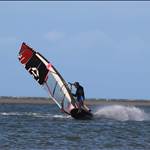
After watching the PWA at Sylt I was inspired to sail at a small beach with dangerous shore break. Well except that I had a nice spring beach with warm and clear water and only 30-50cm dumpers.
Cross onshore wind
1. Come in to the beach behind the biggest and typically last swell in a set. Don't be tempted to race in over the swell!
2. jump in at the first moment of sand scraping the foil. Land between the board and sail. Mast facing the wind!
3. Duck under the board and lift it on your head with the mast resting on the board one hand on the foil mast or fuselage if you can reach it the other hand reaches a long way down the boom.
4. Fly the rig and board as best you can and maintain your balance as you walk in to shore. It's more important to maintain balance and keep the fear higher than the waves than to rush in, but do try to get in before the next big set hits!
?. If you drop the gear try to flip the board onto the sail and hold the mast and footstrap tight! Point the tip of the mast into the swell and hope for the best!
Very interesting technique. Looks like it won't be too hard on my shoulders either. Will be trying that in calm water to get some practice at it.
Select to expand quoteexcav8ter said..
Very interesting technique. Looks like it won't be too hard on my shoulders either. Will be trying that in calm water to get some practice at it.
Practice is a good idea!
Anumber time you rig up just try holding the gear on your head and twist at different angles to the wind. Feel how to react to gusts etc.
Thats ok for flatish water venues but unfortunately, you would get absolutely drilled on the east coast FL trying to get out of the shore break like that!
Don't think my chiropractor would approve me carrying boards and rigs on my nogging either 
Select to expand quoteCoreAS said..
Thats ok for flatish water venues but unfortunately, you would get absolutely drilled on the east coast FL trying to get out of the shore break like that!
Don't think my chiropractor would approve me carrying boards and rigs on my nogging either
I have a pile of respect for you Berowne cause you rip on your race gear and you help others with your posts! But that's not even what I would consider small shore break.
If there are actual breakers I would never use any technique that puts the sharp trailing edge of the front wing up against the gut.
I can't speak for race gear but for smaller freeride gear the best way I have found to get in or out of the soup is to drag the whole kit upside down by either the mast or the bottom handle. Always keeping my body up wave of the kit. I can duck dive the board under small oncoming waves and in general stay away from the sharp stuff. Most of the time I just let the sail flow where it wants, only picking it up when I'm so shallow that the boom drags. The only risky moments are when it's shallow and the back wing is eye level, then I hold on to the back wing and the mast.
Dean has some footage of how to do it, can you repost that mate?
I will carry the kit on my head at times but not with the sail rigged, just too heavy/risky. My body would definitely not handle the weight of a race kit all on my head.
Here is a shot of how I carry my gear to and from the waters edge in one trip. When the board is on the ground on it's side you can grab it right where the mast attaches to the board and the whole board and foil will balance on one hand while you swing onto your head (at least my set ups have). Then I squat down and pick up the rig and set it on my shoulder. The hands can just chill at your side or lightly hold the wing.
Sorry to derail this thread a bit by sharing free ride approaches to this problem, it's just that the topic of getting any foil safely through the shore break is not discussed enough.

Sorry to be so heavy handed Berowne! Especially since my point is mostly semantics about what shore brake means.
I have seen the approach in your video being demonstrated by the pros and I have no business talking about race gear because I have not done it.
But I do have years of experience negotiating ocean shore break with smaller windfoing gear and I guess I just have a really strong reaction to seeing the sharp trailing edge so close to vital organs. I just don't want to see people get hurt.
Like what if on the way in a wave flattened ya from behind and drove you into it. Or on the way out a wave could drive it into your stomach?
Like I said, I respect you and the racing culture it's just the thought of this technique being used in ocean shore break just spooks me and I had to speak up.
Hello All,
I believe berowne has the merit of starting the discussion on this very interesting topic.
I am not Balz Muller, but I am able to windfoil in pretty any condition from flat water to messy waves and 30+ knots o wind pretty under control, though shorebreak is one true limiting factor for the practice. I had some good wind days I didn't go out because of that, otherwise I would have enjoied a pretty nice session windfoiling which I like so much more than windsurfing these days.
I therefore would really appreaciate any suggestion on how to go through shorebreack with the kit without being hurt or destroy it.
Conditions here in Italy expecially in north Tuscany were I leave can be nasty with onshore wind and waves that are challenging even with windsurfing gear without the foil attached, moreover the waves are messy and do not come in sets since they are local wind driven.
I do not pretend to go out in such extreme conditions, but I would appreciate the possibility to do some good sessions I am so far missing cause of shorebreak.
Should you hany suggestion, video or explanation I will be glad to consider them all!
Thank you
Edoardo
I admire all of these approaches but can't do any of them - too may injuries to my spine already to risk another. The only way I can get out through significant shorebreak is to swim out with a small mushroom anchor beyond the break (or between breaks), then swim the board out and tie it on, then swim the sail out and latch the base in out there. It's inelegant and slow but even with the two-pin system my bases have it's not all that hard. A mechanical u-joint would make it even easier but I don't trust them.
A few people have contacted me privately and suggested that in bigger shore break, the original technique migh be dangerous. Especially standing between the gear at the start, and/or having the foil close to you as you walk.
A Better way may be to stand on the windward side of the board, then rest the tail of the board on your shoulder to take the weight, then rest the rig onto your head (balanced with your hand), this shares the loads and is better on your neck.
A lot of good images from last PWA at Sylt


The pro move is then in larger waves to then do an arm straighten, ( one hand where your shoulder was, the other on the mast) This gets everything above your head. 
Also it is generally a big no no in shore break to put yourself between any part of your board / rig and the beach.
Always stay on the outside, Stay safe and have fun :))
Berowne & Anon. You know who you are!
Unless you go backward, how can you avoid Bering in between the Gear and the beach on th way out? Also in the picture you have shown above the gut Is in between the foil and the beach, if a big wave crashes on hin he Is goig to have an hard time I believe...through they are pro...maybe do not apply
Select to expand quoteberowne said..
A few people have contacted me privately and suggested that in bigger shore break, the original technique migh be dangerous. Especially standing between the gear at the start, and/or having the foil close to you as you walk.
A Better way may be to stand on the windward side of the board, then rest the tail of the board on your shoulder to take the weight, then rest the rig onto your head (balanced with your hand), this shares the loads and is better on your neck.
A lot of good images from last PWA at Sylt
The pro move is then in larger waves to then do an arm straighten, ( one hand where your shoulder was, the other on the mast) This gets everything above your head.
Also it is generally a big no no in shore break to put yourself between any part of your board / rig and the beach.
Always stay on the outside, Stay safe and have fun :))
Berowne & Anon. You know who you are!
Looks like they are using the wing to help lift the board/foil and rig over the break, with hand on backside (sharp side) of foil mast. Risky for me, but they are called pros for a reason.
I like Awalkspoiled's technique, my only problem is to get out to the sandbar I go through water that is too deep to stand in, can paddle board/foil out but the sail I would have to swim out and that seems awkward. So I have been slogging out, and then jumping off when I reach the sandbar, but if the breakers are big the sand wash hides the sandbar, and if I jump off in deep water breaking waves grab the kit and drag back to shore
Sounds like you need a pontoon!Select to expand quoteSandman1221 said..
I like Awalkspoiled's technique, my only problem is to get out to the sandbar I go through water that is too deep to stand in, can paddle board/foil out but the sail I would have to swim out and that seems awkward. So I have been slogging out, and then jumping off when I reach the sandbar, but if the breakers are big the sand wash hides the sandbar, and if I jump off in deep water breaking waves grab the kit and drag back to shore

3
I can't rig a wave sail as fast as those guys. Of course, I'm busy talking the whole time. 
Thanks for posting.
Select to expand quoteberowne said..
Some good comments in this video too!
Thanks for sharing


 , that is now my dream!