Yikes!
I'm pretty comfortable cruising around on mid-aspect foils on my Severne Alien 155 but yesterday I scored an killer deal on a well-used IQ set - 115+ fuse, 900 front and 255 rear wing, lightly repaired C400 mast, etc and took it out into the Gulf under an 8.5 Flyer FR in winds around 9-12kt. The setup looked a little weird - leading edge of the foil was right behind the location of the front footstraps, but I set the mast track where I usually like it - about 40.5" from the front bolt, with the +1 shim in (I weigh 100kg) and set out.
It took a lot of pumping to fly and when it did it at first it rode very nose-high, tail of the board sort of whacking against the little chop. I slid the mastfoot forward a bit - to around 41.5 and tried again. Much smoother to rise but when it did it just ROSE UP on that long mast like a rocket. I had both feet curled round the front footstrap like a little koala, trying to keep the thing from breaching. No way I could have cruised any distance, much less tried a jibe. It was very, very fast to be sure, and loud too, which may have been the less than perfect mast-repair singing to me. I fought with it for an hour and a half and came home exhausted.
So, is this going to be a TOW thing, or is there something about setup I need to tweak? How far from front bolt do people run their mastfoot on IQ gear? (I tried at 43" and it just became sluggish to rise.) Try 0.5" shim? Try reducing rake? I've got one more set of inserts forward for my footstraps but that doesn't seem like it would be all that big a difference.
What I didn't try and should have was immediately heeling to windward as soon as I was flying, but there was a lot going on, mostly terror. I'd love to hear from people who are more expert, especially those who've run IQ foils on non-IQ boards.
I have never used a race foil, though my AFS S670 cm2 wing was part of the old pre 2020 slalom series and definitely likes going upwind/downwind fast! With that said, I have read here that race foils are made for upwind/downwind runs and if you go crosswind they are too powerful, that sounds like what you experienced, maybe? The new AFS Performer foil is designed for just that, upwind/downwind slalom racing (according to AFS website), and that is why I have been hesitant to get it, that and the biggest AFS wing for it is 900 cm2 which as you point out with the IQ foil 900 wing (cm2?) takes a lot of pumping to get up on.
You definitely want the board heeled to windward side even while first lifting onto the foil. Weight onto your heels and to hang in the harness lines for mast base pressure. It takes commitment and can be scary at first. Upwind- downwind is definitely best too.
Ugh I think my pictures could have been better as I think there's parallax issue with the bolt hole but somewhere around 43 is the center, maybe a little less.
I personally find the +1 to be challenging above 12kts when the mast is at the center mark. I usually ride +0.5. I think that you rode mine with +0.5.
I've been told by (certain pro) that he can ride a +1 until about 14kts maybe more after a lot of practice. I'm 91kg last I rode (saturday) in somewhere around 7-10 maybe a little more, +0.5, mast at center, not taking too much work but I could've moved the mast back.


Faster race foils can be very scary when switching from freeride foils. For using the 115+ fuse, you'll need a ton of constant mast foot pressure (in addition to railing). I think the difference is bigger than the difference between intermediate level freeride windsurfing and all-out, competition-level slalom racing.
My novice "freerace" experience is that the 115+ fuse is a **** of a thing on a reach. Unless you just want to go up/down wind you'd be better off with a 95/105 fuse. Just my opinion from my own experience. I initially went from Supercruiser to GTR+ (95+) and loved it. Then plugged in 115+.hated it!
If you've got foot strap holes further forward ( and you use the foot straps) then move them further forward. Leading edge of the wing close to under the front foot strap is probably a little too far forward. 50% to 75% of the distance (foil mast to front foot strap position) seems to be the favoured distance. Mast base position can vary a bit.
As others have said, Iq foil with the 115+ fuse is definitely about upwind/downwind. You can go crosswind, but not too comfortably unless it's light.
Please check first your stab if it is 255 or it is 255(-2).
If you used 255 without build in -2 angle and added +1 you set up yourself for incredibly early lift but absolutely no stability in more speed !
That is crazy setup !
When Starboard introduced 115+ & 115++ the recommended stab has built in -2 angle and then you add shims as the balance changes when the front wing is moved forward (from original 115 black one).
Starboard has nice graphs on their website somewhere how moving front wing forward is more efficient geometry.
I think Berowne mentioned in his post that for Starboard Race Foils the shim (stab angle) is the most critical for stability.
You (and many) may be surprised that I ride both fuselages 115+ & 115++ mostly BAF (beam reach) with M1000 (Millenium) wing in relatively light winds and big sails (11m) - no problem with that.
I actually love it. Long fuse and -0.5 shim (on top of -2 build in the stab) is for more speed rather than early lift therefore in gusts the foil shoots forward instead of uncontrolled lift "elevator effect" (like in shovels or aggressive stab angle).
BTW: I am 90kg+ too. In gear over 100kg.
I love to use 115++ fuse with Starboard Go 180L & 200L because the foil mast is behind rear footstraps. Using 75cm mast with a flange.
I love to use 115+ fuse with Starboard FW 167L & Race 100 because the foil mast is where the rear footstraps are. With variety of masts.

When you are 90kg and over, you may revisit some feedback I posted earlier for "Heavy Dudes" in Light winds:
Impressions of new Windfoil boards for super heavyweights | Windsurfing Forums, page 1 (seabreeze.com.au)
www.seabreeze.com.au/forums/Windsurfing/Foiling/Impressions-of-new-Windfoil-boards-for-super-heavyweights#2809771
I weigh 75 kg. The combo I almost exclusively use in summer is the iQFoil with the 1000 wing (instead of the 900) with the 115+ fuse and the 8.5 Flyer FR. But I almost never use the +1 shim. The +1 shims gets very unpredictable really quick: it tends to suddenly breach with no warning. The first IQFOILs were sold without the +0.5 shim. If you don't have it, get it from a store because there is significant power increase compared to the 0, but still way more manageable than the +1
can you measure how far forward the front footstraps are? If the front wing is almost at the distance of the front straps, something might be off. In my board, Roberts 76cm, the front wing is more or less between my feet.
Relative or Starboard discussed angle:
You can find more information about 115+ fuselages, the geometry, default for these + fuselages - stabilizers with built in -2 angle.
You will also find that the angle range with shims becomes from -4 angle (-2 shim) to -1 angle (+1 shim) therefore if you are using the original stabilizer 255 (no -2 built in) then with your +1 shim you are at +1 angle - out of range even for the lightest winds.
Here is more info at Starboard Website:
2022 iQFOIL - Starboard Foils
starboardfoils.com/pages/2022-iqfoil
Absolute angle:
BTW: All above is in reference to "base 3.7 degree angle" which was built in 255 original stabilizer considered as 0 Relative (or Starboard discussed) angle.
So 255 with built in -2 angle is 1.7 degree actual angle (2 less than original 255).
This was earlier discussed on Seabreeze.
Select to expand quotemareks360 said..
When Starboard introduced 115+ & 115++ the
What is the 115++ ?
I have one that has 115plus+ printed on the side waiting in my van for me to learn to foil. I thought that was the 115+ that guys refer to?
I thought there is only a 115, and 115+ ?
bit confused 
Thanks so much for all your thoughts - I really appreciate it.
I do get confused with the + and - designations of Stab and shims! I have four shims on hand: +1, +0.5, 0 and - 0.5.
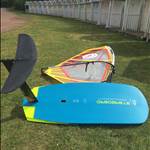
The Stab I have is the 255 (-2.) Below is the 115+ fuse lying on the deck, lined up with the box, with the front footstraps as far forward as possible and you can see that it's pretty close to the straps. What do you think? Unworkable or worth messing with? I may be able to find a 115 non+ fuselage for use with this board but the maximum distance from front bolt to mastfoot is only 42.5" so that's also a limiting factor. Probably the foil would set up better on my Tillo Convertible which has a longer mastfoot but that has a Deep Tuttle Box so I'd have to trim the top of the IQ Masthead to fit. I do like using the Alien because it's lighter and nimbler than the Tillo

Select to expand quoteAwalkspoiled said..
Thanks so much for all your thoughts - I really appreciate it.
I do get confused with the + and - designations of Stab and shims! I have four shims on hand: +1, +0.5, 0 and - 0.5.
The Stab I have is the 255 (-2.) Below is the 115+ fuse lying on the deck, lined up with the box, with the front footstraps as far forward as possible and you can see that it's pretty close to the straps. What do you think? Unworkable or worth messing with? I may be able to find a 115 non+ fuselage for use with this board but the maximum distance from front bolt to mastfoot is only 42.5" so that's also a limiting factor. Probably the foil would set up better on my Tillo Convertible which has a longer mastfoot but that has a Deep Tuttle Box so I'd have to trim the top of the IQ Masthead to fit. I do like using the Alien because it's lighter and nimbler than the Tillo
I firmly believe it's worth pursuing. Once you get it wired, it'll open some great foiling for you. fwiw, I used to run the 115+ at about 105cm on my Tillo with the +0.5 shim and mind that I'm a lot lighter/smaller than you. With a new more race oriented board, I run it all the way back at 106ish. From aeroegnr's pics above, the IQ guys in your neighborhood are running it about the same. There is a very noticeable difference in that extra half degree to 1.0 btw. I tried going from 0 to 1.0 and it about shot me off the board.
Having gone from the Tillo to a full on foilboard with very much wider rear deck, it's another reason to keep at this. The Tillo was a fine board for its purpose but 2 years in, knowing that a) I'm pushing my abilities on foil and b) in those two years, I never stuck a fin on it, a full on foil board makes more sense for me.
Edit: the IQ guys will move the mast base up in windier conditions to the middle of the track but their definition of windy is like the Hawaiian method of measuring waves
That's going to be challenging if you aren't using large sails and sailing upwind, downwind aggressively.
You might try shimming for more rake as well as the stab for less lift.
Select to expand quoteracerX said..mareks360 said..
When Starboard introduced 115+ & 115++ the
What is the 115++ ?
I have one that has 115plus+ printed on the side waiting in my van for me to learn to foil. I thought that was the 115+ that guys refer to?
I thought there is only a 115, and 115+ ?
bit confused
No need to be confused. Just check Starboard webpage for more info (at the bottom of the webpage):
2020 Race Plus - Starboard Foils
starboardfoils.com/pages/2020-race-plus
So Starboard intended 115++ for up down wind racing / sailing BUT that is also "Magic" in another application:
1) When you want to use a legacy board (not built for foil like SB Go) with 75cm mast that has a flange (now discontinued) and your rear footstraps are in front of Deep Tuttle (like on my picture).
2) when you want the earliest foil flights in the lightest winds in BAF - wind in 5-10mph range
3) when you use the board like we used to in windsurfing driving it forward with MBP and increasing speed without need for pumping.
Then the board reaches early plaining with what I call "foil assisted planing".
Then if your shim is set right, it becomes up to you if you want to nudge the board to separate from the water (full foiling) or continue flying through touching the crests of the waves. "no elevator effect".
Foil set up this way is great in particular for gusty conditions. It accelerates forward "no anchoring effect".
BTW: Using original 115 black fuse as a reference 0. then 115+ moves front wing forward extra 70mm. 115++ moves forward 130mm from original 115 (so extra 60mm from 115+).
Please read on Starboard Website about: "HIGH EFFICIENCY FOIL GEOMETRY - HOW DOES IT WORK?".
The link I provided earlier:
Quote:
+++++++++++++
When the front wing and tail wing are closely aligned, there is less drag. You fly with more efficiency, more speed and more stability.
+++++++++++++
That is the Magic that can be used in BAF Sailing as well. Why not ?!
Select to expand quotemareks360 said..racerX said..mareks360 said..
When Starboard introduced 115+ & 115++ the
What is the 115++ ?
I have one that has 115plus+ printed on the side waiting in my van for me to learn to foil. I thought that was the 115+ that guys refer to?
I thought there is only a 115, and 115+ ?
bit confused
No need to be confused. Just check Starboard webpage for more info (at the bottom of the webpage):
2020 Race Plus - Starboard Foils
starboardfoils.com/pages/2020-race-plus
So Starboard intended 115++ for up down wind racing / sailing BUT that is also "Magic" in another application:
1) When you want to use a legacy board (not built for foil like SB Go) with 75cm mast that has a flange (now discontinued) and your rear footstraps are in front of Deep Tuttle (like on my picture).
2) when you want the earliest foil flights in the lightest winds in BAF - wind in 5-10mph range
3) when you use the board like we used to in windsurfing driving it forward with MBP and increasing speed without need for pumping.
Then the board reaches early plaining with what I call "foil assisted planing".
Then if your shim is set right, it becomes up to you if you want to nudge the board to separate from the water (full foiling) or continue flying through touching the crests of the waves. "no elevator effect".
Foil set up this way is great in particular for gusty conditions. It accelerates forward "no anchoring effect".
BTW: Using original 115 black fuse as a reference 0. then 115+ moves front wing forward extra 70mm. 115++ moves forward 130mm from original 115 (so extra 60mm from 115+).
Please read on Starboard Website about: "HIGH EFFICIENCY FOIL GEOMETRY - HOW DOES IT WORK?".
The link I provided earlier:
Quote:
+++++++++++++
When the front wing and tail wing are closely aligned, there is less drag. You fly with more efficiency, more speed and more stability.
+++++++++++++
That is the Magic that can be used in BAF Sailing as well. Why not ?!
No still confused, that link only refers to two versions not three and the picture has 115 plus+.
Is there an easy way to identify what I have?

Select to expand quoteracerX said..mareks360 said..racerX said..mareks360 said..
When Starboard introduced 115+ & 115++ the
What is the 115++ ?
I have one that has 115plus+ printed on the side waiting in my van for me to learn to foil. I thought that was the 115+ that guys refer to?
I thought there is only a 115, and 115+ ?
bit confused
No need to be confused. Just check Starboard webpage for more info (at the bottom of the webpage):
2020 Race Plus - Starboard Foils
starboardfoils.com/pages/2020-race-plus
So Starboard intended 115++ for up down wind racing / sailing BUT that is also "Magic" in another application:
1) When you want to use a legacy board (not built for foil like SB Go) with 75cm mast that has a flange (now discontinued) and your rear footstraps are in front of Deep Tuttle (like on my picture).
2) when you want the earliest foil flights in the lightest winds in BAF - wind in 5-10mph range
3) when you use the board like we used to in windsurfing driving it forward with MBP and increasing speed without need for pumping.
Then the board reaches early plaining with what I call "foil assisted planing".
Then if your shim is set right, it becomes up to you if you want to nudge the board to separate from the water (full foiling) or continue flying through touching the crests of the waves. "no elevator effect".
Foil set up this way is great in particular for gusty conditions. It accelerates forward "no anchoring effect".
BTW: Using original 115 black fuse as a reference 0. then 115+ moves front wing forward extra 70mm. 115++ moves forward 130mm from original 115 (so extra 60mm from 115+).
Please read on Starboard Website about: "HIGH EFFICIENCY FOIL GEOMETRY - HOW DOES IT WORK?".
The link I provided earlier:
Quote:
+++++++++++++
When the front wing and tail wing are closely aligned, there is less drag. You fly with more efficiency, more speed and more stability.
+++++++++++++
That is the Magic that can be used in BAF Sailing as well. Why not ?!
No still confused, that link only refers to two versions not three and the picture has 115 plus+.
Is there an easy way to identify what I have?
Pretty sure yours is a 115+. Mine has 115plus+ written on the side as you describe.
Select to expand quoteracerX said..mareks360 said..racerX said..mareks360 said..
When Starboard introduced 115+ & 115++ the
What is the 115++ ?
I have one that has 115plus+ printed on the side waiting in my van for me to learn to foil. I thought that was the 115+ that guys refer to?
I thought there is only a 115, and 115+ ?
bit confused
No need to be confused. Just check Starboard webpage for more info (at the bottom of the webpage):
2020 Race Plus - Starboard Foils
starboardfoils.com/pages/2020-race-plus
So Starboard intended 115++ for up down wind racing / sailing BUT that is also "Magic" in another application:
1) When you want to use a legacy board (not built for foil like SB Go) with 75cm mast that has a flange (now discontinued) and your rear footstraps are in front of Deep Tuttle (like on my picture).
2) when you want the earliest foil flights in the lightest winds in BAF - wind in 5-10mph range
3) when you use the board like we used to in windsurfing driving it forward with MBP and increasing speed without need for pumping.
Then the board reaches early plaining with what I call "foil assisted planing".
Then if your shim is set right, it becomes up to you if you want to nudge the board to separate from the water (full foiling) or continue flying through touching the crests of the waves. "no elevator effect".
Foil set up this way is great in particular for gusty conditions. It accelerates forward "no anchoring effect".
BTW: Using original 115 black fuse as a reference 0. then 115+ moves front wing forward extra 70mm. 115++ moves forward 130mm from original 115 (so extra 60mm from 115+).
Please read on Starboard Website about: "HIGH EFFICIENCY FOIL GEOMETRY - HOW DOES IT WORK?".
The link I provided earlier:
Quote:
+++++++++++++
When the front wing and tail wing are closely aligned, there is less drag. You fly with more efficiency, more speed and more stability.
+++++++++++++
That is the Magic that can be used in BAF Sailing as well. Why not ?!
No still confused, that link only refers to two versions not three and the picture has 115 plus+.
Is there an easy way to identify what I have?
To late to edit my post.
Sorry I just realised hidden in that link they do refer to a third 115 plus plus, but still how do you identify it? On that page the one they call the 115plus, has 115plus+ written on it.... So what identities a 115plus plus?
Who said foiling is simple?
The question is how many pluses or "+" can you handle without fricking out or getting heart attack 
Yes, you have "single +" though mathematically "Plus" & "+" are 2 pluses (or 2 * +).
Yes, it is the Starboard Way to have fun on our expense.
BTW 115++ has the following printed " fuselage plus ++" so mathematically 3 pluses (or 3 * +)
Compare the track box position for the Alien and the IQFoil board (boards are scaled, the IQ is 5 cm longer):
 If you have the mast foot all the way in front in the Alien, that's all the way in back on the IQ Foil.
Similarly, the front foot strap positions are about 6 cm further back on the Alien.
Both will make it quite difficult to get the same amount of pressure on the nose, which would explain what you experienced.
Select to expand quoteboardsurfr said..
Compare the track box position for the Alien and the IQFoil board (boards are scaled, the IQ is 5 cm longer):
If you have the mast foot all the way in front in the Alien, that's all the way in back on the IQ Foil.
Similarly, the front foot strap positions are about 6 cm further back on the Alien.
Both will make it quite difficult to get the same amount of pressure on the nose, which would explain what you experienced.
That's a good illustration. Didn't realize how far back that mast track is on the alien but that would make a difference.
AWS hopefully next time we see each other you can compare to the IQFoil board and I can also have you try my 105+ as I think that will work a lot better with that board. Another local really rides the hell out of his custom/alien/105+ and 800/725 wings and just started trying the 500 something SLR.
Try without footstraps to see where your feet are when foiling. I was also thinking about you trying a shorter fuselage if different setups don't work.
The correct answer is that the foil does not match the board...you need a fuse that places the front wing closer to the mast...
Select to expand quotemr love said..
The correct answer is that the foil does not match the board...you need a fuse that places the front wing closer to the mast...
+1, ---closer to the "foil" mast, I think that is what you meant.
Select to expand quoteSandman1221 said..mr love said..
The correct answer is that the foil does not match the board...you need a fuse that places the front wing closer to the mast...
+1, ---closer to the "foil" mast, I think that is what you meant.
I think that's right - I have a 115 non-plus (black) fuse on the way, which should help I think.
Select to expand quoteSandman1221 said..mr love said..
The correct answer is that the foil does not match the board...you need a fuse that places the front wing closer to the mast...
+1, ---closer to the "foil" mast, I think that is what you meant.
Yes..closer to the foil mast.
Update with a few more sessions under my belt: It's mostly a ToW thing - just getting used to the sickening acceleration and much higher top speed. Pointing angle is way higher, not surprisingly. It's a much more physical experience than freeride foiling, for sure.
I did find a 115 black fuselage which offered a less scary ride but was harder to pump (makes sense - stab is further back) and not all that stable in the air. What's worked best so far is the -0.5 shim on the 115+ fuse, front footstraps ALL the way forward, mastfoot likewise. It's very front-footed still, and an exhilarating but exhausting ride. I'm not yet nearly good enough at pumping up in marginal wind - best experience has been in around 16 with a 7.0 sail, where I was basically hooking in and taking off.
In the meanwhile, the 1050 Taaroa HA wing I'd given up hope on ever arriving, finally did arrive, not from France but from Thailand via China and Alaska, and I've had a chance to compare it to the IQ foil. It's liftier - siginicantly lower takeoff speed - and in some ways more predictable, but offers a very vague feel directionally and I wonder if that's the shorter (95cm) fuse, or the squishier Taaroa mast, or maybe both.
You may really struggle with the alien / starboard set up.
a friend of mine tried the starboard 95+ fuselage with a 255 minus 2 tw and still found he had too much front foot pressure for his liking.
he eventually gave up on the project.
unfortunately I never tried his board with the foil, to see how the foot pressure compared to mine. It may have been manageable with a different technique.
on my foilx the mast track was about 4cm further back in comparison to the alien. However I'm using the same starboard foil ( although with a 330tw) and enjoy the front foot pressure
Yeah unfortunately you have a mismatch between board and foil at this stage. The ideal setup for this race gear is to have your mast base forward enough that you can keep it flying level by powering up your sail (sheeting in) and using the mast base to push the nose down to a level attitude when flying. Then as others have mentioned you need to angle the board to windward and point upwind and downwind when hit by gusts as this set up is not for reaching. If you can get it sorted you will love it, but it is scary so dont expect it not to be. :)
All of this discussion really boils down to one thing: balance. Mast tracks, fuselages, footstraps, all the above. What you want is balance.
Note: all the plus and double-plus and "black" fuselages in this discussion are about race foils, which all move the front wing further forward of the foil mast compared to shorter freeride fuselages.
So, regardless of type and length of fuselage, position of footstraps, position of the foil mast, etc., what you have to achieve is balance.
What has worked for me (and for everybody who follows Sailworks directions) is
1. Locate the front wing at about the mid point between your footstraps, or feet if unstrapped. Move footstraps or feet if necessary. Move twin tracks (can't do this with tuttle) if necessary. Move wing (hoverglide switchfuse A, B, or C) if necessary. Get the wing between your feet, preferably at about the mid point. If it is too far forward you will have too much front foot pressure, and you will foil out too easily. If it is too far aft, you will not be able to lift it into flight at speed. Get it in the middle. Think of the front wing as the fulcrum of a teeter-totter (because that's exactly what it is).
2. Locate the sail mast base about 42" in front of the front tuttle fin screw.
Then fine-tune from there.