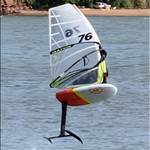
Great video with very clear instructions.
One thing I'm confused about. He mentions moving the sail mast base forward to reduce lift. Does having the sail mast forward also increase the effects of wind gusts on foil lift?
Thanks,
Greg.
Select to expand quotegregwho said..
Great video with very clear instructions.
One thing I'm confused about. He mentions moving the sail mast base forward to reduce lift. Does having the sail mast forward also increase the effects of wind gusts on foil lift?
Thanks,
Greg.
From my little experience.. when I move the rig a bit forward (tilting forward) the nose of the board goes down, and I fly lower.
If I see that a gust will hit me, I anticipate: 1) a sudden increase in speed 2) increase in winglift 3) the whole thing rising up.. (potentially wings coming out of the water with consequence of a crash!!  )
)
and therefore I:
- compensate by moving the rig a bit forward
- straighten back leg, and leaning forward, by bending front leg
Select to expand quotegregwho said..
Great video with very clear instructions.
One thing I'm confused about. He mentions moving the sail mast base forward to reduce lift. Does having the sail mast forward also increase the effects of wind gusts on foil lift?
Thanks,
Greg.
I wish the term lift wasn't used so much. In my opinion a better term would be balance. The lift from a wing varies with speed and angle of attack.
Changing the foil, footstrap or mast foot position alters the balance of the board - not the amount of lift from the wing. Getting the balance right is important so that you are not applying too much weight through your front or rear foot. Generally being 60% or more biased to your front foot helps for going upwind and gybing.
If you are balanced on the board you can control the angle of attack (i.e. pitch of the board and foil relative to the surface) and therefore alter the lift as required to maintain a constant height.
Moving the mast foot forward will make the balance more rear foot biased. I'm not sure it has an effect particularly in gusts.
Select to expand quotesimonp123 said..gregwho said..
Great video with very clear instructions.
One thing I'm confused about. He mentions moving the sail mast base forward to reduce lift. Does having the sail mast forward also increase the effects of wind gusts on foil lift?
Thanks,
Greg.
I wish the term lift wasn't used so much. In my opinion a better term would be balance. The lift from a wing varies with speed and angle of attack.
Changing the foil, footstrap or mast foot position alters the balance of the board - not the amount of lift from the wing. Getting the balance right is important so that you are not applying too much weight through your front or rear foot. Generally being 60% or more biased to your front foot helps for going upwind and gybing.
If you are balanced on the board you can control the angle of attack (i.e. pitch of the board and foil relative to the surface) and therefore alter the lift as required to maintain a constant height.
Moving the mast foot forward will make the balance more rear foot biased. I'm not sure it has an effect particularly in gusts.
Agreed simon.
Select to expand quotesimonp123 said..
I wish the term lift wasn't used so much. In my opinion a better term would be balance. The lift from a wing varies with speed and angle of attack.
Changing the foil, footstrap or mast foot position alters the balance of the board - not the amount of lift from the wing.
I agree that balance is very important, and a good concept to understand once past the beginner stage.
But for a beginner, "lift" is much easier to understand. That's what we feel from the foil, and that's what's new.
In your analysis, you compensate for moving the mast base forward by increasing back foot pressure. That is, or course, exactly what happens for foilers who have learned to fly the foil steady. But beginners are trying to reach that point. For them, the effect of each change has to be looked at in isolation. All else being equal, moving the mast foot forward will push the nose down. That actually does change the lift of the foil since it affects angle of attack.
It so happens that we just spent yesterday afternoon watching a large group of beginner foilers at our local spot. Our annual ABK 3-day windsurfing clinique just started, and more than half of the participants want to get into foiling, or improve their often unsteady flights. A very typical sight for those getting their first flights was that the nose was riding too high. When a gust hits, that invariably leads to a crash, typically from a breach. The fun part was to see a couple of guys making rapid progress, getting the board more level, and getting much longer controlled flights.
I think Cookies' video is excellent. It's one of the best, if not the best, explanations for what matters most to beginners: how to get the board flying, and (at least as important) how to get it back down.
Think of the front wing as the fulcrum of a teeter-totter, which, by the way, it is. A fulcrum. One that can move up and down under the water.
This fulcrum is the ONLY thing that is pushing UP. Everything else, board, stabilizer, sail, sailor, is pushing DOWN (and some sideways).
Once you understand this, you understand balance.
This is an excellent video, however I suggest that learners also consider a strapless option, particularly if their board has an outboard strap placement. Cookie stays out of the back footstrap and I believe a learner would be better off to be a bit closer to the centreline than the front strap was placed on Cookie's board. For me, and folks I have taught, it was just easier to find the balance point without straps. Straps will need to be used for more advanced foiling once folks figure out the basics including jibing.
I also have to stay despite being an Engineer and being fascinated by all the talk about lift and fulcrum; 90% of learners eyes glaze over when I talk about foiling that way and seem to get it when I explain it's all about balance. But that may not be a good indicator as most people tune out once I start talking anyway  .
.
For students that I teach it is pretty easy to talk about the teeter-totter without the physics or the glazed eyes. Assemble the board and foil and show them on the beach. Have them rock the board back and forth on the beach.
Then turn 'em loose on the water. They will understand pitch very quickly.
Select to expand quoteLeeD said..
I wonder how anyone learned anything before video?
We crashed for six months. Good times...
For the early adopters, there was so little info. We went out and tried to figure out if it was us or something on the board that needed to be changed. Crash, adjust, rinse, repeat.
Select to expand quotePaducah said..LeeD said..
I wonder how anyone learned anything before video?
We crashed for six months. Good times...
For the early adopters, there was so little info. We went out and tried to figure out if it was us or something on the board that needed to be changed. Crash, adjust, rinse, repeat.
I hate crashing ... I just hate falling in the water!!!!!!!!!!!
When I first started foiling, there were no videos on it. So, I used Paducah's 4-step cyclic method.