I just completed building this front wing - see full build video below. In the pic below I'm using a home made copy router setup to try to more accurately create the foil profile based on a NACA foil shape.
Does anyone have any ideas to improve on this design method, keeping with the laminated wood core concept? Also any advise on lamination schedules, foil profiles, or techniques for better end results?
As a proof of concept, I think it turned out fairly well although still not quite as precise as I would like. It looks like it should fly :) but no idea how it performs yet - I'll post a follow up when I get a chance to take it out on the water.
I'm already thinking about making a lot smaller wing, but I think the build method needs to be improved a bit to achieve better design tolerances. eg less hand sanding of both the wood core and final lamination - possibly use the copy router with some kind of sanding attachment that follows the foil shape guides?

Video:
now that you have a well finished wing you could make a mold out of it and adapt it for smaller sizes
Nice build! I made one myself a carbon copy of a slingshot front wing but the connection to the fusalage was not strong enough
Select to expand quotebarthbb said..
Nice build! I made one myself a carbon copy of a slingshot front wing but the connection to the fusalage was not strong enough
How many carbon fiber layers did you use? Or was it some other issue?
Select to expand quoteGulfWinds said..
I just completed building this front wing - see full build video below. In the pic below I'm using a home made copy router setup to try to more accurately create the foil profile based on a NACA foil shape.
Does anyone have any ideas to improve on this design method, keeping with the laminated wood core concept? Also any advise on lamination schedules, foil profiles, or techniques for better end results?
As a proof of concept, I think it turned out fairly well although still not quite as precise as I would like. It looks like it should fly :) but no idea how it performs yet - I'll post a follow up when I get a chance to take it out on the water.
I'm already thinking about making a lot smaller wing, but I think the build method needs to be improved a bit to achieve better design tolerances. eg less hand sanding of both the wood core and final lamination - possibly use the copy router with some kind of sanding attachment that follows the foil shape guides?
Video:
Thanks for taking the time to show all the steps - great vid 
It will fly for sure 
I think the limitation for wood core construction will show up with smaller high aspect wings.
It will be difficult to achieve both thinness and stiffness over wide spans.
I like how you made the core.
Have you reduced the profile for the wood core by the thickness of the fabric?
Why is there no wing spar of carbon rovings in the wood core? That would be easy to realize and gain a lot of stiffness and help to not break. The center area of the core with the holes should be complete of carbon, not wood
Select to expand quoteazymuth said..GulfWinds said..
I just completed building this front wing - see full build video below. In the pic below I'm using a home made copy router setup to try to more accurately create the foil profile based on a NACA foil shape.
Does anyone have any ideas to improve on this design method, keeping with the laminated wood core concept? Also any advise on lamination schedules, foil profiles, or techniques for better end results?
As a proof of concept, I think it turned out fairly well although still not quite as precise as I would like. It looks like it should fly :) but no idea how it performs yet - I'll post a follow up when I get a chance to take it out on the water.
I'm already thinking about making a lot smaller wing, but I think the build method needs to be improved a bit to achieve better design tolerances. eg less hand sanding of both the wood core and final lamination - possibly use the copy router with some kind of sanding attachment that follows the foil shape guides?
Video:
Thanks for taking the time to show all the steps - great vid
It will fly for sure
I think the limitation for wood core construction will show up with smaller high aspect wings.
It will be difficult to achieve both thinness and stiffness over wide spans.
Thanks for the feedback. Yes, definitely pushing the limits of what is practical with a wood core as things get smaller/thinner. I might try a more dense wood for a smaller wing and I think will require solid carbon fiber wing tips like I did with the trailing edge to get them thin enough? See sketch in post below.
Select to expand quotePatK said..
I like how you made the core.
Have you reduced the profile for the wood core by the thickness of the fabric?
Why is there no wing spar of carbon rovings in the wood core? That would be easy to realize and gain a lot of stiffness and help to not break. The center area of the core with the holes should be complete of carbon, not wood
Good ideas, thanks! I didn't change the wood core to accommodate for fabric thickness, but will try for future builds. Interesting that this should allow changing the lamination order and everything should be flatter (see v2 sketch below). Stiffness is surprisingly good for just a couple of full layers - I just used some left over carbon fiber for the first build so nothing directional. But good idea to add roving - maybe unidirectional layer top and bottom.
Not sure how to make the center bolt area full carbon and connect it to the wood core either side without cutting through the wing? Maybe compromise and just make the piece that connects to the fuse solid carbon, and add more reinforcement to the other side? I should be able to add the solid carbon fuse attachment on top of some of the layers per sketch below, which I think is also an improvement.
Thanks for the ideas...this has turned into another project:)
Design/lamination schedule:

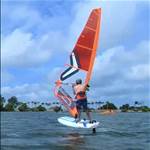
Well the wing worked - nothing broke! See the video below for a more in depth look.
First impressions are that performance was somewhat as expected. It's a good light wind foil with lots of lift. It feels quite fast for its size, and does well upwind and downwind. As a flat wing it's good in a straight line, but isn't very easy to gybe, so you have to take it slow and wide.
It's been an interesting process and there's a lot to learn about wing design - small features have a big impact in performance in the water.
For the next build, I am thinking about something smaller. It will be more important to have stability/control at higher speeds and for gybing so a smaller wing will need some anhedral/dihedral and wingtip washout, so I'll have to rethink the build process a little.
Select to expand quoteGulfWinds said..
Well the wing worked - nothing broke! See the video below for a more in depth look.
First impressions are that performance was somewhat as expected. It's a good light wind foil with lots of lift. It feels quite fast for its size, and does well upwind and downwind. As a flat wing it's good in a straight line, but isn't very easy to gybe, so you have to take it slow and wide.
It's been an interesting process and there's a lot to learn about wing design - small features have a big impact in performance in the water.
For the next build, I am thinking about something smaller. It will be more important to have stability/control at higher speeds and for gybing so a smaller wing will need some anhedral/dihedral and wingtip washout, so I'll have to rethink the build process a little.
What was your assessment of cost in terms of materials and labour
Excellent job, not many have built their own wing
Impressive video production.
Do you think the slight roll instability could also be related to wing stiffness?
I'd guess that it not feeling very "surfy" is mostly due to the 111cm span.
Where are you foiling?
Select to expand quoteJohn340 said..GulfWinds said..
Well the wing worked - nothing broke! See the video below for a more in depth look.
First impressions are that performance was somewhat as expected. It's a good light wind foil with lots of lift. It feels quite fast for its size, and does well upwind and downwind. As a flat wing it's good in a straight line, but isn't very easy to gybe, so you have to take it slow and wide.
It's been an interesting process and there's a lot to learn about wing design - small features have a big impact in performance in the water.
For the next build, I am thinking about something smaller. It will be more important to have stability/control at higher speeds and for gybing so a smaller wing will need some anhedral/dihedral and wingtip washout, so I'll have to rethink the build process a little.
What was your assessment of cost in terms of materials and labour
Materials costs are negligible...I used less than a yard of left over carbon fiber and epoxy, just had to buy the wood, but less than $50 US. Includes a few other things eg items for vacuum bagging etc. Was time consuming, maybe 15+ hrs over 6 weeks when I had time?
As a side note, if it were just about costs, I would buy a wing. As DIY this method is not comparable to a commercial wing which use a lot more CF, industrial process etc, producing more reliable, durable product. But DIY has been an interesting and rewarding process, and I'm sure I will build another one soon:)
Select to expand quoteazymuth said..
Excellent job, not many have built their own wing
Impressive video production.
Do you think the slight roll instability could also be related to wing stiffness?
I'd guess that it not feeling very "surfy" is mostly due to the 111cm span.
Where are you foiling?
Thanks, Azymuth! Yes, roll stability might be better with a stiffer wing - I'm sure even small amounts of flex and twist under load create instability...will add directional/ more cf next build which can't hurt. It's definitely a big wing:) and glad I went something more forgiving to start. The video is Florida Gulf Coast.
Select to expand quoteazymuth said..
I think the limitation for wood core construction will show up with smaller high aspect wings.
It will be difficult to achieve both thinness and stiffness over wide spans.
Oh come on JJ. You know you want to give a custom build a go.
Thats amazing James! So clever how you shaped it!
Are you heading towards molds or will you stick build your next?
Select to expand quoteutcminusfour said..
Thats amazing James! So clever how you shaped it!
Are you heading towards molds or will you stick build your next?
Thanks! I think I will stay with wood core with some modifications for my next build. I'm planning a smaller gull wing shape which creates some new challenges, but hopefully will work.
Almost done with another smaller front wing! Just needs final sand and paint. Went kind of mad scientist on this one to create the gull-wing shape...steam bent 2 pieces of wood for the core, then sandwiched uni directional carbon between, with more CF layers top and bottom. Now very stiff! Hopefully it works? Will post the full build video when complete.


Finally done...here's the video of the full build. On the water footage is at the end.
Wow! That's great! It looks like all the effort paid off. Jibes wayyy better with that shape.
Super nice project with good skills like a steam bend core combined with a sandwich carbon. And a dremel copy device!