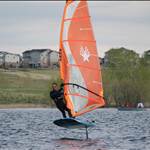
There are a lot of designs on wings and stabs out there. What is the advantage/disadvantage to having the curved ends? What are the flight characteristics?
Although I'm sure we'll get tons of opinions (I'm open to these too), I'm curious to know a little more scientific evidence that these work/don't work. What's the intent?
Discuss!
Do all airplanes need canard tips?
Maybe there are different thoughts, all of which can work.
Downturned wingtips do a couple of things: keep kiters and SUPfoilers from impaling themselves; and help keep the tips underwater when turning. While it's easy to point at airplanes, especially passenger jets, and see all sorts of things, we shouldn't jump to conclusions. Some of the reasons they use wingtip devices include trying to squeeze performance out of wings that are restricted by gate size and that very long wings pose structural/weight challenges. The 777, for example, doesn't use any wingtip devices because, usually, the gates it flies from aren't as space restricted.
www.businessinsider.com.au/boeing-airplanes-winglets-nasa-2016-9?r=US&IR=T
aviation.stackexchange.com/questions/8556/is-a-winglet-better-than-an-equal-span-extension
This is also why you are seeing quite wide racing wings like the AFS 1000 - a wing that has raked wingtips which can show an improvement over a straight wing.
One of my two main foils has curved wingtips and stabs, the other is dead flat. I don't notice any difference in directional stability - another reason mentioned.
But shaped ends do look cool!
Select to expand quotestehsegler said..
apparently safes 10% in fuel...
Source? Most versions I read about it's about 3-5% - almost always on planes that can't extend their wingtips. Read the stackexchange link above.
en.wikipedia.org/wiki/Wingtip_device
Plus - almost all those are upswept tips unlike windfoils which are downswept. There are downswept aero wings but those usually are for STOL purposes
Select to expand quotePaducah said..
Source? Most versions I read about it's about 3-5% - almost always on planes that can't extend their wingtips. Read the stackexchange link above.
No idea. Read it somewhere in a magazine...
Select to expand quotestehsegler said..Paducah said..
Source? Most versions I read about it's about 3-5% - almost always on planes that can't extend their wingtips. Read the stackexchange link above.
No idea. Read it somewhere in a magazine...
It is probably not good to try to compare foil wingtips with airplane wingtips. Just look at the Reynolds numbers.
An airplane with 45" chord at the wingtip flying at 300 mph is running a Re orders of magnitude larger than a 3" foil wingtip chord running at 20 mph.
On all flying devices, the purpose of wingtips is to reduce drag by suppressing tip vortices. At any Re in any fluid.
RM, retired Boeing
Select to expand quotesegler said..
It is probably not good to try to compare foil wingtips with airplane wingtips. Just look at the Reynolds numbers.
An airplane with 45" chord at the wingtip flying at 300 mph is running a Re orders of magnitude larger than a 3" foil wingtip chord running at 20 mph.
On all flying devices, the purpose of wingtips is to reduce drag by suppressing tip vortices. At any Re in any fluid.
RM, retired Boeing
So, does a higher Re mean tip vortices are more or less of an issue?
The new 777x will have folding wing tips - wingtips at the gate (for space reasons) and extended wingspan in flight. Interesting that they are choosing a more complex solution of a folding tip/longer wing rather than a winglet to increase performance
www.boeing.com/777x/reveal/video-777x-Folding-Wingtip/
In windsurfing the wing tips dont have the same goal as those an airplane have. To begin with the tips are the wrong way round on most windfoils compared to airplanes... I've tested numerous wings with different shapes (and tips) and there is quite a feelable difference, mostly when powered up and banking the board, the flat wings tend to slip away/out from under you and are overall less locked. Curved tips are way easier to keep steadily banked over simply said, they have more "grip".
That's what some AmericanAirlines pilots tell me. Straights, no diff, but in squirrelly crosswinds, the canards help stabilize noticeably.
Should I add wingtip canards to my 1st gen Naish WS-1?
Slip happens mostly on low powered jibes.
Not discounting others experiences but this is interesting
"???? Just tried for the first time the new speed wing 550cm2 from @phantominternational with the new 200cm2 Stab ?? 0 spin out, despite I was pushing as hard as possible, turning sharp and lifting up and going down quickly intentionally to find the limit. I think I have never been flying so stable and no-stress as such high speed ?? can't wait to try the 350cm2 now !
??I was on 9.0m with 15 knots and 91cm wide. Very probably better with much smaller sail and more wind. But interesting to see it was working really good in terms of balance and control.Need to buy a new gps watch as I lost mine ... rip ????@ Plage Des Minimes"
www.facebook.com/thomasgoyardwindsurfing/posts/2430676057022519?__tn__=-R


Select to expand quotePaducah said..
Not discounting others experiences but this is interesting
"???? Just tried for the first time the new speed wing 550cm2 from @phantominternational with the new 200cm2 Stab ?? 0 spin out, despite I was pushing as hard as possible, turning sharp and lifting up and going down quickly intentionally to find the limit. I think I have never been flying so stable and no-stress as such high speed ?? can't wait to try the 350cm2 now !
??I was on 9.0m with 15 knots and 91cm wide. Very probably better with much smaller sail and more wind. But interesting to see it was working really good in terms of balance and control.Need to buy a new gps watch as I lost mine ... rip ????@ Plage Des Minimes"
www.facebook.com/thomasgoyardwindsurfing/posts/2430676057022519?__tn__=-R
Yes interesting indeed, but what does it have to do with the topic? Phantom has medium curved wings for the front wing, and a little more than medium curved wings for the stab. Tbh when I tried the Phantom (F) it felt very sensitive in roll stability (so side to side). I attributed that to the fact the winglets on the front and backwing are both aimed down.
I believe to recall the phantom wings have some twist at the wingtips. The Select profoil, taaroa and F-One Levo use the same concept to reduce drag. Its a different approach but also seems to work (like iwth your sail.
As I said tho, I've never really seen the curved tips as being drag reducing. Rather creating extra stability at the expense of extra drag, plus you loose the possibility for twist, which gives a way more consistent balance of lift over a high range of speeds due to "reducing" surface when reducing angle of attack.
Select to expand quoteWhiteofHeart said..
I believe to recall the phantom wings have some twist at the wingtips. The Select profoil, taaroa and F-One Levo use the same concept to reduce drag. Its a different approach but also seems to work (like iwth your sail.
As I said tho, I've never really seen the curved tips as being drag reducing. Rather creating extra stability at the expense of extra drag, plus you loose the possibility for twist, which gives a way more consistent balance of lift over a high range of speeds due to "reducing" surface when reducing angle of attack.
Sounds like we are on the same page. Worded differently but same page. 
Slingshot has curved wing tips on the infinity wings that cause downward force at higher speeds to make it easier to keep the foil in the water. I have noticed sometimes I need to get my weight more aft (slightly) to prevent touch downs at higher speeds. I also notice when touching down at higher speed the board is harder to get back up, like it is in mud. Probably has something to do with not correcting quick enough, everything happens quicker at higher speeds.
Select to expand quoteCAN17 said..
Slingshot has curved wing tips on the infinity wings that cause downward force at higher speeds to make it easier to keep the foil in the water. I have noticed sometimes I need to get my weight more aft (slightly) to prevent touch downs at higher speeds. I also notice when touching down at higher speed the board is harder to get back up, like it is in mud. Probably has something to do with not correcting quick enough, everything happens quicker at higher speeds.
Try a little bit more rake on the mast! 1 degree will probably do you wonders about the sticking ;). If the sticking remains it could be the wing creates downforce at the tips at speed, but I don't think that'd be intended. It seems more like they used the twist concept but did it too much (still needs to be refined).
Select to expand quoteCAN17 said..
Slingshot has curved wing tips on the infinity wings that cause downward force at higher speeds to make it easier to keep the foil in the water. I have noticed sometimes I need to get my weight more aft (slightly) to prevent touch downs at higher speeds. I also notice when touching down at higher speed the board is harder to get back up, like it is in mud. Probably has something to do with not correcting quick enough, everything happens quicker at higher speeds.
I think, and I am not alone, that this "downforce at the wing tips" theory does not cut the mustard. More likely there is a loss of lifting force when the depth of the wing immersion becomes less than the wing's chord. Turns out this phenomenon is well known and described long ago in the hydrofoil literature. Loss of lifting force is more gradual in case of low aspect wings like Infinity or Supercruiser and, therefore, easier to detect early and control. As the speed increases, the lift also increases, but as soon as the depth becomes less than the chord, the wing starts loosing its lift and starts to sink down, which feels like a cruise control kicks in. We have to increase the angle of attack by shifting weight back to prevent sinking; we also feel loss of speed accordingly. Long and narrow high aspect wings due to short chord loose power way more abruptly as they approach the surface -and we crash.

They love a good acronym at Alpine foils that's for sure Doesn't make a whole lot of sense to me, it looks to be a more inefficient wing per unit area than a more standard design. At low speed AoA you have a lot of lift from the main area of the foil then 'a bit' from the twisted tips, wasted efficiency. Then at high speed AoA you have all the lift from the main section and nothing at the tips. The tips are just drag at this point, doesn't make a lot of sense?
It's why all the fast race foils symmetric-ish laminar flow profiles, still efficient and low speed and high AoA but then at high speed in low AoA positions the lift is still manageable...to a point obviously.
Maybe they have a variable profile along the wing and determined the most efficient AoA for the entire wing, requiring twisted tips....but I highly doubt it. I would have thought they would be twisted the opposite way if that where the case anyway, unless they switch to a radically asymmetric profile at the tips.
Select to expand quotesl55 said..
I think, and I am not alone, that this "downforce at the wing tips" theory does not cut the mustard. More likely there is a loss of lifting force when the depth of the wing immersion becomes less than the wing's chord. Turns out this phenomenon is well known and described long ago in the hydrofoil literature. Loss of lifting force is more gradual in case of low aspect wings like Infinity or Supercruiser and, therefore, easier to detect early and control. As the speed increases, the lift also increases, but as soon as the depth becomes less than the chord, the wing starts loosing its lift and starts to sink down, which feels like a cruise control kicks in. We have to increase the angle of attack by shifting weight back to prevent sinking; we also feel loss of speed accordingly. Long and narrow high aspect wings due to short chord loose power way more abruptly as they approach the surface -and we crash.
Very interesting. I have played around a bit with 4 Slingshot wings and found their breaching behavior very different. The i84 is very gently with plenty of "hey I will breach soon" warnings that make it easy to avoid breaches; the i76 is similar, but a bit less so; the higher aspect TC68 and Gamma 68 have much more abrupt breaching behavior with harder crash downs.
Even when flying low, though, I thought speed control is a bit easier with the Infiniti wings than with the older wings. Especially the TC68 seemed to have a bit a mind of its own when it accelerates, and did not want to slow down again. But perhaps I just need a few more sessions on it to get used to it more.
The diagram is excellent. Wing twist is exactly what airplanes have. When the wingtip has a lower incidence angle than the root, it will delay the wingtip stall at low speed. This is a safety of flight issue for landings and take-offs. I used to work in the Boeing 737 factory. You can easily see the wing twist by carefully sighting along the trailing edge of the wing.