Today I hit a shallow sandbank with my Fanatic Flow H9 Foil and I broke one of the two red screws which apparently hold the mast to the deep Tuttle box. These are the only two screws the manual says nothing about, as opposed to several others which one deals with in the assembly process. Back home I unscrewed the other screw and nothing happened, that is, the mast didn't separate from the fin box. I therefore cannot remove the broken screw (which I had hoped to do with a pair of pliers or similar tool) so I don't know how to fix it. Any ideas?
^^^ +1
I can't get my head around it, as if you undo one, and the other is broken then the mast should come out of the box just the same as if you undo both screws. Am I missing something?
Select to expand quoteMark _australia said..
^^^ +1
I can't get my head around it, as if you undo one, and the other is broken then the mast should come out of the box just the same as if you undo both screws. Am I missing something?
Probably the force of hitting the sandbank rotated the tuttle insert and jammed it in the tuttle box. That would be consistent with breaking one screw, I bet the broken screw is the front one.
If this is the case then the tuttle box is probably also split.
if it's what I'm thinking, that connection is "glued and screwed" on the old H9 masts and current Aero masts. would explain why you can't separate even after removing both bolts
like others have said, probably more than just a snapped bolt. Only fix i can think of is to pull harder. Try knocking the foil mast away from the hole the unsnapped bolt was in first. If it'll go that way, but not the other then the barrel nut might have caused more damage in the box.
when you say the bolt snapped, did it shear in half? Is it in two pieces? If it is, can you see the other half through the bolt hole?
Hi folks, thanks for all the replies and sorry for not being precise. When I said the "Tuttle box" I should have said the "Tuttle box insert", which is screwed to the mast by two red bolts. One of these broke in the sense that the bolt's head is missing. @sunsetsailboards seem to have understood me, regardless of my imprecision, and their answer seems to be the right one! Now, should I ignore the broken screw and rely solely on the glue? Or should I try to separate it by force, replace the broken screw and glue it again? In that case, which is the appropriate glue to use?
Select to expand quotecurioswindsurfe said..
Hi folks, thanks for all the replies and sorry for not being precise. When I said the "Tuttle box" I should have said the "Tuttle box insert", which is screwed to the mast by two red bolts. One of these broke in the sense that the bolt's head is missing. @sunsetsailboards seem to have understood me, regardless of my imprecision, and their answer seems to be the right one! Now, should I ignore the broken screw and rely solely on the glue? Or should I try to separate it by force, replace the broken screw and glue it again? In that case, which is the appropriate glue to use?
you meant to say tuttle head not tuttle box ?
Select to expand quotecurioswindsurfe said..
Yes, I meant Tuttle head! Thanks for pointing it out.
Contact the manufacture, they will know what to do. If the bolt head is missing, then glued joint flexed and may not be solid anymore. Personally, I would not try to separate the glued joint, may only result in more damage. I would replace ALL screws on the foil that were stressed by impact, stabilizer probably did not hit sandbar. And honestly, you may need to replace the mast/deep Tuttle insert, that is what manufacture might say.
Thanks a lot guys. You all helped a lot! And here are some news on my ordeal: I eventually managed to remove the broken screw with a specialized screw removal tool and I think I'll simply replace it with a new screw. There are no signs of further damage so I might get away with it. The only trouble is I can't find an aluminum screw, like the original one, so I'm wondering if a stainless steel screw will be a bad idea given the possibility of galvanic corrosion.
Select to expand quotecurioswindsurfe said..
Thanks a lot guys. You all helped a lot! And here are some news on my ordeal: I eventually managed to remove the broken screw with a specialized screw removal tool and I think I'll simply replace it with a new screw. There are no signs of further damage so I might get away with it. The only trouble is I can't find an aluminum screw, like the original one, so I'm wondering if a stainless steel screw will be a bad idea given the possibility of galvanic corrosion.
The screws were aluminum!? Glad you got it separated.
Most of the foil hardware I have now is stainless or Ti bolted into aluminum through composite parts. Regardless, I coat them with tefgel at least. Make sure to get on the underside of the bolt head/countersink to prevent that from corroding there. You can also coat it with lanolin or marine grease and wrap it with teflon tape (that's what slingshot provides/recommends, but I'm not sure about fanatic's foils). People have preferences with all that. But being liberal with tefgel on stainless/aluminum and getting under the bolt head so far hasn't caused problems in saltwater foiling. Just don't put anything back in without at least a coating. I periodically wash, try to clear the grit/old lubricant off, and reapply.
Hi Curious and welcome to the forum. Very unlikely the screws were aluminum. Most likely titanium. When you hold a stainless steel bolt and a titanium bolt, the titanium feels so light that you might think is aluminum. I might be wrong but I have never seen or heard that foils use alu bolts. You can contact a Fanatic dealer, they should have spare bolts. Good luck.
Hi Willy, that is a very good point! I simply assumed the bolt's were aluminum without ever double checking. I spent quite a while searching for aluminum bolt's without any luck, so perhaps there is no such thing! Could you confirm that titanium and aluminum are indeed compatible in terms of avoiding corrosion?
Select to expand quotecurioswindsurfe said..
Hi Willy, that is a very good point! I simply assumed the bolt's were aluminum without ever double checking. I spent quite a while searching for aluminum bolt's without any luck, so perhaps there is no such thing! Could you confirm that titanium and aluminum are indeed compatible in terms of avoiding corrosion?
Not really compatible corrosion wise, but its what some foil manufacturers have gone with in the past for bolts etc for supposed strength purposes. The titanium won't corrode, but the aluminium will. Titaniums a tough material, but can be brittle i believe.
Whatever replacement bolt you use, wrap bolt threads with teflon tape and use a thin nylon washer between bolt head and aluminum base, that will greatly reduce/eliminate galvanic corrosion. I did that for all the screws on my Streamlined mast extension and mast base, stopped the galvanic corrosion.
But the bolt head broke off because of the impact, right? So be careful, aluminum may have been stressed and weakened, another impact could cause aluminum to crack, do not want to lose your foil!
There will not be any galvanic corrosion with either stainless or titanium screws.
Select to expand quotesegler said..
There will not be any galvanic corrosion with either stainless or titanium screws.
I had galvanic corrosion on my Streamlined mast extension and mast base, was between the respective anodized aluminum body and stainless steel screws. And titanium is certainly more stable than stainless steel, but is very reactive with oxygen, that is why titanium has to be welded in an oxygen free atmosphere. And the below colored chart indicates that aluminum and titanium do have a corrosion potential when aluminum is the anode.
For my Streamlined mast extension salt water could connect the underside of pan head SS screws and the anodized aluminum extension, because the extension body is round while the underside of the pan head screw is flat and so saltwater could bridge the two allowing for galvanic corrosion.
BEST METHODS TO PREVENT GALVANIC CORROSION between DISSIMILAR METALS:
Separate metals electrically by using non-conductive materials which stops ion migration:
Separate metals with an insulator like plastic; (this is what I did, used teflon tape and nylon washers)
Use water-repellent compounds like grease to prevent contact with electrolytes;
Consider electroplating using noble metals* (like gold, silver or platinum) that resist corrosion better.
Apply cathodic protection; This is the technique used to control the corrosion of a metal surface by making it the cathode of an electrochemical cell. A simple method of protection connects the metal to be protected (anode) to a more easily corroded 'sacrificial metal' to act as the anode. This is accomplished by physically connecting the anode that needs protecting by a wire to the sacrificial metal.
For Aluminum and Copper, apply antioxidant paste. Antioxidant paste can easily be found on the internet. It is sometimes referred to as 'connection grease.'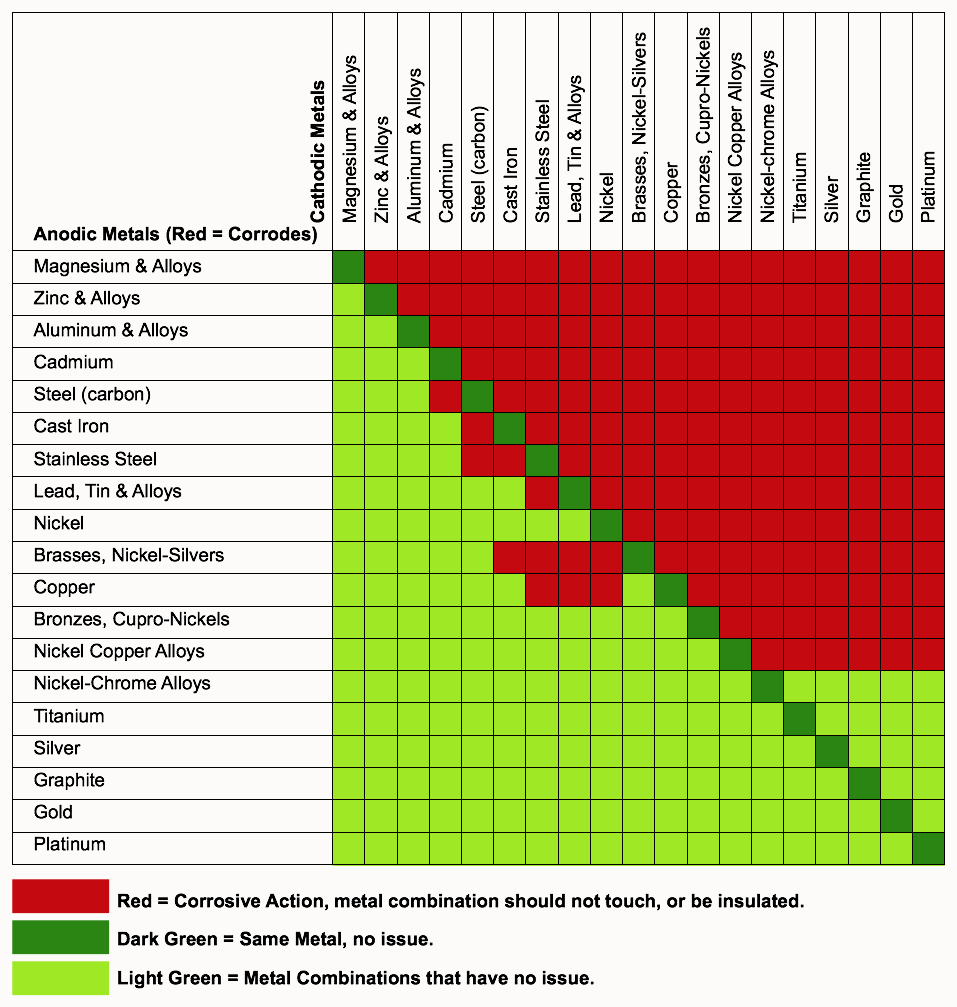

There is more to galvanic corrosion than just electropotentials. There is also kinetics. Every chemical reaction has an activation energy. If your corrosion couple can exceed the activation energy, then the reaction will proceed. Temperature is the most common source of activation energy. Heat it up to make it go.
The activation energy between carbon and aluminum is low. This makes corrosion easy. This is why there is no contact between aluminum and carbon in Boeing 787 airplanes.
The activation energy between carbon and stainless or titanium is very high. Yes, the potential delta is there, but the activation energy prevents corrosion from proceeding. The Boeing 787 has tons (yes, tons) of contact between carbon and titanium. No corrosion. They don't even know yet how long a 787 will last, but they keep inspecting the structure for corrosion.
I used to work in chemical processing. We had contact between aluminum and stainless everywhere, and never detected any corrosion, even in acidic conditions.
Select to expand quotesegler said..
There is more to galvanic corrosion than just electropotentials. There is also kinetics. Every chemical reaction has an activation energy. If your corrosion couple can exceed the activation energy, then the reaction will proceed. Temperature is the most common source of activation energy. Heat it up to make it go.
The activation energy between carbon and aluminum is low. This makes corrosion easy. This is why there is no contact between aluminum and carbon in Boeing 787 airplanes.
The activation energy between carbon and stainless or titanium is very high. Yes, the potential delta is there, but the activation energy prevents corrosion from proceeding. The Boeing 787 has tons (yes, tons) of contact between carbon and titanium. No corrosion. They don't even know yet how long a 787 will last, but they keep inspecting the structure for corrosion.
I used to work in chemical processing. We had contact between aluminum and stainless everywhere, and never detected any corrosion, even in acidic conditions.
"We had contact between aluminum and stainless everywhere, and never detected any corrosion, even in acidic conditions."
Did you submerge those parts in salt water for hours at a time, and then let the salt water dry on the parts, and repeat that process 40-60 times a year over several years? I think salt water acts as the catalyst to decrease the activation energy of galvanic corrosion between dissimilar metals.
I can do better than that. We had those parts submerged in nitric acid for years at a time. In another tank it was sulfuric acid. When we needed to change out the acids, we inspected everything. They all ran at room temperature.
Select to expand quotesegler said..
I can do better than that. We had those parts submerged in nitric acid for years at a time. In another tank it was sulfuric acid. When we needed to change out the acids, we inspected everything. They all ran at room temperature.
I disagree with you, salt water is far more corrosive because it serves as a bridge to allow electron movement between dissimilar metals, and that is how it reduces the activation energy of galvanic corrosion. Acids are used to anodize aluminum to protect against corrosion.
Select to expand quotecurioswindsurfe said..
Hi Willy, that is a very good point! I simply assumed the bolt's were aluminum without ever double checking. I spent quite a while searching for aluminum bolt's without any luck, so perhaps there is no such thing! Could you confirm that titanium and aluminum are indeed compatible in terms of avoiding corrosion?
There are people who know more about this topic. What I can tell you is that titanium and SS are the only available options and it seems titanium might be a little bit better re corrosion but the ti bolts are more expensive and more brittle than SS.
I mostly sail on fresh water and have used SS and Ti bolts. My first foil had a mix of SS an Ti bolts. I would leave the front wing and stabilizer connected to the aluminum fuselaje for months at a time and never had any issues. I am being nicer to my newer foil and take everything apart (I don't rinse anything though). If I were sailing on the ocean, I would at least take everything apart and rinse. That would also let you inspect part for possible cracks.
some also use tef-gel or Teflon tape on the bolts to prevent issues.
Select to expand quoteSandman1221 said..
Whatever replacement bolt you use, wrap bolt threads with teflon tape and use a thin nylon washer between bolt head and aluminum base, that will greatly reduce/eliminate galvanic corrosion. I did that for all the screws on my Streamlined mast extension and mast base, stopped the galvanic corrosion.
But the bolt head broke off because of the impact, right? So be careful, aluminum may have been stressed and weakened, another impact could cause aluminum to crack, do not want to lose your foil!
Someone said the tefgeled thread but screw still stuck as head corroded, so as you say need barrrier everywhere
Select to expand quoteSandman1221 said..segler said..
There will not be any galvanic corrosion with either stainless or titanium screws.
I had galvanic corrosion on my Streamlined mast extension and mast base, was between the respective anodized aluminum body and stainless steel screws. And titanium is certainly more stable than stainless steel, but is very reactive with oxygen, that is why titanium has to be welded in an oxygen free atmosphere. And the below colored chart indicates that aluminum and titanium do have a corrosion potential when aluminum is the anode.
For my Streamlined mast extension salt water could connect the underside of pan head SS screws and the anodized aluminum extension, because the extension body is round while the underside of the pan head screw is flat and so saltwater could bridge the two allowing for galvanic corrosion.
BEST METHODS TO PREVENT GALVANIC CORROSION between DISSIMILAR METALS:
Separate metals electrically by using non-conductive materials which stops ion migration:
Separate metals with an insulator like plastic; (this is what I did, used teflon tape and nylon washers)
Use water-repellent compounds like grease to prevent contact with electrolytes;
Consider electroplating using noble metals* (like gold, silver or platinum) that resist corrosion better.
Apply cathodic protection; This is the technique used to control the corrosion of a metal surface by making it the cathode of an electrochemical cell. A simple method of protection connects the metal to be protected (anode) to a more easily corroded 'sacrificial metal' to act as the anode. This is accomplished by physically connecting the anode that needs protecting by a wire to the sacrificial metal.
For Aluminum and Copper, apply antioxidant paste. Antioxidant paste can easily be found on the internet. It is sometimes referred to as 'connection grease.'
Aluminium booms and extensions seem to corrode by themselves in sea water. Got some ally wall hooks water never touches but also corrode as wet gear elsewhere in shed.
Select to expand quotepatronus said..Sandman1221 said..segler said..
There will not be any galvanic corrosion with either stainless or titanium screws.
I had galvanic corrosion on my Streamlined mast extension and mast base, was between the respective anodized aluminum body and stainless steel screws. And titanium is certainly more stable than stainless steel, but is very reactive with oxygen, that is why titanium has to be welded in an oxygen free atmosphere. And the below colored chart indicates that aluminum and titanium do have a corrosion potential when aluminum is the anode.
For my Streamlined mast extension salt water could connect the underside of pan head SS screws and the anodized aluminum extension, because the extension body is round while the underside of the pan head screw is flat and so saltwater could bridge the two allowing for galvanic corrosion.
BEST METHODS TO PREVENT GALVANIC CORROSION between DISSIMILAR METALS:
Separate metals electrically by using non-conductive materials which stops ion migration:
Separate metals with an insulator like plastic; (this is what I did, used teflon tape and nylon washers)
Use water-repellent compounds like grease to prevent contact with electrolytes;
Consider electroplating using noble metals* (like gold, silver or platinum) that resist corrosion better.
Apply cathodic protection; This is the technique used to control the corrosion of a metal surface by making it the cathode of an electrochemical cell. A simple method of protection connects the metal to be protected (anode) to a more easily corroded 'sacrificial metal' to act as the anode. This is accomplished by physically connecting the anode that needs protecting by a wire to the sacrificial metal.
For Aluminum and Copper, apply antioxidant paste. Antioxidant paste can easily be found on the internet. It is sometimes referred to as 'connection grease.'
Aluminium booms and extensions seem to corrode by themselves in sea water. Got some ally wall hooks water never touches but also corrode as wet gear elsewhere in shed.
Some aluminum is better than other aluminum in resisting corrosion, maybe some alloys are better than pure aluminum? And some anodized aluminum is better than other anodized aluminum, maybe deeper anodization?
The aluminum fins on my 12 yr old home AC evaporator and condenser coils corroded, turned into a whitish powder. But my neighbor's AC aluminum cooling fins did not, maybe mine are less pure aluminum, or not anodized? Lennox aluminum cooling fins have a reputation for corroding. Now Lennox is advertising that they use corrosion resistant aluminum!
Have you ever seen a car radiator with corroded cooling fins?, I have not.
All aluminum you've ever seen is an alloy of some sort. There are trade offs of strength vs rigidity vs corrosion resistance for all of them.
Probably 95% of the stuff used for windsurfing is 6061 or the European/Asian equivalent. The differences in corrosion come down to anodizing.
Chances are if you are seeing corrosion around fasteners it's because the holes were drilled after anodizing or installing the fasteners adversely impacted the anodizing.
Ironically completely unanodized parts can last longer than ones which have been anodized poorly or have been scratched since the corrosion acts on the whole surface area. Which is also why well finished and polished parts are more resistant to corrosion.