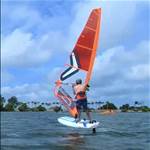
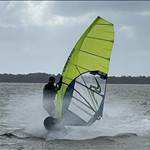
Interesting comment by Nico Goyard (google translated) source: www.windsurfing33.com/forum/viewtopic.php?f=42&t=126876&p=922159#p922159
I suspect I'm starting to understand why one of my boards heels to windward easier than the other.
"Reducing the stab angle amounts to reducing the nose-up torque of the foil. In other words, with less stab angle you will have to navigate more on the back foot.
As a result, you will load your foil mast laterally, which will lead to a more complicated counter-heel. Less counter-heel means that most of the anti-drift (lateral) support will be done by the mast of the foil like a fin.
However, the profile of the mast being symmetrical, it is less effective than a wing whose profile is asymmetrical.
It is therefore more advantageous to have a certain counter-heel by loading the front wing so that it generates both lift and anti-drift force.
When you have too much stab angle, you generate too much drag through the stab and conversely when you don't have enough, in addition to being unstable, you have to load the mast instead of the wing which is much more expensive than the stab angle.
So there is a happy medium to find to have the right counter heel and free the mast from the foil without getting up in the air."
Makes sense. When I first switched to a race setup, I rode the board quite flat and parallel to the water like a freeride foil, and I felt incipient spinouts or would have a spinout/stall/crash. I had to learn to heel windward much more than on slingshot gear. I really should experiment more with positive shim in lightwind but I think I was getting going in about 7 knots with 0 shim? Was a lot of work, even +0.5 helps a lot on IQFoil setup. I just haven't tried in a bit. I'll have to play more this summer with the race kit, been having too much fun on freeride foil kit lately.
It seems to be much less of an issue on slower freeride gear.
Loading up the mast like a fin also contributes a lot towards ventilation (because it's sensitive to the angle of attack) and forming the big bubble that causes an instant drop back to water.
Related to this, I've been meaning to draw a diagram showing how all that front footed feeling starts going away when you heel the board, I just haven't had the time.
Select to expand quoteaeroegnr said..
Related to this, I've been meaning to draw a diagram showing how all that front footed feeling starts going away when you heel the board, I just haven't had the time.
found this even more so now with the 115+ fuse, to the point where i've moved the front foot strap right forward to make downwind a bit more comfortable. Can afford to do it, because it really only gets pressure intermittently. not from lack of lift, it's all being redirected through the rig pressure and being converted into upwind drive.
Very interesting comments by NG, thanks for posting Paducah. The efficiency of achieving lateral resistance more from wing than mast makes a lot of sense conceptually however I'm not entirely sure how to best execute this from an equipment tuning and technique point of view. Can any of the more experienced foilers provide tips on what to focus on. What to do, what not to do?
You get less front foot load when you heel the board over as you are changing the lift vector. When the foil wings are dead flat (upright stance) the lift vector is straight up lifting you out of the water. When you tip the wing on an angle the lift vector changes in angle so the result being less upward lift and you introduce some sideways lift...why you go upwind better when heeled over.
Its the same as why flexy fins create more uplft on a board..the lift vector changes.

Top image is sailing upright..the lift vetor is perpendicular to the wing surface. As you tip it over the lift vector changes with the wing angle so there is less direct up lift and more side lift.
The discaimer here though is at low angles of heel the effect is very minmal and you need to heel sigificantly to have a big reduction in the load carrying capaicy of the wing..its not a linear curve. So maybe this is only a small input into why heeling the foil reduces the front foot pressure. I beleive the angled rig taking some of your body load off the board is a contributor as we.
Then this from Tom Speers who is talking about what happens when you heel a T foil..
The T foil becomes a "y" foil. It's as though you took the "V" foil and added an extra leg in the middle. This extra panel does not contribute very well to the object of deflecting the flow along the span to produce lift. The span in this tilted coordinate system is determined by the shaft and windward panel, so from an induced drag standpoint it is better to have them carry the lift instead of the leeward panel. Since the leeward panel is not loaded as much as the windward panel, it has excessive area and contributes more to the parasite drag than is warranted by the amount of lift it produces.
If I understand this correctly heeling the T foil reduces induced drag.
Select to expand quoteStretchy said..
Very interesting comments by NG, thanks for posting Paducah. The efficiency of achieving lateral resistance more from wing than mast makes a lot of sense conceptually however I'm not entirely sure how to best execute this from an equipment tuning and technique point of view. Can any of the more experienced foilers provide tips on what to focus on. What to do, what not to do?
Old thread that may help until people with a clue show up and give a proper answer: www.seabreeze.com.au/forums/Windsurfing/Foiling/Foiling-comfort--Hiking-out-further-and-the-hand-drag?page=1