Hey everyone,
So I am curious; how important to you is having a lightweight paddle? Although I am someone who is very inexperienced with the sport, I see that the weight of a paddle is an important characteristic of the paddle.
I am part of a group of composite engineers that are looking to bring an ultra lightweight paddle to the stand up paddle boarding community. The technology that we are considering could reduce the weight of a typical all carbon SUP paddle by about 40%.
That being said, I am curious as to how important paddle weight is to you all and how much of an impact it has on your decision of which paddle to purchase.
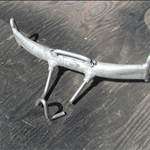
I've attached some renderings that accurately represent optimized design of the shaft (the main weight saving component, disregard the rather ugly blade design).


Select to expand quoteNextGenPaddles said...
Although I am someone who is very inexperienced with the sport
Yep.
Select to expand quoteNextGenPaddles said..
..disregard the rather ugly blade design.
My wise old grandad once told me - pants first, then shoes.
Sorry, but this puts me in mind of when industrial design students that don't ride bicycles render up "the bicycle of the future". Or when naval architects design paddleboards. Are you an industrial design student doing a project?
I really don't know where to start with this, but I reckon if you build one it'll make a cool noise in the wind.
Select to expand quoteNextGenPaddles said..
The technology that we are considering could reduce the weight of a typical all carbon SUP paddle by about 40%.
Wow.......bold claim!!
Perhaps the 'could' above should have been in bold capitals.
I'll throw a few figures at ya.
A top end paddle weighs somewhere around 450g.
The shaft at full length weighs bang on half that at 225g......cut down to average Joe's racing length weighs around 200g
You reckon you can reduce the paddle weight by 40% with your shaft design......you're not likely to achieve any significant weight savings in the blade or handle and offer something durable enough to do the job.
So your shaft is going to have to come in at somewhere between 20-45grams.
Maybe your weights for your 'typical all carbon SUP paddle' stacks up differently?
If you can pull it off I'd love to give it a try......whilst wearing a pair of carbon splinter proof gloves and safety goggles 
Best of luck with your project and achieving your claims.
Looks like the same technology that is used in carbon yacht rigging. The majority of a paddles weight is increasingly heading towards the paddle blade.
Doubt that getting any lighter than premium paddles are already, is of much importance to me. I would be concerned about strength, if they were to become too much lighter - but blade designs would be where future improvements and developments are more likely to occur. oh... and they MUST float, btw. 
Great people are having a go at improving an already pretty awesome bit of kit.
Durability much more important to me. Flex, responsiveness also over reduced weight. And it must float just in case I stuff up.
I still think paddles will drop in weight and it's not through the shaft but the head. Impact is the other big problem one tiny crack and all paddles fail eventually , whether that web design is more impact proof I don't know but there would be no fixing it.
Cons:-Drag through foam balls and white wash is also another problem and the real obvious one is flotation , if it floats it will only just head up making it really hard to pick back up. They will have to add more volume to the head to make it float. That has to add weight. Maybe make the first 300m at the handle sealed to help this. Plus I can't see it being cheap to build. In big surf when my leggie has snapped I use the paddle as floatation. This open web could actually pull you down.
Pros:- If it does float head up it won't carry in on the wave like a normal paddle if you loose it. It will have a really nice long flex pattern no just around your hand. Your hands will never slip but might be a hard on them.
Love seeing all the new stuff , props to the designers. Would love to try it.
Yes reduced weight is important, but strength and comfort must also accompany this. Balance may also be a problem considering Deans observations on blade weight compared to shaft weight, you may end up with apparent head weight or swing weight (this may or may not be critical in surfing) . looks like the idea has holes in it but keep working on it
Thank you for all of the input and opinions! I'd just like to make a few comments and try to answer some questions.
We are not industrial design students, but a group of graduate school mechanical and composite engineers. The patented technology used to produce the shaft is very real and manufacturable, it is not just some fantasy rendering. The way the material can be optimized for a given application provides tremendous weight savings over a 'traditional' braided carbon shaft. Despite these weight savings, there is no substantial reduction in strength. There has been much research and testing conducted on the mechanical properties of this material, which we will gladly make available if we decide to move forward with this. The way the material is produced ensures that there will be no need to worry about carbon splinters! There seems to be a lot of concern over the way that it floats, but I can assure you that it will in fact float. The shaft can even be manufactured such that it provides a buoyant effect as well, so that it will not just float via the blade. One option we have considered was selling it just as the shaft, allowing you to use your blade of choice.
Again, thank you for all of your comments!
My paddle shaft weights 83g per meter (I weighted the part I cut to adjust the length). total weight 350g. Paddle price: 200€.
How much does weight your shaft? (no pun intended, of course :-) )
I am interested if the reduction in materials would bring cost down? Also as I am very accident prone I wouldn't want my fingers getting caught in the weave.
Those with wax would probably end up with an increase in weight due to wax inevitably it being caught in the shafts weave.
Inevitably when paddling a portion of the shaft also goes into and through the water. What effect does this shaft have on the paddle with the water passing through the holes in the shaft? Does it increase or decrease flutter within the blade or have any other adverse affects.
Select to expand quoteCraig66 said..
Thanks for the idea, I just lodged registered my 'worldwide patent pending" form
So you're in the queue behind the KeNalu wings? 
Modern paddles are pretty light right now, and swing weight is kind of important (switching hands/ paddling sides), I like a bit of swing weight, it helps with paddle control when it's out of the water. I tried a friends paddle once that was too light for me, the wind would effect it when switching sides, and you need some swing weight on down winders for that very reason. So a paddle can be too light, IMO, of course.
Im always looking for a heavier paddle. This is why I fill my paddle shaft with lead and use stainless steel blades. Designing anything like that?
I love the idea,but imo there is right now a lot more to gain in optimising the efficience of blades and flex of the shaft as in weightsavings.
At the moment the concavedblades alike the Quickblade Vdrive are hot and they work great, but as far as I know its more or less all based on trial and error instead of serious research.
If you wanna make a break through in paddles I would concentrate on making a hell of a blade. 
Lucky enough to paddle a 385 gram paddle today and i can tell you weight does make a difference.
100 grams lighter than my normal paddle.